
Rene Vautier, Bretaña, 1928, estudió en el “Institut des Hautes Etudes Cinématographiques”. Autor de varios trabajos que denuncian el Colonialismo. Entre ellos: Afrique 50, Un homme est mort, Une nation, l'Algerie, L'Algerie en Flammes, Hirochirac,... René Vautier aparece como el arquetipo del cineasta comprometido: su cine militante se sostiene por un rigor plástico y una inventiva formal que le ayudan a superar las dificultades prácticas ligadas a su obra de “intervención social”. Su eslogan podría ser, según sus propias palabras; “escribir la historia en imágenes, en seguida”. En 1950, despechado por la censura francesa que le confisca una gran parte de sus carretes, consigue terminar Afrique 50, la primera película francesa anticolonialista. Es un cineasta comprometido, lo que le supone 13 inculpaciones y una condena de cárcel. Desde entonces, al precio de los numerosos años de cárcel y de una huelga de hambre, la lucha de René Vautier contra todas las formas de opresión, políticas, económicas y culturales, ya no tendrá fin.
ovni 2006
67 Descripción archivística resultados para ovni 2006
67 resultados directamente relacionados
Excluir términos relacionados
ES ES-OVNI CTX-S011-SS004-0007
·
Item
·
2006
Parte de Observatorio de Vídeo No Identificado (OVNI)

ES ES-OVNI CTX-S011-SS002-0011
·
Item
·
2003
Parte de Observatorio de Vídeo No Identificado (OVNI)
¿Quieres ver el mundo desde otra perspectiva? ¿Quieres cambiar una vida aburrida por otra apasionante? ¿Quieres planear tu huida rebelde ahora mismo? Political Travel es lo que estás buscando si quieres encontrar una forma revolucionaria de viajar.
Sin título
ES ES-OVNI CTX-S011-SS005-0002
·
Item
·
2004
Parte de Observatorio de Vídeo No Identificado (OVNI)
Este video pone al descubierto la estrategia de relaciones públicas que está llevando a cabo Israel en combinación con los intereses de política exterior de las élites estadounidenses, para ejercer una poderosa influencia sobre la información difundida por los medios sobre el conflicto de Oriente Medio. Mezclando extractos de telediarios americanos y británicos con los comentarios de analistas, periodistas y activistas, Peace, Propaganda and the Promised Land nos ofrece una visión histórica general, una comparación impactante de diferentes medios de comunicación y un análisis de los factores que han distorsionado la cobertura mediática en EE.UU. y, a su vez, la opinión publica de ese país.
ES ES-OVNI CTX-S011-SS005-0009
·
Item
·
2005
Parte de Observatorio de Vídeo No Identificado (OVNI)
Paris Couleurs se centra en los Zoos Humanos que se celebraron en Francia, y concretamente en Paris. Como una consecuencia y un reforzamiento de los estereotipos racistas y eurocentricos: “el negro divertido, dócil, siempre con ritmo en el cuerpo; el oriental trabajador y enigmático; el árabe fanático, valiente, en permanente reivindicación”. Hacia ellos, desconfianza, control o paternalismo, pero también demanda constante para que formen parte de las tropas de choque que defiendan las conquistas del Imperio, las agresiones a una “madre patria”, los trabajos más duros, el erotismo reprimido. De todos ellos el árabe, el musulmán, representa el ejemplo más irreductible, un desafío cultural en las fronteras, un peligro interno. Lentamente se forja la etiqueta mediática del terrorismo. Mientras, el extrarradio urbano y los barrios marginales van creciendo. La represión salvaje empieza a ser una necesidad.
Sin título
ES ES-OVNI CTX-S011-SS002-0012
·
Item
·
1947
Parte de Observatorio de Vídeo No Identificado (OVNI)
La ONU vota por la partición de Palestina. Revueltas ante la partición de Palestina. El Canal de Suez pasa a Egipto después de 72 años de control Británico. El Cairo vitorea a Nasser. Británicos y Franceses aumentan la presión contra la nacionalización de Suez. Incidentes en la frontera de Israel-Egipto. La Crisis de Egipto. Israel se retira del Sinaí.
Sin título
ES ES-OVNI CTX-S011-SS002-0013
·
Item
·
2005
Parte de Observatorio de Vídeo No Identificado (OVNI)
On Translation: Fear/Miedo es un proyecto de intervención televisiva de Antoni Muntadas, a partir de la producción de un video que reúne entrevistas a personas que viven cotidianamente las tensiones en esta zona, imágenes de archivos televisivos que refieren al término de miedo/fear en la frontera entre México y los Estados Unidos; así como otros materiales documentales y periodísticos. El video busca exponer cómo el miedo es una emoción traducida en ambos lados de la frontera desde perspectivas muy diferentes; una construcción cultural/sociológica que siempre remite al ámbito político y al económico. On Translation: Fear/Miedo se creó para ser transmitido entre agosto y noviembre 2005 desde cuatro locaciones que de algún modo conectan los centros de tomas de poder y toma de decisión con los sitios donde estas políticas cotidianamente se manifiestan: Tijuana, San Diego, Ciudad de México y Washington DC.
Sin título
ES ES-OVNI CTX-S011-SS004-0008
·
Item
·
2006
Parte de Observatorio de Vídeo No Identificado (OVNI)
Viajes y sueños entre las montañas del sureste mexicano, la selva y la ciudad... Rituales, emociones y palabras para tod@s!
ES ES-OVNI CTX-S011-SS004-0014
·
Item
·
1991
Parte de Observatorio de Vídeo No Identificado (OVNI)
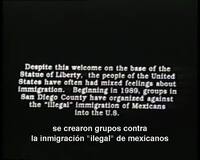
Los Estados Unidos han mantenido durante mucho tiempo su reputación como paraíso para los inmigrantes; sin embargo, ha sido también tradicional el “autoctonismo” norteamericano que busca excluir a los inmigrantes. En la década actual se ha observado un nuevo brote de estos sentimientos contra los inmigrantes. Esta película examina el discurso del autoctonismo a principios de la década de los 90s, especialmente en relación con la frontera México-EE.UU. como un lugar que brinda la oportunidad de observar muchas de estas cuestiones.
Sin título
ES ES-OVNI CTX-S011-SS001-0007
·
Item
·
1995
Parte de Observatorio de Vídeo No Identificado (OVNI)
Una de las más poéticas y esclarecedoras miradas sobre la realidad colonial. Muestra las grandes obsesiones del “hombre blanco”, su etnocentrismo y su visión unívoca del progreso. Construída íntegramente con imágenes de archivo filmadas por los colonizadores holandeses en Indonesia, examina la tala masiva de árboles, la explotación del territorio, el desprecio a la cultura autóctona, la imposición evangelizadora... pero también la existencia de una cultura rica y compleja que lucha por sobrevivir y por mantener su visión y placer de la vida. Un retrato de la Indias Holandesas de 1912 a 1933. Más de 260.000 metros de filme documental en 35 mm (de nitrato) provenientes de los archivos mudos holandeses, han servido de materia prima para este documental que muestra cómo los Países Bajos administraban su colonia (Indonesia). El comentario tradicional ha sido reemplazado por poemas (retocados y a veces escritos de nuevo por el realizador) y por cantos tradicionales de la región. Monnikendam respeta la duración original de los planos y los sonoriza con atmósferas electrónicas y ambientes reales, dejando las bocas mudas y algunos ruidos fuera de sincronismo, acentuando así el “efecto histórico”.
Sin título
ES ES-OVNI CTX-S011-SS001-0005
·
Item
·
1958
Parte de Observatorio de Vídeo No Identificado (OVNI)
Jóvenes nigerinos que van a trabajar a Costa de Marfil, desarraigados en medio de la civilización moderna. El protagonista y sus amigos toman seudónimos para tener una personalidad ideal.
Sin título