
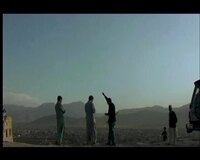
In the broken cityscape of Kabul, Afghanistan, amid the dust and rubble of war, Westerners and Afghans adjust to the uncertain possibilities of peace. Kabul Transit shuttles through the broken streets of the city, moving between public space and private, listening in on conversations, posing questions, probing the darker alleys mainstream media avoids. The result is a shifting mosaic of encounters and raconteurs, captured glances and telling gestures, all beautifully shot and woven together by the music and the found sounds of a city sluggishly coming to life, a place that is at once hauntingly strange and altogether familiar.
UntitledExodus

64 Archival description results for Exodus
In 1925 William Faulkner lived in New Orleans for a few months writing short sketches in which he called the city to life. Inspired by Faulkner's impressions, Dutch Filmmaker Marjoleine Boonstra drifts through the devastated streets of New Orleans, at any hour of the day, looking for the fears and dreams of people whose lives have gone adrift as a result of hurricane Katrina.
UntitledThe life story of an elderly Mauritanian woman, Aïcha Messaoud, who spent her whole life as part of Sheik Ma-el-Aïnïne's distinguished family of nomads and now lives in the small Moroccan village of Tata, in the northern part of Western Sahara. The filmmaker sets out to trace the memories of her heroine. Stage after stage, she travels through thousands of kilometres across the desert, encountering the descendants of the Sheik.
Untitled“Radical Imagination (Carnivals of Resistance)” is the second part of the “Entre sueños” (Between Waking and Sleeping) series. It deals with the “Global carnival against capital”, an action staged by the Reclaim the Streets movement in London on June 18, 1999, which brought urban commercial life to a standstill. The City of London, a world financial centre and a major hub of international capital, was paralysed, and the protest developed into an epicentre of a political current that reappropriated the idea of the carnival as a tool that points to new approaches of the occupation and formation of public space in recent anti-globalization movements.
UntitledLa Makabra is a squatted factory, usually occupied by around fifty people. It is open to the public, and it works as a self-managed cultural centre in Barcelona's Poble Nou district. This is one of the social and artistic collectives affected by 22@, the urban design plan responsible for restructuring the district, which plans to evacuate the building. In spite of this situation the squatters continue performing shows and cabarets, because that is how they use this space, placing creativity up against consumption.
A documentary that criticizes Barcelona's mammoth urban restructuring process, which is carried out without the participation of the people who live in and use the city according to a model that chooses to ignore social memory, especially when it comes to the working class. Through the voices of some of the people behind this process, the documentary shows a side to this chapter of the city's history that is usually not presented by the media.
UntitledParallel testimonies of Youssoupha, a rap artist and Thomas. Evocation of rap as an object of censorship, often criminalised by successive governments, and as a weapon of political struggle, far removed from the clichés of commercial rap.
UntitledFair trading is very much in fashion today. The idea is to help the most underprivileged populations on our planet to emerge from this state thanks to a fairer distribution of revenue. Shea butter is increasingly appreciated in Europe, where it is used in the cosmetic industry and as a cocoa substitute. In sharing the lives of Shea butter producers in Burkina Faso, the film carries us to the heart of the problems of survival in Africa.
Untitled“Le cercle des noyés” (The circle of the drowned men) is the name given to a group of black political prisoners in Mauritania who were arrested in 1986 and incarcerated in the city of Oulata's former Colonial Fort. The documentary follows the subtle mental process of one of the ex-prisoners as he remembers his own story and that of his fellow prisoners. Like an echo, we see a series of images of the sites of their confinement – bare, stripped of all traces of this past.
A journey through Beirut's devastated neighbourhoods and some villages in southern Lebanon. The ordinary stories of ordinary people. Women, children and men face the challenge of remaking their lives in the midst of the devastation. 34 days of bombing by Israel have left indelible marks. Hundreds of families have lost their loved ones, a million displaced people return to their devastated houses. The Lebanese people wake from the nightmare full of rage and sorrow. Bombs are heavy, peace has no weight.
Untitled