
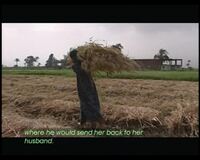
Janata Bennuna is from Morocco; Hanan Al Shaykh is from Lebanon; and Nawal Al Saadawi is from Egypt. All three are authors of the Arab word, committed intellectuals who shed light on the complex social reality of the Arab world through their books. In their hands, literature becomes a weapon through which to draw attention to and denounce situations that they oppose. The three women, from a generation heavily influenced by Pan-Arabism, initially studied against the wishes of their families, but ended up gaining their support. In A Woman's Word, these three very different writers who nonetheless share a common ground talk about their lives and their work. By learning about them, we also gain an insight into the Arab world, which is much more complex than the Manichean and mostly malicious information on the subject that predominates in our own society today. They too are Arabs, women, who refuse the victim mentality, and demand their rights through their work and their commitment.
UntitledEsteriotipos Àrabes

16 Archival description results for Esteriotipos Àrabes
Abu Dhabi Style shows us some glimpses of the city, and introduces us to the students' lives at the college and during their spare time. But we also learn about traditions and the importance of religion in the lives of these modern young men.
UntitledWhen terrorism becomes even more closely linked to Arabs and Islam, a terror prevention rehabilitation camp known as the (Arab Terrorist Management Camp) is designed to help potential Arab terrorists overcome their terrorist tendencies. The film starts off in a documentary fashion but slowly takes the shape of an infomercial mocking the capitalization on "terrorism”.
Gema Martín Muñoz, professora de Sociología del Mon Àrab a l'Universitat Autónoma de Madrid. Entre altres treballs, es autora del llibre "El Estado Árabe. Crisis de legitimidad y contestación islamista". (Bellaterra, 2000).
Edward Said talks about the context within which the book "Orientalism" was conceived, its main themes and how its original thesis relates to the contemporary understanding of "the Orient." Said argues that the Western (especially American) understanding of the Middle East as a place full of villains and terrorists ruled by Islamic fundamentalism produces a deeply distorted image of the diversity and complexity of millions of Arab peoples.
UntitledOn the border, the line as principle of property and belonging reaches an extreme dimension where it physically defines the sphere of its relations. Those who transgress it reconstruct these imaginary lines on a daily basis, redefining the traditional geography and occupying the non-spaces where others live in a temporary form of existence. These others, the non-citizens, are phantasmtic, exchangeable parts of a flexible market. Made invisible, they are permanently controlled persons. Under the pretext of a greater civilian security, they are kept clear from the public spaces reserved for the citizens with rights and pushed into non-public spaces, which are run by state and military surveillance, multinational operations servicing a European market and non-governmental organisations.
UntitledSandra Staffl visits two young women from Abu Dhabi. Raweya and Fatima study film production in order to become independent and determine their own future lives. They proudly wear traditional clothing, which they perceive as a privilege.
UntitledThis highly kinetic tableaux of uprooted sights and sounds works most earnestly to expose the racial biases concealed in familiar images. Relying on valuable snippets from feature films such as Exodus, Lawrence of Arabia, Black Sunday, Little Drummer Girls, and network news shows, the filmmakers have constructed an oddly wry narrative, mimicking the history of Mid East politics.
UntitledVideo footage questioning who is the terrorist and why. Reflection on the daily conflict in the occupied territories accompanied by Rap music produced by youth under occupation and inspired by the Intifada.
UntitledTraditionally considered a postmodern city, Dubai is actually a confrontation between two ways of life. The most densely populated part of the city lives in what could be considered a “modern” architecture and society. The other and more widely known part is based along the lines of the postmodern philosophy that Jeremy Rifkin has described so well.
Untitled