Barzaj

Elements area

Taxonomy

Code

Scope note(s)

    Source note(s)

      Display note(s)

        Hierarchical terms

        Barzaj

          Equivalent terms

          Barzaj

            Associated terms

            Barzaj

              22 Archival description results for Barzaj

              22 results directly related Exclude narrower terms
              ES ES-OVNI DIF-S002 · Series · 2003/2009
              Part of Non-Identified Video Observatory (OVNI)

              Video Concerning the Arab World

              TransArab Itinerant 2003-2005

              2003 / 2005 / 2006 / 2009 - TransArab

              Video Concerning the Arab World

              This programme is not intended to provide an overview of independent video in Arab and Islamic countries, nor does it seek to be representative in any way.

              The works being presented, like the programme as a whole, reflect the notion of “slices of reality”, in the sense that they are subjective visions, aware of their partiality, which do not exclude contradiction or conflict. Visions that perceive a strong tension on their surface and take up these eddies of confusion and violence as cause for  urgent reflection and knowledge.

              Images and stories, realities in themselves, rhizomatic realities: interwoven without a centre or a fixed meaning. And for that very reason, instead of giving rise to cultural dualism based on opposition, they engender a web of underground connections.

              Al Barzaj
              ES ES-OVNI CTX-S014-SS001-0135 · Item · 2010
              Part of Non-Identified Video Observatory (OVNI)

              Al Barzaj [Between the worlds] is a poem about the halfway world, between the visible and the invisible, sleep and wakefulness... An inner journey through underground streets, secret gardens.

              Untitled
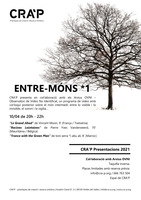
              Between Worlds *1
              ES ES-OVNI DIF-S009 · Series · 2021
              Part of Non-Identified Video Observatory (OVNI)

              CRA’P in collaboration with the Archives OVNI – Observatory of Video Not Identified, presents a video program with a subsequent discussion about the intermediate world: between the visible and the invisible, sleep and wakefulness ...

              “ Le Grand Jihad” by Vincent Moon, 9’ (France / Chechnya). No dialogue.

              One of the most beautiful and significant practices of the great jihad is the ritual ceremony of dhikr (zikr). Arabic word that means memory ... an intimate reconnection - but within a collective ceremony - with the mystery of the Real ... that is, with the indefinable, un-representable, inappropriate ... beyond all measure, physical or rational.

              “ Racines Lointaines“ by Pierre Yves Vanderweerd, 70’ (Mauritania / Belgium). VO. Arabic, French.

              Subtitles in Spanish.

              Travel through Mauritania in search of a tree. Throughout the journey, encounters with men and women who share their ways of seeing the world and life. For some, the tree is a sign from the invisible world, or a call from the light ... for others it is a tree only seen when you get lost.

              “ Trance with the Green Man” by toni serra *) abu ali, 8’ (Morocco). No dialogue.

              A search for Al-Jádir الخضر, the inner master. Al-Jádir, literally means the one who grows green, inhabits the intermediate world, the no man's land. The fine gap between the real and the unreal, life and death, sleep and wakefulness.

              Limited places with prior reservation: info@cra-p.org / 666 763 504

              CRA'P - pràctiques de creació i recerca artística

              08100 Mollet del Vallès

              http://www.cra-p.org/

              http://www.cra-p.org/

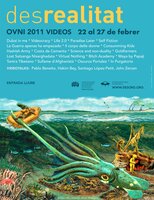
              Dis_Reality
              ES ES-OVNI CTX-S014 · Series · 2011
              Part of Non-Identified Video Observatory (OVNI)

              / CONTEXT 1994 - 2020

              "You are asleep, and your vision is a dream; all you see is an illusion.” (1)

              OVNI disReality aims to reflect upon different phenomena of the critique of reality, their repercussions and the horizons that they illuminate, or recall.

              Extremely heterogeneous traditions and forms of experience radically question not only the concept of reality, but the very experience of the real.

              Some of the most radical questionings of reality arise from the culture of images, “when the real world is transformed into mere images, mere images become real beings.” (2) Others are a result of simulation mechanisms: as soon as the copy ceases to be a pale reflection of the original image and begins to erode it in its entirety, then the original becomes nothing more than one copy among many, and not necessarily the one with the greatest verisimilitude. The extreme condensation of these phenomena springs from digital technology: video games, simulation, virtual images, expanded reality, mutating into fields as diverse as leisure, military training, communication, industrial processes, personal relationships, the administration of pleasure... becoming the psychic and emotional habitat of a large part of the population. A fictional whole.

              Nevertheless, this virtual reality in turn generates a reified, totally physical reality, like that which we now see on a grand scale in cities like Dubai, and in so many other instances of our everyday life. Realities emanating directly from virtual environments, which also condense around social and work relationships, and the spaces and non-places that they generate. Virtual metaphysics thus seems to turn back to the physical, in a feedback dynamic. The evanescent and inapprehensible post-modern reality once again coagulates into cumbersome, real structures of power and exploitation, but this time they are suspended in the digital cloud, and their presence is therefore more volatile and harder to confront. In China, for example, there are hundreds of thousands of illegal workshops in which workers play online videogames for twelve hours a day, to win and accumulate virtual assets that are then exported to the rest of the world, and virtual currency that is traded against real currencies. In the fictional “all” that emerges, realities merge like layers in the dreams of an ever-deepening sleep.

              “The sleep of our era is not a good sleep that provides rest. It is an anxious sleep that leaves you feeling even more worn out (...) There is a narcosis that begs for an even deeper narcosis. Those who, by luck or misfortune, awaken from the prescribed sleep, come into this world like lost children.” (3)

              A sleep that turns everything it touches into images. A sleep based on image as a veil, as as a social instrument of blindness. Sure enough, a veil of mass produced images spreads out, covering the entire field of vision, like a master film, a screen-world with a flexible, ever-changing reality that clings to the skin of objects, people and landscapes. Not like a patchwork of handcrafted images, personal visions, dreams, imaginations or ruins of former imaginaries...sprinkled with gaps, inaccuracies that invite vision and imagination. Rather, a visible “all,” fuelled by the realities it conceals.

              Thus we find a kind of questioning of reality that is directly political: the observation of the expansion of a dominant reality that threatens the fabric of other realities; that threatens to erase forms of knowledge, landscapes, people, ways of life, feelings... As if a thousand libraries of Alexandria, still inscribed in people’s daily lives, in their actions, in their spaces, were already burning once again. As if, perhaps within a very short space of time, all that will remain to read, with luck, will be their sad ashes catalogued by experts.

              There has never been such an intense and extensive expansion of a dominant reality as that of global capitalism, or, in consequence, a comparable resistance or refusal. In fact, this dominant reality is already “the” reality; a reality that has the consistency of a “beached jellyfish,” a gelatinous mass that covers any surface, filling any crack. In the face of this, “Only the total refusal of reality reveals it to us in its reality, reveals it to us in its truth.” (4) A reality that disrealizes us: a disreality.

              On another level, this refusal of the world as reality coincides with visions that stem from the poetic and the metaphysical: the advaita vedanta (Hindu non-dualism) or Sufi mysticism in Islam, among others. “The One is reality. Multiplicity is illusion, the world of names and forms.” (5) If we identify with these names and forms, if we endow them with reality, we move away from our true nature, we set out in pursuits of phantoms. From this perspective, so-called reality only seems to persist through a kind of autosuggestion, which stems from the dense network of desires and fears, false identifications, actions and reactions... in an experience not too distant from a dream.

              Pondering on sleep and wakefulness reveals the following. In wakefulness, the world exists clearly in the light of the sun, things appear to be “out there” and consciousness simply has to initiate the move towards appropriation, under the impulse of desire. From wakeful life we learn that a reality exists, but this reality is the reality of the other: objects, beings, etc... and our reality is defined in relation to this alterity. In sleep, however, the light that shines on the world and reveals it to us is the light of the mind; alone with ourselves, we cannot talk about an external reality. Our own consciousness projects the world of objects and beings, it is created by the dreamer; a world that disappears when we awaken. Sleep liberates us from time, and teaches us to doubt the external reality of waking life: perhaps we awaken from one dream and enter another. Perhaps the difference between sleep and wakefulness is simply one of duration. Finally, in deep sleep, both the inner and and outer world disappear without affecting consciousness: one is there, without dreams, without desires, without world.

              In this context, awakening means that the dreamer ceases to project reality onto the imagined dis_reality of separate entities; it means remembering the essential unity of all things, recognising oneself in the consciousness that is One, but the intimate experience of which is unique in each being, and which we call by different names, Being, Life, Reality,...

              “Oh mankind, your injustice is only against yourselves.” (6)

              (1) Mahmud Shabistari, The Secret Garden. Persia, 18th century.

              (2) Guy Debord, Society of the Spectacle.

              (3) And the War has Only just Begun (Tiqqun)

              (4) Santiago López Petit, La movilización global.

              (5) Ramana Maharshi, Be as You Are

              Thematical screenings

              Hall and Auditorium.Simultaneous Screenings

              Centre de Cultura Contemporània de Barcelona

              Montalegre 5. 08001 Barcelona

              Image: Collage numérique. Alain Kugel

              http://photografiques.free.fr/montages/vues/pages/pieuvre.html

              En el camino de las abejas
              ES ES-OVNI CTX-S020-SS003-0006 · Item · 2018
              Part of Non-Identified Video Observatory (OVNI)

              In a time that is becoming difficult for bees (as for us) In a year of severe drought, in a country that is already often arid, taking the path of bees has been to make a journey through moors and mountains, but also through states of mind, obstacles and encounters .. until reach their generous garden. Video made for the BEEHAVE exhibition, Joan Miró Foundation 02/16/2018 - 05/21/2018. Available online until December 27th 2020.

              ES ES-OVNI RSC-1914 · Item · 1999
              Part of Non-Identified Video Observatory (OVNI)

              A journey of initiation into a city and a its culture. The set of projections (10 screens) aimed to create a journey in the complex sense of the term: using audiovisual segments to illustrate aspects of the anthropological, sociological, urban and religious tissues of the city. A journey claiming both: a certain objectivity (in the working method), and the subjectivity (of the travel experience and approach to another culture). Moreover, the projections do not meet the criteria of a film with a beginning and an end, but rather the creation of a landscape, so the viewer choosed the time he/she wished to dedicated to each fragment. This made it possible to enjoy a deeper level of inquiry to specific fragments (artisans, rituals interviews, etc.). Consequently, the result of each visit to the exhibition gave an unique combinatorial fragments, since the total length of the projections would be about 6 hours. VideoInstallation 10 screens total lenght: 6h 40' Toni Serra , Albert García Espuche CCCB Centre de Cultura Contemporània de Barcelona 2002

              Untitled
              For the Birds
              ES ES-OVNI CTX-S008-SS002-0014 · Item · 2000
              Part of Non-Identified Video Observatory (OVNI)

              Part three of a cycle of digital video works I'm beginning to call -after Bataille- "Theory of religion, theory of ecstasy." The other two parts are Mirror and The Zapruder Footage. This tape is inspired by the 11th century Sufi mystical text The Conference of the Birds. It is a text which explores transparency and opacity, multiplicity and unity, narrative and insight, the mundane and the ecstatic. I include a postscript from the text which I included at the end of the tape, and perhaps best responds to the attempt to phrase it: "Seek the trunk of the tree and do not worry whether the branches do or do not exist."

              in Limbo
              ES ES-OVNI CTX-S016 · Series · 2014
              Part of Non-Identified Video Observatory (OVNI)

              falling and flying / OVNI 2014

              / CONTEXT 1994 - 2020

              falling and flying / OVNI 2014

              Limbo (Lat. Limbus) ~ the world between the living and the dead ~ the storage space where deleted files are sent ~ a tale by Aldous Huxley.

              There is an enormous, constant, and well-organised pressure on social rights and freedoms, backed by a media apparatus that appropriates language and steals our words. Meanwhile, nature is still the source from which we extract the fuel that feeds the engines of progress for the few.

              Borders spill beyond boundaries and permeate cities like the laboratory for a new totalitarian society.

              Fall & Winter, Cómo robar la vida a un ser humano, Terrorisme d'Auteur, Barcelona the Dead City, Deleuze à Vincennes, Marinaleda, iPhone China, Detroit Wildlife, Barcelona panAfrica, Agustín García Calvo at Sol, Homeland Security.

              Thematical screenings

              Hall and Auditorium. Simultaneous Screenings

              Centre de Cultura Contemporània de Barcelona

              Montalegre 5. 08001 Barcelona

              Image: Pour Auguste (2010). Chantal Michel