The UN votes to partition Palestine. Riots in the face of the partition of Palestine. The Suez Canal is handed over to Egypt after 72 years of British control. Incidents on the Israel-Egypt border. The Egyptian Crisis. Israel withdraws from Sinai.
UntitledSueño Colonial
34 Archival description results for Sueño Colonial
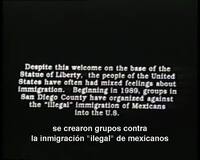
The U.S.-Mexican Border is the site of a disturbing increase in violence and racial intolerance. Along the border there are now a number of autochthonous groups that have organized with the stated purpose of ending undocumented immigration. “Natives” follows the individuals involved in San Diego's anti-immigration movement. Relying principally on a direct cinema style and an eye for the absurd, the film critiques the autochthonous position by contrasting their professed love of country with their racist and anti-democratic attitudes. Though the US has long maintained a reputation as a haven for immigrants, there is nonetheless a strong tradition of xenophobia. In the decade of the 1990s, there was a new surge of anti-immigrant sentiment. This film examines the autochthonous discourse along the US-Mexico border, a place that brings issues of nationalism and intolerance into sharp focus.
UntitledTreichville is a poor suburb of Abidjah, the capital of Ivory Coast and the destination of the two protagonists in this docudrama by Jean Rouch. The two men in question are originally from Nigeria, and they call themselves Eddie Constantine and Edward G. Robinson, clear indications of who their heroes are. The perpetual conflict between traditional ways of life and new Western imports comes up several times as the two men continue on their daily rounds and reveal a little about their hopes for the future.
UntitledAn extract from a dialog between Noam Chomsky and Michel Foucault in 1971. The topic: Human Nature: Justice versus Power. Foucault claims that “Power is not an institution, it's not a structure or a force available to some: it is the name given to a strategically complex situation in a given society”. If the centrality of a power that we can submit to or resist no longer exists, than it is impossible to seize power (if in the center there is nothing to seize). If power is reticulated, resistance must take place everywhere and in every way; if power is exercised at countless points, it must be challenged point by point.
UntitledThis collaborative film, banned for more than a decade by French censors as an attack on French colonialism (and now available only in shortened form), is a deeply felt study of African art and the decline it underwent as a result of its contact with Western civilization. Marker's characteristically witty and thoughtful commentary is combined with images of a stark formal beauty in this passionate outcry against the fate of an art that was once integral to communal life but became debased as it fell victim to the demands of another culture.
Untitled“I will show two videos: “Trobriand Cricket”, and “Les Maîtres Fous” to talk about what I will call “mimetic excess”. By this I mean a joy or "jouisance" in mimesis itself (Nietzsche talks about this in his description of Dionysus). An “excess” produced at the moment of de-Colonisation in the 1950s-1960s, with the encounter between the Indigenous and the European worlds; the first with its mimetic body, and the European world with its mimetic-machine (the camera). A question for us: Now, in 2006, what do we do with this "excess?"
A French government report explaining the reasons why it was impossible to accept Algeria’s independence.
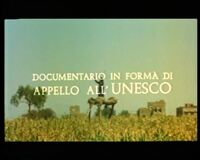
UntitledOn Sunday October 18, 1970, the last day filming “Flower of the Arabian Nights” on location in Sanaa, the capital of Yemen, Pasolini decides to use some leftover rolls of film to make a documentary about the city and thus persuade Unesco to intervene to protect the beauty of this world heritage. ”With every passing day, one part of the Sanaa walls falls to pieces... One of my dreams is to save Sanaa and other cities – their historic centres. I will strive for my dream and endeavour for Unesco to intervene”, says Pasolini.
UntitledLe Malentendu Colonial is a courageous voyage into Africa's “German past,” looking at European attempts to colonise Africa through religion and trade. Filmmaker Jean Marie Tenor revisits the role of missionaries in laying the foundations for colonialism in countries like Togo, Cameroon, Namibia and South Africa. The genocidal wars waged by the Germans against the Herrero in Namibia (1904-1907), in which thousands of people were locked up in concentration camps or driven into the desert and forced to scatter in order to survive the genocide, was a practice ground for the later crimes perpetrated by the Nazi army. Through interviews with experts from Germany and Africa, Teno paints a picture of a deeply unsettling period of history that was relatively short but nevertheless horrific.
UntitledThe story of a failed encounter between two cultures with different sensitivities and fantasies. This led to colonisation - one marked by brutality - despite the fact that wars, chaos and destruction could have been avoided. Based on archive footage, the film sends a chant echoing infinitely through time and space: "France is our homeland".
Untitled