
1958 General De Gaulle pronunces -in a very convulse and tragic moment for an Argelia under rigorous represion and torture- its famous and demagogic “Je vous ai Compris” (I understand you). A reading on several audiovisual documents of that time gives to us an opposite meaning to that sentence. “Je vous ai Compris” now means and show us the real sense of the civilizational work of the western powers. Today so enthusiaticly renovated.
Sueño Colonial
34 Archival description results for Sueño Colonial
Classic adventure film based on the H. Rider Haggard novel. Kathy O'Brien convinces explorer/adventurer Alan Quatermain to lead a small rescue party to search for her father who abandoned her to find the fabled diamond mines of King Solomon. www.archive.org
The tragic participation of Africans from the French colonies in major world conflicts is a very important issue. We have just commemorated the 60th Anniversary of the Liberation of Europe. Unfortunately, not a single African or Asian who fought alongside the allies has been honoured together with his French, American and English brothers in arms....
UntitledIn Benyounes forest, “la foret” as they called their habitants, was the last stage of a long trip for thousands of people coming from Sub-Saharan Africa. Close to the fence that divides Ceuta (Spain) from Morocco, they establish in a variable time, before flank the last obstacle in they way to Europe, looking for a better life. Sometimes running away from wars, politics persecutions, hunger or a precarious economy situation. Lots of times of all of this. In years, the migrants pass across this forest and after some weeks or months they manage to arrive to Ceuta. In finals of 2004, European union start agreements of subcontract Morocco in the control of the Spanish – Moroccan border. The habitants of the forest, started to feel the effects of this agreements: the increase of illegal devolutions, the abuses from the civil police, they install police controls near the forest, they forbid the access to current water, military attacks to the camps in with they made mass arrests and rapes as a war weapon. The border it's close. Systematic violation of human rights, financed with the tax of the democratic European Union citizens. The migrants organize themselves in spaces like this and construct spaces; support nets in Moroccan territory, confronting and resisting this way the European politics. In the forest of Benyounes, they organized themselves from origin communities. In February of 2005, decided between all the community's, record this video, to made visible their situation, in with they report the systematic violation of their human rights, the absolutely abandonment from the NGO's, Associations an Human Rights Institutions, an they demand their citizens condition and they require their rights as human beings.
UntitledThe story of a failed encounter between two cultures with different sensitivities and fantasies. This led to colonisation - one marked by brutality - despite the fact that wars, chaos and destruction could have been avoided. Based on archive footage, the film sends a chant echoing infinitely through time and space: "France is our homeland".
UntitledLe Malentendu Colonial is a courageous voyage into Africa's “German past,” looking at European attempts to colonise Africa through religion and trade. Filmmaker Jean Marie Tenor revisits the role of missionaries in laying the foundations for colonialism in countries like Togo, Cameroon, Namibia and South Africa. The genocidal wars waged by the Germans against the Herrero in Namibia (1904-1907), in which thousands of people were locked up in concentration camps or driven into the desert and forced to scatter in order to survive the genocide, was a practice ground for the later crimes perpetrated by the Nazi army. Through interviews with experts from Germany and Africa, Teno paints a picture of a deeply unsettling period of history that was relatively short but nevertheless horrific.
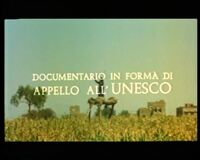
UntitledOn Sunday October 18, 1970, the last day filming “Flower of the Arabian Nights” on location in Sanaa, the capital of Yemen, Pasolini decides to use some leftover rolls of film to make a documentary about the city and thus persuade Unesco to intervene to protect the beauty of this world heritage. ”With every passing day, one part of the Sanaa walls falls to pieces... One of my dreams is to save Sanaa and other cities – their historic centres. I will strive for my dream and endeavour for Unesco to intervene”, says Pasolini.
UntitledA French government report explaining the reasons why it was impossible to accept Algeria’s independence.
Untitled“I will show two videos: “Trobriand Cricket”, and “Les Maîtres Fous” to talk about what I will call “mimetic excess”. By this I mean a joy or "jouisance" in mimesis itself (Nietzsche talks about this in his description of Dionysus). An “excess” produced at the moment of de-Colonisation in the 1950s-1960s, with the encounter between the Indigenous and the European worlds; the first with its mimetic body, and the European world with its mimetic-machine (the camera). A question for us: Now, in 2006, what do we do with this "excess?"
This collaborative film, banned for more than a decade by French censors as an attack on French colonialism (and now available only in shortened form), is a deeply felt study of African art and the decline it underwent as a result of its contact with Western civilization. Marker's characteristically witty and thoughtful commentary is combined with images of a stark formal beauty in this passionate outcry against the fate of an art that was once integral to communal life but became debased as it fell victim to the demands of another culture.
Untitled