Taqwacore: The Birth of Punk Islam follows Michael and his kindred spirits as they travel across the U.S. in their green school bus, challenging Muslims and non-Muslims with punchy anthems like “Sharia Law in the U.S.A.” Their spiritual odyssey leads them to Pakistan, where they bring punk to the streets of Lahore and reconnect with Islam in a bold new way.
UntitledRu'a
37 Archival description results for Ru'a
Grief and mass media in Algeria.
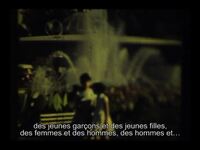
UntitledThis work by Lebanese filmmaker Danielle Arbid is based on the secret, ardent and obsessive sexual experiences that are freely recounted in minute detail by her friends. Archival super-8 footage of prim young girls alternates with darkened shots of men and women discussing their formative experiences and their fantasies. Their words and the visual representations create a highly poetic erotic tension.
UntitledThis documentary by Ahmed EL Maanouni consists of footage of concerts, interviews and the final performances by the music group Nass El Ghiwane, which shot to fame when Scorcese discovered them as “the Rolling Stones of North Africa.” Nass El Ghiwane emerged from the poor outskirts of Casablanca, fusing elements of traditional Moroccan music such as Sufi chants, mystic Berber rhythms and dances of the gnawa, to create their own sound.
UntitledWhen Israel withdrew from the Sinai Peninsula in 1982, the city of Rafah was suddenly split, between Egypt and Gaza, by an immense metal and concrete wall. Families found themselves divided by a highsecurity international border, though their houses often lay less than 100m apart. Before long, influential families moved their business underground, through dozens of secret tunnels burrowed below the Israeli border fence. Everything moves through Rafah's tunnels: from cigarettes and drugs to cash and people. It is a vast enterprise, and pays five times the average annual Gaza salary in one month. It is a family business, passed on from father to son and always - for reasons of security as well as economics - kept in the family.
UntitledHe asked me: “Ms Ziadah, don’t you think that everything would be resolved if you would just stop teaching so much hatred to your children? (...). Pause. I look inside me for strength to be patient but patience is not at the tip of my tongue as the bombs drop over Gaza. Patience has just escaped me. Pause. Smile. We teach life, sir! (...) These are not two equal sides: occupier and occupied. And a hundred dead, two hundred dead, and a thousand dead. (...) Is anybody out there? Will anyone listen? I wish I could wail over their bodies. I wish I could just run barefoot in every refugee camp and hold every child, cover their ears so they wouldn't have to hear the sound of bombing for the rest of their life the way I do. (...) Today my body was a TV’d massacre. We teach life, sir. We Palestinians wake up every morning to teach the rest of the world life, sir.”
UntitledTriggered by the memoirs of a medical missionary on the Afghan borderlands, this film is constructed from still photographs of colonial life on the North West frontier of British India at the turn of the 20th century. Searching for clues to the realities behind images framed during a time of colonial conflict, the film plays sound against image to find contemporary parallels in Western portrayals of a distant place and people.
Untitled