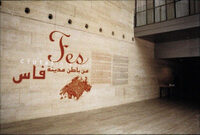
An initiatic journey Videos from an exhibition at the Centre de Cultura Comtemporània de Barcelona from March 26 to May 30, 2002 (a project by Albert Garcia-Espuche and Toni Serra). Into the innermost parts of the city of Fes.Using audiovisual recordings that illustrate some of the different anthropologic, sociologic, urbanistic and religious aspects that make up the fabric of the city. A journey that requires both objectivity (in the working method) and subjectivity (for the experience of the journey and immersion in another culture).
Ru'a
37 Archival description results for Ru'a
Fourteen centuries after the revelation of the holy Qur'an to the Prophet Muhammad (peace be upon him), Islam today is the world's second largest and fastest growing religion. Muslim gay filmmaker Parvez Sharma travels the many worlds of this dynamic faith discovering the stories of its most unlikely storytellers: lesbian and gay Muslims. Filmed over 5 1/2 years, in 12 countries and 9 languages, "A Jihad for Love" comes from the heart of Islam. Looking beyond a hostile and war-torn present, this film seeks to reclaim the Islamic concept of a greater Jihad, which can mean 'an inner struggle' or 'to strive in the path of God'. In doing so the film and its remarkable subjects move beyond the narrow concept of 'Jihad' as holy war
UntitledAl Barzaj [Between the worlds] is a poem about the halfway world, between the visible and the invisible, sleep and wakefulness... An inner journey through underground streets, secret gardens.
UntitledDuring the third Rif war, from 1923 and 1927, the Spanish army used massive quantities of mustard gas against civilians, thus making Spain one of the first world nations to use chemical weapons on a civilian population. Eighty years later, a young man from the Rif living in Madrid embarks on a race against the clock to safeguard the memories of the last remaining witnesses of that war. The Spanish government has never acknowledged its crimes. And the victims, now elderly, threaten to die without ever having spoken out about those years of suffocation and death.
UntitledA military helicopter circles in the sky like an evil wasp. Chaos on the ground after the attack. A fast-paced sequence - bleeding people, burning cars and confused soldiers. Subheading: From Beirut - with Love. A cinematic postcard-greeting, so bitter and cynical, it can only come from a city at war with itself. The only dialogue in the film reveals a surprising connotation: Beirut is Paris, or Madrid, or any other metropolis. The scene is set: youth without a future, bomb attacks, drugs, arms, soldiers. The postcard has arrived.
UntitledThe Gaston Berger University in Senegal has nearly five thousands students. The University canteen assures all these people their daily food. It is a food chain operating each day from the early hours of daybreak until the twilight of dusk. The film reveals the slow and meticulous transformation of food, but also the bodies at work of the individuals of both sexes who prepare and serve the meals.
UntitledKhaled, a Syrian worker earns his living in old town Beirut. He was born transvestite. Ever since he suffered of his sexual identity. Yet, he has determined to change his sex by a surgery which allows him to become a woman. This film enters into Khaled's intimate world, daily struggle and damages that inflict him in an intolerant society.
UntitledCoca-Cola Bottling Plant in Egypt. Coca Cola Advertisement for Arabic countries.
UntitledThe Observatory Archives invites Hakim Bey to reflect on this subject as a contribution to OVNI dis_Reality. Hakim Bey is the pseudonym of Peter Lamborn Wilson (EE. UU. October 1945 - May 2022), an American writer, essay writer and poet who describes himself as an “ontological anarchist” and a Sufi. His 1990 work TAZ: The Temporary Autonomous Zone made him famous. As well as writing a series of essays on the traditions of Chinese secret societies (Tong), Bey introduced the concept of the Temporary Autonomous Zone based on his research into pirate utopias. Bey has also written about figures like Charles Fourier and Friedrich Nietzsche, and on the links between Sufism and ancient Celtic culture. Along with these authors and theories, Situationism has also been an important influence in Bey's texts, which could be considered as an updating of its ideas for the present.
Edward Said talks about the context within which the book "Orientalism" was conceived, its main themes and how its original thesis relates to the contemporary understanding of "the Orient." Said argues that the Western (especially American) understanding of the Middle East as a place full of villains and terrorists ruled by Islamic fundamentalism produces a deeply distorted image of the diversity and complexity of millions of Arab peoples.
Untitled