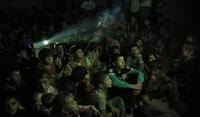

Erase and new count... Reset the equipment... or better even, format the world... No apocalyptic attempt. I propose that the interpretation be optimistic. Anyway, some Scientists affirm it... and others don't... In this Universe, All End is a Beginning. The Civilization is fragile, the humanity don't Enjoy it while we have it, and then... the afterculture. This is the third part of a TOING! tripartite video. Zerzan, Savinar, Godesky and others, are of course, subjects to scrutine that we may find hope in the coming collapse, to rediscover the balance and fullness of life we enjoyed for millenia. “Yu Koyo Peya” is an expression of the Ipili Papua tribe of the highland of New Guinea, that means “The Land is Ending”.
UntitledRizomas
36 Archival description results for Rizomas
Israel Ministry of Foreign Affairs promotional video: “Did you know that there is one place on earth that has it all' It is called Israel, but I call it home. Did you know that Israel has invented a capsule that can travel through the whole body and film the functioning of all of its parts? Curing the world. Did you know that Israel sends hundreds of missions to developing countries? Did you know that Israel is a world leader in agricultural development and fruit cloning? I hope to see you all next year in Israel!”.
Made over six years in the hotels of six different countries, Hotel Diaries is a series of video recordings which relate personal experiences to the current conflicts in the Middle East. In these works, which play upon chance and co-incidence, the hotel room is employed as a 'found' film set, where the architecture, furnishing and decoration become the means by which the filmmaker's small adventures are linked to major world events. Works in the series include Frozen War (Ireland, 2001), Museum Piece (Germany, 2004), Throwing Stones (Switzerland, 2004), B & B (England, 2005), Pyramids/Skunk (The Netherlands 2006/7), Dirty Pictures (Palestine 2007) and Six Years Later (Ireland 2007).
UntitledThe public presentation
The Purple Meridians is a joint project by three organisations in Spain, Italy and Turkey that brings together eighteen women filmmakers, six from each country, to debate the difficulties faced by women working in the filmmaking industry and wider screen sector. The aim is to share strategies for overcoming common obstacles and set up a support and exchange network for future partnerships crisscrossing Europe from east to west.
The project is made up of three workshops, an online roundtable, onsite screenings in Barcelona, Turin and Diyarbakır and an online programme featuring a selection of films by the participating filmmakers. The films, subtitled in English, will be made available on the streen.org platform, free of charge on the first day (to be decided on the basis of the onsite screenings) and then on a pay-per-view basis for three months.
Once the onsite and online workshops have been held in Barcelona, Turin and Diyarbakır, each group will watch the videos of the workshops held by the other two groups and draw up a set of conclusions to share at the online international roundtable.
The filmmakers resident in Catalonia ( Anna Giralt Gris, Raquel Marques, Pilar Monsell , Ro Caminal, Lara Vilanova i Lili Marsans) will meet at the Centre Cívic Pati Llimona , where they will connect with Turin (as part of the Torino Film Festival) and Diyarbakır (Turkey).
OVNI, Mostra de Films de Dones i l’Alternativa will present a programme of films made up of two films by each of the eighteen participating filmmakers.
The remaining shorts will be screened on the same day on a continuous loop on a monitor at the Pati Llimona Civic Centre.
All the films will be available from 3 December in their original language with English subtitles on purplemeridians.org .
1- Spain Workshop (onsite)
Monday 15 November , 4 pm to 8 pm
Sala Raval, CCCB, Not open to the public
2- Spain Workshop (online)
Monday 22 November , Not open to the public
3- International Roundtable (online)
Saturday 27 November, 11 am to 12.30 pm
Open to the public, The roundtable will be held in English
4- The Purple Meridians Screenings
Thursday 2 December , 6.30 pm to 8.30 pm
Centre Cívic Pati Llimona, Free admission
Films in their original language with Catalan subtitles
The Purple Meridians is a joint project by three organisations in Spain, Italy and Turkey with the support of 2021 Eurimages Gender Equality Sponsorship.
A 20 minute short movie-presentation of the insurrection of December 2008 in Greece through the words and actions of people that took part in it. The video was created in Thessaloniki in January 2009 and its first presentation took place before an open discussion-review of the insurrection in the squatted public library of Ano Poli.
UntitledThe film focuses on the re-enactment of a demonstration of women against the prohibition of work introduced by the Taliban. The shots were taken during the shooting of the Afghan feature film OSAMA in November 2002 in the streets of Kabul. 1000 women had come to play in this scene, and their personal experiences were identical with the ones of the protagonists. Most of the women acted in the demonstration scene to earn money. By demanding work they hoped to improve their real situation.
A Saakhelu ritual carried out at the Panteón (Jambaló, Cauca). The documentary shows each stage of the ritual step by step, and explains its meaning and importance to the entire community of the Nasa people, in Columbia.
UntitledRod Coronado is a Yaqui Native American who explains how the massacre of his people went hand in hand with the massacre of animals. The two are deeply interrelated, with the same aggressor: a system, a predatory culture. This realization led him to take an active part in ALF actions to protect animals from cruelty, slavery and extermination: “There was no time for those animals suffering in labs and fur farms and factory farms to wait to exhaust more legal means. I could see already that people for many, many years had chosen that path and although it is effective at times, it was not bringing about results quick enough for those animals now suffering. So I became involved in direct action with the Animal Liberation Front.
UntitledLiberated spaces / OVNI 2009
/ CONTEXT 1994 - 2020
Liberated spaces / OVNI 2009
OVNI Rhizomes lays bare the subterranean, rhizomatic points of contact between worlds and experiences that seem very different from each other. The remembered image is that of a rhizome (1), or rhizomes, it doesn't matter which because it is both at once, the singular and plural do not affect it.
“Advice, slogans: follow the plants” (2). In a world of concrete and asphalt we see different plant species living in cracks in the most unlikely places, gathering rain and seeking out soil that has been banished. At other times, these same plants, or the roots of trees, create the cracks and buckle the asphalt. We have also seen plants cover entire buildings, opening walls and destroying them; but so have we seen them holding together the ruins of immemorial knowledge, ancient temples in the jungle, in a strange union that seems to complete them. Like the cobra that saw Buddha meditating and instead of biting him, decided to cover him and shelter him from the rain. An image that perhaps renews a forgotten pact: to awaken to the smooth continuity between nature and human, between nature and knowledge, a continuum that hovers over words to remind us of the essential unity and manifest multiplicity of all things.
Plants also show us diverse systems. Along with the centralised and hierarchical organisation of the roots of trees, there are the spidery roots of shrubs and bushes, the rhizome of certain species (grass, reeds, ginger, mangroves...) creates "an acentred, nonhierarchical and nonsignifying system without a General and without an organizing memory or central automation, defined solely by a circulation of states" (3).
We screen videos like visions that connect and interrelate these states and realities, producing rhizome in space, but also in time, given that the first two principles of the rhizome are connection and heterogeneity: any of its points can and must be connected to anything else. This is not the case with trees and roots, which always fix a point, a particular order. Thus, like a violently smothered echo, the Black Panthers’ "all power to the people” resonates in the possibility of immigrant communities, in the “banlieues" of the world. The anti-Vietnam war protests and the underground that derived from them emit lines that break the sad, or even complicit, silence around the occupation of Palestine, Iraq, Afghanistan... or around the wars "subcontracted" by big corporations in Africa. (4)
Indigenous peoples are part of a rhizome that includes the earth, plants and animals, forms of knowledge that derive from their forms of survival and celebration, and wakefulness and dreams. They see this multiplicity as a substantive, not an accumulation: another of the principles of rhizomes. They know that an attack against any one of their realities is unavoidably a prelude to other acts of violence. This is why a Yaqui Indian explains that those responsible for the genocide against his people also exterminated wild animals, domesticated others, imprisoned the survivors of his people in reserves. It is also like the indigenous community in Peru that dreams up a different kind of schools, and creates them with urgency on awakening; because they seen how the official educational system teaches their children to be enemies of their own traditions, of their own environment. They warn us, they are not isolated points on the outside of the “other”, they are lines of alert, for ourselves (5).
In Europe, the warning came from Exarchia, a neighbourhood in Athens. The death of 15 year old Alexis, shot by a policeman, triggered a new awareness, the occupying of spaces, the issuing of communiqués in which teenagers sorrowfully condemned the submissiveness of many of their parents, the conformism instilled by the schools of consumption and production;... the impossibility of imagining, together, another form of existence:
“We want a better world. Help us. We are not “terrorists”, nor “hooded ones", nor the "known-unknowns". We are your children, they are the known-unknowns... We have dreams, don’t destroy them We are alive, don’t stop us Remember, you were also young once Today you run after money, you only worry about “appearances” You’ve grown fat, you’re bald You’ve forgotten We hoped for your support We hoped for your concern We wanted you to make us proud for once. But it was in vain. You lives are nothing but lies, you have bowed down You’ve dropped your pants and you are waiting to die You don’t imagine, You don’t fall in love You don’t create You only buy and sell Materialism everywhere, Love nowhere, Truth nowhere (6).
Dark roots, prisons opposite factories, maps and imaginaries that don't include us as life, neighbourhoods in ruins, third-generation migrants – forever migrants? - bombed hospitals, hundreds of dead birds by a lake, torn rhizomes.
But unlike the cuts that isolate other kinds of structures, a rhizome can be torn and cut off at any part. Rhizomes can be broken or cut without causing any harm (7), because rhizomes are made up of ruptures, they can keep functioning and even thrive in spite of these “ruptures”. This is how other nomadic maps begin, inspired by roaming cats, in the non-useful areas of cities: where abandoned sites create space for communities of cats and, and room for the dreams of the people who feed them, humans adopted by feline tribes; in urban micro deserts, jungles and ruins. Where squatted abandoned buildings become hybrid, mingling with other distant memories, scorned by speculation. Liberated spaces that come back to life, that break the Totality (8).
“What is the Totality? It is the high residue of hazardous and potentially lethal chemicals inside your fat cells. It is you shopping when you are depressed. It is you sitting inside and turning on the television or computer on a beautiful day. It is feeling you get that something is missing. It is the headache that won't go away. It is the bleeding in your intestines from years of pain alleviating drug use. It is the drugs you have take when you need an escape. The bulldozer that destroyed the woods you might have known so well. It is the towering skyscraper that makes you feel forever tiny and powerless. It is your prison, sometimes with bars, sometimes without. It is all your fears. It is the thing that has categorised you. It is the ache in your back. It is your adrenaline. The tears that pour down your face after a sad movie. It is your longing for a dramatic romance with a happy ending. It is the extinct species. It is the dying world. It is polluted air. It is the farmer killing her/himself with the pesticides that were going to make life better. It is the feeling of superiority, which supplies the reason to destroy all else.” (9)
A Totality that is always aimed at the conquest of the other. And the result is a society based on competition, on commodification and global expansion. A society that doesn’t contemplate any logic other than growth (10). A society made up of masses of solitary individuals.
Dominant thought can be recognised in power that is directed outwards. But this outward-focus does not mean that this form of power is only exercised on material forms and surfaces. Rather, it causes and forces everything that is inwardly focused – anonymous, hidden, insignificant – to flow towards the surface, be reduced to the external, reveal itself, publicise itself, to end up becoming nothing more than the outside. This is the only way that it can impose its full cartography, group and produce its identities... so that it can allocate its experts and target its goods. This outwardly-directed power necessarily dominates and subjugates the other – whether beings, territories or forms of knowledge – but also to constantly produces it, through the exhibition of images and attitudes, the unceasing creation of politica
Practical information
A presentation of Kurdish films by the Rojava Kurdistan Film Commune (Northern Syria)
OVNI has collaborated with the Rojava Film Commune in a project aimed at researching, screening, and promoting their work in Spain, Italy, and France. A process of investigation through videos, texts, and meetings, in order to listen to their voices and understand their struggle together. We have created a website that you can visit link.
Komîna fîlm a Rojava (Rojava Film Commune) is a collective of filmmakers founded in 2015, based in the autonomous Rojava region in the Federation of Northern and Eastern Syria. The Commune is actively working in the region to rebuild and reorganise filmmaking and film education infrastructures.
The Rojava Film Commune was established to promote local film culture by organising film screenings, facilitating discussions on the role of film within society, producing new films, and setting up a Film Academy. Following the 1960 fire in Rojava’s only cinema in the city of Amude—which saw the death of 298 children trapped inside—the Commune aims to reclaim film as a central space for reimagining society, by democratising and revolutionising the imagination itself.
The Commune has educated a new generation of Rojava filmmakers, organized screenings in cities and villages, and produced new films. It seeks to represent the values and ideals of the Rojava Revolution, but also to mediate and depict the daily struggles in the Syrian civil war and Rojava’s collective attempt to build a new society.
The Rojava Film Academy provides education for aspiring filmmakers in Northern Syria. Founded in 2015, it offers one-year programmes, with courses on international film history, Kurdish film history, film theory, photography, cinematography, script writing, editing, and sound design, taught by local and international film professionals.
The Academy is self-organized and non-hierarchical, encouraging students to participate in every aspect of its organization. Exchange networks have also been set up with other academic, media, and news platforms, and with civil society organizations, in order to engage in broad discussions and create screening possibilities. Considering the influx of foreign filmmakers and journalists to Rojava, it is important for the Commune to reclaim the representation and imagination of the revolution.
After decades of oppression of Kurdish language and culture, the Rojava Film Academy aims to revitalize local film culture, reclaiming the power to narrate and imagine one’s dreams and realities. After the Syrian Civil War started, the predominantly Kurdish northern region declared the Autonomy Administration, creating structures based on grassroots democracy, women’s liberation, and cultural diversity.
The Academy bases its methodology on ‘revolutionary realism’, i.e. a realism that does not merely reveal the current reality in a new way, but also restructures the reality of the possible . As well as finding forms to express things as-they-are, it creates the opportunity to imagine the not-yet-present, the ‘eternal becoming’ that is the revolution itself.