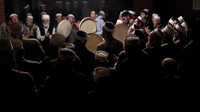
A document about Kumbh Mela, in India. More than 10 million people: pilgrims, saddhus, babbas, .... meet over the course of a month in this psychic vortex, to celebrate the fight between angels and demons. Edited from more than 60 hours of tape filmed in 1986, and edited in 1998 in Mistyc Fire Video.
Ritual
36 Archival description results for Ritual
L'escriptor Jordi Esteva torna a Costa d'Ivori per a esbrinar sobre l'esperit de la pantera que es va manifestar durant el rodatge del seu anterior documental "Retorn al país de les ànimes" sobre les creences ancestrals i els fenòmens de tràngol i possessió. En la pel·lícula, rodada en blanc i negre, amb el ritme d'una "road movie", l'escriptor assistirà de nou a una cerimònia de tràngol en la qual un komian serà posseït per l'esperit de la pantera i emprendrà la cerca de l'altra komian, en tota la Costa d'Ivori, posseïda pel mateix esperit poderós. El periple li portarà a la veïna Ghana a la recerca dels únics percussionistes que poden invocar a l'esperit de la pantera amb els seus ritmes.
UntitledAbubakar is 46 years old and participates in the Zikr - ritual dances performed by Chechen Sufi Muslims. At each Zikr he reaches a state of ecstasy. For Abubakar it is an exorcism, a form of liberation from everything that his people have suffered over so many years of occupation. It is an act of resistance where they reunite with their dead. An encounter with the Real.
UntitledAnonymous guide. Fes el Bali, the old medina of Fez founded in 809 by Idris II, is still completely contained within city walls. The gates (Bab Bou Jeloud, Bab Fteuh, Bab Er Rsif, Bab Guissa...) therefore retain all their social and symbolic value, associated with the different activities of the city and its inhabitants.
collection Petites Planètes. ‘Jihad’ is a fundamental Arab concept. In these times of conflict and violence, we only hear the mass media version – the extreme meaning of the term, which has strayed from its original sense – while its deeper meaning is ignored. Jihad can be translated as effort, commitment, and struggle in the broad sense. It is a concept and an experience with two different levels, one subordinate to the other. On one hand there is the ‘small jihad’ which has to do with effort, with the communal struggle to attain a society that is fairer and more aware of the mystery of reality (Al-Haqq) and of life (Al Hayy), which are two of the names of Allah. And the other is the ‘great jihad’, which is considered more important, and which determines whether the success, failure, or digression of the small jihad. This great struggle is the inner quest, the effort to cleanse everything inside us that distances mankind from the real... everything that favours a world made up of separate, selfish entities, a world that is closed, appropriable, and doomed to conflict. One of the most beautiful and profoundly meaningful practices of the great jihad is the ritual ceremony of ‘dhikr’ (zikr), an Arabic word that means memory... and in this context refers specifically to the memory of Allah... a personal reencounter - within a collective ceremony - with the mystery of the Real... in other words, with that which is cannot be defined, represented, or appropriated... that which is beyond physical or rational measure. According to this tradition, only one organ is capable of accommodating such an immensity: the human heart. Sufism struggles to remain within the heart of Islam. And in suffering Chechnya, Sufism is the most widespread form of Islam. Vincent Moon and Bulat Khalylov recorded a beautiful, immersive form of the experience of this dhikr ceremony.

UntitledFez is the Moroccan city with the liveliest tradition of artisans. Far from being "just a job", the activity of the artisan reflects a whole conception of the world and a way of experiencing time and giving it meaning. This native wisdom is passed down from parents to children, from the maalem, the master, to the apprentice.
Fez is one of the North African cities to have had most madrassas, of great architectural beauty. Madrassas, former Koran schools and now open for visits as public monuments, formerly provided one of the functions that raised Fez to the height of its splendour: the study of Islamic tradition and the body of laws and regulations governing social life. They were also the home of the students. Madrassas: Bu Inaniyya (1350), al-Attarin (1323), Seffarin (1280), al-Sahri (1321).
The markets of Fez, accessible from the main streets of the medina, are mostly situated very near the entrances to the city and reflect the vitality of an economic microsystem associated with the basic needs of the medina and its immediate rural surroundings.
Deliberations on death while a corpse is carefully cleaned and shrouded. 3 Mostra de Vídeo Independent de Barcelona 1996.
Untitled“My spiritual journey had taken me from the land of Ahuramazda to the realm of Allah. I came to believe there is only one God, the God of light, goodness and joy. A God who abides not on the mountains or in the oceans, nor the cities or the sanctuaries, but in the human souls who worship there”. Aryana Farshad.