
ovni 2015

Àrea d'elements

Taxonomia

Codi

Nota(es) d'abast

    Nota(es) sobre l'origen

      Mostra la nota(es)

        Termes jeràrquics

        ovni 2015

          Termes equivalents

          ovni 2015

            Termes associats

            ovni 2015

              5 Descripció arxivística resultats per al ovni 2015

              5 resultats directament relacionats Exclou els termes específics
              ES ES-OVNI CTX-S017 · Series · 2015
              Part de Non-Identified Video Observatory (OVNI)

              Concerning Violence / Le Grand Jihad / Le Jour a Vaincu la Nuit

              / CONTEXT 1994 - 2020

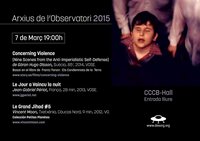
              Observatory Archives 2015

              March 7th 2015 19:00h

              OVNI opens up public access to the Intranet of the Observatory Archives, founded in 1993. To launch this new phase, we will screen a programme of videos that establish the two poles of this project, which span from social critique at one end, to personal exploration at the other. Concerning Violence by Göran Hugo Olsson with texts by Frantz Fanon, Le Grand Jihad by Vincent Moon , a ritual around memory, and Le Jour a Vaincu la nuit, by Jean-Gabriel Périot, another around dreams.

              OVNI Archives Intranet.

              OVNI opens up public access to the Intranet of the Observatory Archives, founded in 1993, at the CCCB. The collective behind OVNI considers that audiovisual creation (video art, documentary, and media archaeology) is more than just a creative, innovative, and aesthetic discourse... it is the most contemporary and non-elitist reflection on today’s culture and society.

              It is a collective visual thinking that reflects social, personal, poetic and political realities... flowing smoothly from reality to fiction. And its specificity makes it both a device for the construction of imaginaries and a tool for deconstruction.

              In The Society of the Spectacle, Guy Debord wrote that when reality is captured and turned into mere images, these images become reality: a mechanism that consolidates the unreal core of our reality. It seem to us then, as a counterpoint, that reality itself is at stake in the creation and dissemination of images. This is why it is necessary to develop an independent audiovisual discourse: independent of commissioning dynamics, independent in regard to the choice of subject matter and the approach, and above all independent of the prefabricated norms and grammars of the audiovisual industry and its consumption and production criteria. This entails a differential defence of the perception of reality. The mechanisms of cloning and the monoform (Peter Watkins) are countered by a rhizome of unique approaches, overlapping coincidences and disparities that do not exclude contradiction, but instead value it as the presence of reality in the images.

              Fortunately, the same market logic that flooded the landscape with banal images and with devices for recording, editing, and spreading images has also enabled the democratisation of access to the means of production and has broken the audiovisual oligopoly, downplaying the importance of the big mainstream channels.

              However, we need to take advantage of this window of possibility, which may remain open for a shorter time than we imagine. He have to go beyond the fog of compulsive images that flood the networks, and pierce the veil of media images, the master copy of the film that aims to reduce reality to the order of representation, and individuals to a handful of stereotypes.

              This process of audiovisual dissidence and resistance has been, and remains, fundamental. The mirror of representation has shattered into thousands of fragments: pieces that are deep cuts in reality and at the same time reflections of it.

              We suddenly enter a complex rhizome (Deleuze_Guattari) of stories that reflect plural reality. A discourse in which the principal values are heterogeneity, contradiction, and subjectivity. An antidote to the cloning and repetition of the corporate mass media. In this rhizome made up of disparate visions, the vision that the mass media presents as objective reality is deconstructed, and revealed as the subjective imaginary of the dominant discourse.

              We could say that there is a conflict of imaginaries. On one side, the omnipresent, formidable machine for the production and dissemination of prefabricated messages, creating a range of versions based on the same basic pattern as any other consumer product: to maximise profits and ensure its own continuity. On the other side, a kind of artisan patchwork of personal or collective experiences, a patchwork that has been torn in places and is full of life.

              Fragment of the article-interview on OVNI by the magazine:

              Intertartive [a platform for contemporary art and thought]. Herman Bashiron

               http://interartive.org/2011/04/ovni/

              “In an age where show business – too often mistaken for the world of culture - has become a model for real life, where fiction and reality melt into the one solution, and where physical and mental solidity dissolve into a continuous flow of images and appearances, here, in this intricate and complex mutation of reality, the work of OVNI offers an antidote to the poisons of contemporary information and communication. For over twenty years, it has been a “Temporary Autonomous Zone” – as Hakim Bey, collaborator of one of the editions of OVNI, would say –, presenting an intense programme of video art, independent documentary and mass media archaeology at the CCCB in Barcelona and beyond. The in-depth research carried out by OVNI clearly shows how independent audiovisual productions are gaining increasing visibility and international recognition and, at the same time, they are devices that are highly critical of contemporary culture and society."

              The Intranet Archives.

              The launch of this Intranet of the OVNI Archives at the CCCB makes approximately 2000 audiovisual works – the entire holdings of the Archives – available to the public. A collection of works that we will continue to build on with new acquisition, as in the case of the works screened at the launch, which will be incorporated into the archive.

              The Observatory Archives: A tool.

              Over the last few years, various developments have forced us to review our project, leading us to closely examine the real characteristics and functionalities of other parallel projects: how they work and how they are used.

              It is necessary to think critically about what archives are, and about the value of an archive. This is the case now more than ever, against the backdrop of the compulsive creation of numerous Archives over the past ten years, most of which are based on accumulative criteria: either the accumulation of existing dominant values (a "who's who" of a particular audiovisual scene) or simply a quantitative accumulation. In contrast, the OVNI Archives are the result of specific reflection on a continuum of themes that have been crucial in recent decades; a reflection that has been woven into the works themselves, in a kind of meta search. We could say that they are archives with a thesis; they have gone against the flow of dominant thinking and fads.

              At the same time, there is only limited value in archives that can be consulted but are isolated and fossilised. Archives become valuable when they can be read, when they can create meanings, suggest transversal readings and intersections. Being accessible to the public is one condition that allows this, but it does not guarantee or facilitate it. It is the knowledge generated by the Archives, and above all, the knowledge that has been generated through them, that makes it possible to make the most out of them: as a base from which to organise workshops, debates, specific programmes... This is the project that we are working on; the launch of this Intranet is only the first step.
              ES ES-OVNI CTX-S017-SS001-0001 · Item · 2014
              Part de Non-Identified Video Observatory (OVNI)

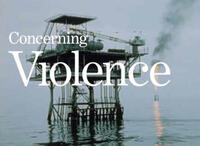
              A film by Göran Hugo Olsson Based on Frantz Fanon’s The Wretched of the Earth Narrated by Ms. Lauryn Hill Preface by Gayatri Chakravorty Spivak Including appearances by Thomas Sankara Amílcar Cabral Tonderai Makoni Robert Mugabe FRELIMO MPLA. Concerning Violence is both an archive-driven documentary covering the most daring moments in the struggle for liberation in the Third World, as well as an exploration into the mechanisms of decolonization through text from Frantz Fanon’s The Wretched of the Earth. Fanon’s landmark book, written over 50 years ago, is still a major tool for understanding and illuminating the neocolonialism happening today, as well as the violence and reactions against it. In the middle of the Cold War, radical Swedish filmmakers set out to capture the anti-imperialist liberation movements in Africa first hand. With their 16mm footage, found in the Swedish Television archives, filmmaker Göran Hugo Olsson draws on his experience making The Black Power Mixtape (2011) to create a visual narrative from Africa - images of the pursuit of freedom, the Cold War and Sweden. Swedish filmmakers, with their sense of solidarity with anti-imperial and socialist struggles around the world at the time, created images and stories which still resonate today, and can change and deepen our impression of the globalized world we live in. The people captured by these filmmakers fought with their lives at stake, for their and others’ freedom. The unique archival footage features a nighttime raid with the MPLA in Angola, interviews with the guerrilla soldiers of FRELIMO in Mozambique, as well as with Thomas Sankara, Amílcar Cabral and other African revolutionaries. The imagery is fantastic: clear, crisp and unique films that convey a sense of urgency and dedication that was at the heart of the decolonization movements. ”National liberation, national renaissance, the restoration of nationhood to the people: whatever may be the headings used or the new formulas introduced, decolonization is always a violent phenomenon.” In pictures and interviews, as well as with a narrating voice guiding the audience through the material with the words of Frantz Fanon. Concerning Violence tells the story of the people and ideas behind one of the most urgent struggles for freedom and change in the 20th century. The organization of the film into nine chapters connects quite abstract ideas with concrete images and real people who embody and carry the story. Crafting a form that is unique in its blend of cinematic essay and archival footage documentary, Concerning Violence re-introduces Fanon’s humanist, post-colonial vision through a cinematic journey that brings us face to face with the people for whom Fanon’s writings on decolonization were not just rhetoric, but a reality. In layering Fanon’s text with archive footage, graphic design and music in a contemporary tone, filmmaker Göran Hugo Olsson presents a new generation of audiences with a re-examination of the machinery of colonialism that is at the root of much of the violence we see breaking out in parts of the world today. About the story and production Concerning Violence combines incredible footage from a pivotal time with an iconic text by Frantz Fanon, first published in 1961. A psychiatrist from Martinique who played an active role in the Algerian struggle for liberation, Fanon was a major intellectual voice in support of the decolonization struggles taking place after the Second World War. Fanon’s writings were central to the formation of African thought, which was being crafted during this period of upheaval in the continent by the visionaries of the new African nations - some of whom appear in the featured archive material in the film. Reading The Wretched of the Earth today is an amazing yet unsettling experience, because of how accurate it was in predicting the world today. This text explains the destructive dynamics between the rich and the Third World (a term first coined in the English translation of this book), like nothing else. With absolute precision, Fanon paints an image of an abstract mechanism in the relation between two worlds and sometimes two persons, the colonizer and the ‘native’, but also in relation to international corporations and people living off land containing the natural resources that such corporations seek to exploit – a situation that clearly has contemporary resonance. Fanon also made the critical point that decolonization is something that has to happen in both directions – both the colonized and the colonizer need to be decolonized. As a psychiatrist, he recognized the deep implications of this, as well as the enormous adjustments this would require. He also saw that this would not happen without a tremendous struggle that could take many forms, including what he referred to very controversially as “therapeutic violence”. In a nod to Jean-Paul Sartre’s 1961 preface to The Wretched of the Earth, the film is placed within a contemporary social and historical context in a cinematic preface by Gayatri Chakravorty Spivak, one of the world’s most renowned philosophers and a central theorist of postcolonial consciousness that Fanon helped set into motion - and which is today shaped by developments that he, in his short lifetime, did not witness. In its essence, Concerning Violence is a film about how deeply twisted the relationship is between “Third World” Africa and Europe - in its modern form of neo-imperialism this includes the USA, China, and the Gulf States - and how much harm and injustice this is causing. It is an attempt to understand the profound hypocrisy at the centre of the Western values that underpin our current world order. This text explores what poverty and oppression does to a mind, and why a human being exposed to such exploitation and violence eventually erupts in what to us at a remove may seem like an irrational reaction. In a time of globalization, it is very interesting to explore the extraordinary violence of colonization both ideologically and in practice, and to see that in the context of that legacy, many of the tensions of our time were mapped out long ago. The explosion of violence and contemporary conflict situations in Africa and elsewhere were perhaps entirely predictable. Fanon’s text is narrated in the film by Ms. Lauryn Hill - a respected and socially engaged musical contemporary with an ability to speak to a new generation living in a postcolonial world.

              Göran Hugo Olsson
              ES ES-OVNI CTX-S017-SS001-0003 · Item · 2012
              Part de Non-Identified Video Observatory (OVNI)

              collection Petites Planètes. ‘Jihad’ is a fundamental Arab concept. In these times of conflict and violence, we only hear the mass media version – the extreme meaning of the term, which has strayed from its original sense – while its deeper meaning is ignored. Jihad can be translated as effort, commitment, and struggle in the broad sense. It is a concept and an experience with two different levels, one subordinate to the other. On one hand there is the ‘small jihad’ which has to do with effort, with the communal struggle to attain a society that is fairer and more aware of the mystery of reality (Al-Haqq) and of life (Al Hayy), which are two of the names of Allah. And the other is the ‘great jihad’, which is considered more important, and which determines whether the success, failure, or digression of the small jihad. This great struggle is the inner quest, the effort to cleanse everything inside us that distances mankind from the real... everything that favours a world made up of separate, selfish entities, a world that is closed, appropriable, and doomed to conflict. One of the most beautiful and profoundly meaningful practices of the great jihad is the ritual ceremony of ‘dhikr’ (zikr), an Arabic word that means memory... and in this context refers specifically to the memory of Allah... a personal reencounter - within a collective ceremony - with the mystery of the Real... in other words, with that which is cannot be defined, represented, or appropriated... that which is beyond physical or rational measure. According to this tradition, only one organ is capable of accommodating such an immensity: the human heart. Sufism struggles to remain within the heart of Islam. And in suffering Chechnya, Sufism is the most widespread form of Islam. Vincent Moon and Bulat Khalylov recorded a beautiful, immersive form of the experience of this dhikr ceremony.

              Vincent Moon