
ovni 2012

Elements area

Taxonomy

Code

Scope note(s)

    Source note(s)

      Display note(s)

        Hierarchical terms

        ovni 2012

          Equivalent terms

          ovni 2012

            Associated terms

            ovni 2012

              4 Archival description results for ovni 2012

              4 results directly related Exclude narrower terms
              The Tracks of My Tears II
              ES ES-OVNI CTX-S015-SS007-0022 · Item · 2011
              Part of Non-Identified Video Observatory (OVNI)

              Saddam Hussein’s palace is looted in Baghdad 2003. A red Ferrari Testarossa disappears from his garage. Years pass by and cars from the same garage are found around the world; some crashed, some in mint condition. The Testarossa is still out there, ghost riding through the never-ending desert.

              Untitled
              ES ES-OVNI CTX-S015-SS007-0012 · Item · 1968
              Part of Non-Identified Video Observatory (OVNI)

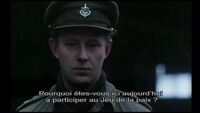
              The Gladiators is a bleak satire set in the near future, in which the major powers of the world, East and West, aligned and non-aligned, recognize the possibility of a major world war within our lifetime and try to forestall it by channelling man’s aggressive instincts in a more controllable manner. They do this by forming an International Commission along the lines of the United Nations, dedicated to fighting a series of contests between teams of selected soldiers from each country. These competitions, which can be fought to the death, are called “Peace Games”, and are broadcast on global television via satellite - complete with sponsors and commercials. The film follows Game 256... The international group of officers watching Game 256 decide to eliminate a man and a woman from opposing teams who reach out to each other, because they decide that such forms of communication would be the gravest threat of all to the stability of the existing world-system.

              Untitled
              ES ES-OVNI RSC-4083 · Item · 1994
              Part of Non-Identified Video Observatory (OVNI)

              "THE FREETHINKER was originally conceived under the title ‘August Strindberg’ as a full-length feature film which I was commissioned to make by the Swedish Film Institute and the Swedish TV in the late 1970s. The result, a four-and-a-half hour film entitled ‘The Freethinker’, is based on the original manuscript, with many new scenes and important facets developed by the students themselves, who researched, directed, filmed, recorded, edited, costumed and principally organized the production and funding of this major pedagogical project! Among many aspects of the high standard of work by these students, was their research into social conditions in Sweden during the 1870s. ‘The Freethinker’ endeavours to show: a) how non-orthodox filmic language forms can expand our view of history, and our way of relating to people on the screen, and to each other. b) that there are ways to produce audio-visual material other than according to the rigidly centralized methods used by the MAVM. c) that, contrary to what we see on TV, there are potentially alternative processes for viewers as well - through which they can become individual participants instead of hierarchically dominated, passive receivers". Peter Watkins

              Untitled
              Eduard Munch
              ES ES-OVNI RSC-4085 · Item · 1973
              Part of Non-Identified Video Observatory (OVNI)

              "EDVARD MUNCH is the most personal film I have ever made. Its genesis lies in a visit to the Edvard Munch Museum in Oslo, in 1968, during the time of a screening of several of my films by the Oslo University. I was awestruck by the strength of Munch’s canvases, especially those depicting the sad life of his family, and was very moved by the artist’s directness - with the people in his canvases looking straight at us. I also felt a personal affinity with his linking of past and present, e.g., in the large painting showing the anguish of his family as his sister Sophie is dying: the artist and his brothers and sisters are depicted as adults -as they were in the 1890s when he painted this scene - even though the event had taken place ca. 20 years earlier. On another occasion, I was also very moved by Munch’s masterpiece Death of a Child, hanging in the National Gallery in Oslo; in this painting the artist is broken, and has, in an almost desperate frenzy, blurred the form of his earlier depiction of Sophie’s death. This painting, in its time, was attacked as being “incomplete” - a charge which branded certain of his other works as well". Peter Watkins

              Untitled