ovni 2012

Elements area

Taxonomy

Code

Scope note(s)

    Source note(s)

      Display note(s)

        Hierarchical terms

        ovni 2012

          Equivalent terms

          ovni 2012

            Associated terms

            ovni 2012

              49 Archival description results for ovni 2012

              49 results directly related Exclude narrower terms
              Slow Action
              ES ES-OVNI CTX-S015-SS007-0002 · Item · 2012
              Part of Non-Identified Video Observatory (OVNI)

              Slow Action is a post-apocalyptic science fiction film that brings together a series of four 16mm works that lie somewhere between documentary, ethnographic study and fiction.Continuing his exploration of curious and extraordinary environments, Slow Action applies the idea of island biogeography - the study of how species and eco-systems evolve differently when isolated and surrounded by unsuitable habitat - to a conception of the Earth in a few hundred years; the sea level rising to absurd heights, creating hyperbolic utopias that appear as possible future mini-societies. Slow Action is filmed at different sites across the globe: Lanzarote - a beautiful strange island known for its beach resorts yet one of the driest places on the planet, full of dead volcanoes and strange architecture; Gunkanjima - an island off the coast of Nagasaki, Japan, a deserted city built on a rock, once home to thousands of families mining its rich coal reserves; Tuvalu - one of the smallest countries in the world, with tiny strips of land barely above sea level in the middle of the Pacific; and Somerset - an as yet to be discovered island and its various clades. This series of constructed realities explores the environments of self-contained lands and the search for information to enable the reconstruction of soon to be lost worlds. The film’s soundtrack - narratives by writer Mark von Schlegell - detail each of the four islands’ evolutions according to their geographical, geological, climatic and botanical conditions. Slow Action, inspired by novels such as Samuel Butler’s Erewhon, Bacon’s The New Atlantis, Herbert Read’s The Green Child and Mary Shelley’s The Last Man, embodies the spirit of exploration, experiment and active research that has come to characterise Rivers’ practice.

              ES ES-OVNI CTX-S015-SS003-0002 · Item · 2009
              Part of Non-Identified Video Observatory (OVNI)

              Alarm-raising and catastrophist films have been made, and they have served their purpose. Now it is time to show that there are solutions. To give voice to the farmers, philosophers and economists who are inventing and experimenting with new alternatives while also explaining why our society is mired in the current ecological, financial and political crises. Pierre Rabhi, Claude and Lydia Bourguignon, the landless workers of Brazil, Kokopelli and Vandana Shiva in India, Mr. Antoniets in Ukraine... Meet the resistance fighters in love with planet Earth. The series of surprisingly concordant interviews proves that options exist and that an alternative is possible. It is a concrete response to the ecological challenges – and the crisis of civilisation in general – that we are currently in the midst of.

              Untitled
              ES ES-OVNI CTX-S015-SS007-0026 · Item · 2011
              Part of Non-Identified Video Observatory (OVNI)

              The precarious housing and employment conditions of the immigrant population in Barcelona's El Raval neighbourhood are simply a reflection of the conditions that our Spanish parents and grandparents - also migrants - experienced during the post-war period.

              Untitled
              Stop the Machine
              ES ES-OVNI CTX-S015-SS007-0023 · Item · 2011
              Part of Non-Identified Video Observatory (OVNI)

              October 2011 is the 10th anniversary of the invasion of Afghanistan and the beginning of the 2012 federal austerity budget. It is time to light the spark that sets off a true democratic, non-violent transition to a world in which people are freed to create fair and sustainable solutions.

              Untitled
              ES ES-OVNI CTX-S015-SS007-0015 · Item · 1959
              Part of Non-Identified Video Observatory (OVNI)

              In The Diary of an Unknown Soldier Watkins initiated a style of filmmaking which he has consistently developed and experimented with in all of his professional films… Watkins refused to be constrained by cinematic conventions. In this film, he freed the camera from the limitations of a fixed vantage point and forced it to take part in the action so that he could create strikingly realistic, almost newsreel-like, effects and directly involve the viewing audience in the events it was witnessing. The Diary of an Unknown Soldier, however, is not limited strictly to techniques of realism. It contains a curious, almost uneasy, mixture of expressionist and documentary styles, and one suspects that the financial and physical limitations that Watkins faced because of equipment and location problems played a major part in the evolution of this syncretistic approach.

              Untitled
              ES ES-OVNI RSC-4083 · Item · 1994
              Part of Non-Identified Video Observatory (OVNI)

              "THE FREETHINKER was originally conceived under the title ‘August Strindberg’ as a full-length feature film which I was commissioned to make by the Swedish Film Institute and the Swedish TV in the late 1970s. The result, a four-and-a-half hour film entitled ‘The Freethinker’, is based on the original manuscript, with many new scenes and important facets developed by the students themselves, who researched, directed, filmed, recorded, edited, costumed and principally organized the production and funding of this major pedagogical project! Among many aspects of the high standard of work by these students, was their research into social conditions in Sweden during the 1870s. ‘The Freethinker’ endeavours to show: a) how non-orthodox filmic language forms can expand our view of history, and our way of relating to people on the screen, and to each other. b) that there are ways to produce audio-visual material other than according to the rigidly centralized methods used by the MAVM. c) that, contrary to what we see on TV, there are potentially alternative processes for viewers as well - through which they can become individual participants instead of hierarchically dominated, passive receivers". Peter Watkins

              Untitled
              ES ES-OVNI CTX-S015-SS007-0012 · Item · 1968
              Part of Non-Identified Video Observatory (OVNI)

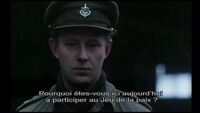
              The Gladiators is a bleak satire set in the near future, in which the major powers of the world, East and West, aligned and non-aligned, recognize the possibility of a major world war within our lifetime and try to forestall it by channelling man’s aggressive instincts in a more controllable manner. They do this by forming an International Commission along the lines of the United Nations, dedicated to fighting a series of contests between teams of selected soldiers from each country. These competitions, which can be fought to the death, are called “Peace Games”, and are broadcast on global television via satellite - complete with sponsors and commercials. The film follows Game 256... The international group of officers watching Game 256 decide to eliminate a man and a woman from opposing teams who reach out to each other, because they decide that such forms of communication would be the gravest threat of all to the stability of the existing world-system.

              Untitled
              The Mahabharata
              ES ES-OVNI CTX-S015-SS007-0011 · Item · 1989
              Part of Non-Identified Video Observatory (OVNI)

              The Mahabharata is one of the world’s greatest books. It is also the longest poem written. It was written in Sanskrit, and is about fifteen times the length of the Bible. “Maha” in Sanskrit means “great” or “complete”, “Bharata” is primarily the name of a legendary character, and then that of a family or clan. So the title can be understood as “The Great history of the Bharatas”. However in an extended meaning “Bharata” can mean “Hindu”, and, even more generally “Man”. So the Mahabharata could be translated as “The Great history of Mankind”. According to most scholars, the events recounted in The Mahabharata probably have a historical source. Others maintain that the correct interpretation of the poem lies entirely in the direction of myth. Yet others point out the importance of the teaching books in the epic - political, social, moral and religious - and see The Mahabharata as a long treatise of government initiation. “As far as we were concerned, this immense poem, which flows with the majesty of a great river, carries an inexhaustible richness which defies all structural, thematic, historic or psychological analysis. Doors are constantly opening which lead to other doors. It is impossible to hold the Mahabharata in the palm of your hand. Layers of subtext, sometimes contradictory, follow upon one another and are interwoven without losing the central theme. The theme is a threat: we live in a time of destruction - everything points in the same direction. Can this destruction be avoided?” Jean-Claude Carrière. In our interview with Carrière, he pointed out what he thinks is the core of the Mahabarata: it is a poem on oblivion. Mankind seems to constantly forget the source of their truly nature. Indian tradition says: “Everything in the Mahabharata is elsewhere. What it is not there is nowhere”.

              Untitled
              ES ES-OVNI CTX-S015-SS002-0003 · Item · 1989
              Part of Non-Identified Video Observatory (OVNI)

              The Mahabharata is one of the world’s greatest books. It is also the longest poem ever written. It was written in Sanskrit, and is about fifteen times the length of the Bible. “Maha” in Sanskrit means “great” or “complete”, “Bharata” is primarily the name of a legendary character, then that of a family or clan. So the title can be understood as “The Great history of the Bharatas”. However in a extended meaning “Bharata” can mean “Hindu”, and, even more generally “Man”. So the Mahabharata could be translated as “The Great history of Mankind”. According to most scholars, the events recounted in The Mahabharata probably have a historical source. Others maintain that the correct interpretation of the poem lies entirely in the direction of myth. Yet others point out the importance of the teaching books in the epic - political, social, moral and religious - and see The Mahabharata as a long treatise of government initiation “As far as we were concerned, this immense poem, which flows with the majesty of a great river, carries an inexhaustible richness which defies all structural, thematic, historic and psychological analysis. Doors are constantly opening which lead to other doors. It is impossible to hold the Mahabharata in the palm of your hand. Layers of subtext, sometimes contradictory, follow upon one another and are interwoven without losing the central theme. The theme is a threat: we live in a time of destruction - everything points in the same direction. Can this destruction be avoided?” Jean-Claude Carrière In our interview with Carrière, he talked about what he sees as the core of the Mahabharata: it is a poem on oblivion. Mankind seems to constantly forget the source of its true nature. Indian tradition says: “Everything in the Mahabharata is elsewhere. What it is not there is nowhere”. Part one, "The Game of Dice", shows us a growing confrontation between two sides battling for power. One side is clearly closer to the idea of dharma than the other, which barely bothers to respect it. To avoid direct hostilities, they decide to play a game of dice; but the game is rigged. Playing with power is a rigged game.

              Untitled
              ES ES-OVNI CTX-S015-SS004-0001 · Item · 1989
              Part of Non-Identified Video Observatory (OVNI)

              After the reflections from the Bhagavad Gita, the war begins: a tragedy that pits brother against brother and sucks up whole families, people of great courage. It is a war of devastating consequences, which does not just threaten the survival of one of the two sides, but the continuity of life on earth. “Even the blades of grass tremble in fear.” A battle in which the clashing sides do not hesitate to use the ultimate weapons. Vishnu himself exclaims: “Now I am become Death, the destroyer of worlds.” This is a war that is also played out inside every human being.

              Untitled