
ovni 2011

Elements area

Taxonomy

Code

Scope note(s)

    Source note(s)

      Display note(s)

        Hierarchical terms

        ovni 2011

          Equivalent terms

          ovni 2011

            Associated terms

            ovni 2011

              106 Archival description results for ovni 2011

              A Film Unfinished
              ES ES-OVNI CTX-S014-SS001-0121 · Item · 2010
              Part of Non-Identified Video Observatory (OVNI)

              This film seeks the truth behind one of the most mysterious Nazi propaganda films ever shot inside the Warsaw Ghetto: a silent film that meticulously placed staged scenes of Jews enjoying a life of luxury in the ghetto alongside other chilling images that required no staging at all. Ironically, after the war, filmmakers and museums used fragments of the film as objective, general illustrations to accompany narratives of survivors and other written documents. Few people were aware of the dubious manner in which these images were created and the true but inconceivable reality that they bear witness to. The cinematic deception was forgotten and the black and white images remained etched in memory as historical truth.A Film Unfinished shakes our naive trust in photographic images and the way we perceive the historical past.

              Untitled

              A Woman's Word
              ES ES-OVNI CTX-S014-SS001-0119 · Item · 2004
              Part of Non-Identified Video Observatory (OVNI)

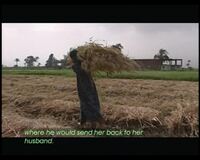
              Janata Bennuna is from Morocco; Hanan Al Shaykh is from Lebanon; and Nawal Al Saadawi is from Egypt. All three are authors of the Arab word, committed intellectuals who shed light on the complex social reality of the Arab world through their books. In their hands, literature becomes a weapon through which to draw attention to and denounce situations that they oppose. The three women, from a generation heavily influenced by Pan-Arabism, initially studied against the wishes of their families, but ended up gaining their support. In A Woman's Word, these three very different writers who nonetheless share a common ground talk about their lives and their work. By learning about them, we also gain an insight into the Arab world, which is much more complex than the Manichean and mostly malicious information on the subject that predominates in our own society today. They too are Arabs, women, who refuse the victim mentality, and demand their rights through their work and their commitment.

              Untitled
              Abu Dhabi Style
              ES ES-OVNI CTX-S014-SS001-0037 · Item · 2008
              Part of Non-Identified Video Observatory (OVNI)

              Abu Dhabi Style shows us some glimpses of the city, and introduces us to the students' lives at the college and during their spare time. But we also learn about traditions and the importance of religion in the lives of these modern young men.

              Untitled
              ES ES-OVNI CTX-S014-SS001-0128 · Item · 1993
              Part of Non-Identified Video Observatory (OVNI)

              How can we learn ecological solutions from an ancient Culture? Ladakh, or Little Tibet, is a wildly beautiful desert land high in the western Himalayas. Although it has few natural resources and an extreme climate, it has been home to a thriving culture for over a thousand years. A tradition of frugality and cooperation coupled with an intimate and location-specific knowledge of the environment enabled the Ladakhis not only to survive, but also to prosper. Until development arrived.

              Untitled
              ES ES-OVNI CTX-S014-SS001-0030 · Item · 2009
              Part of Non-Identified Video Observatory (OVNI)
              1. A handful of pioneers, mostly Europeans disappointed by Western society, set out to build Auroville, a utopian city of dawn. Forty years later, their desert plateau somewhere in Tamil Nadu, India, has become a jungle. Each day, some 2000 Aurovilians try to live by the ideals of Mira Alfassa, known as the Mother. In order to grow, they must push the limits of their environment and their own consciences through thick and thin. It is an enormous task. This documentary looks at the life of Aurovilians and the paradoxes of cities, and explains the reasons that led them to start afresh and reject a system that is on track to dominate all continents in the near future.
              Untitled
              Avatar Palestina
              ES ES-OVNI CTX-S014-SS006-0003 · Item · 2010
              Part of Non-Identified Video Observatory (OVNI)

              Five Palestinian, Israeli and international activists paint themselves blue and don pointy ears and tails that make them look like the characters in the film Avatar. Although their colonisers are from different origins, the Avatars, like the Palestinians, fight imperialism. 'The Avatars' presence in Bil'in today symbolizes united resistance to imperialism of all kinds.

              Untitled
              Bananas!*
              ES ES-OVNI CTX-S014-SS001-0101 · Item · 2009
              Part of Non-Identified Video Observatory (OVNI)

              The world's largest fruit country is on trial in the United States, charged with poisoning its workers. For the first time in history, a small firm of lawyers is representing Nicaraguan banana workers claiming to have become infertile due to the toxic pesticides that the company uses in its banana plantations in this Central American country.

              Untitled
              Being Local
              ES ES-OVNI CTX-S014-SS001-0036 · Item · 2008
              Part of Non-Identified Video Observatory (OVNI)

              A portrait of Ahmed Al Mazourei, a student of Applied Media at Dubai Men's College. The filmmaker focuses on Ahmed's leisure time, which he spends with his friends in shopping malls or sometimes in the desert...

              Untitled
              ES ES-OVNI CTX-S014-SS001-0089 · Item · 2005
              Part of Non-Identified Video Observatory (OVNI)

              Of how a small middle-class housing estate in Creil turned into a ghetto in the space of forty years, time enough for two generations to lose their sense of self in a context of everyday violence... The third part in a series coproduced by public television channel France 2 on the problems in the suburbs, Les Mauvais Garçons is a critique of immigration and urban planning policies of recent decades. The filmmakers spent two years getting to know the residents as part of their research. The result is an intimate portrait of a housing estate, portrayed in all its complexity, focusing on the stories of Ariadna, Eric, I-B, Zac and their mates.