
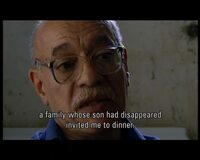
In Argentina, between 1976 and 1983, the military dictatorship was responsible for the 'disappearance' of tens of thousands of people. Victor Basterra was one of the few prisoners who survived the regime's concentration camp, the ESMA. After surviving six months of torture, he agreed to produce false identity documents for his tortures. This included taking passport photos of them. During the subsequent three years of his imprisonment, he managed to hide some of the photos of the oppressors in private parts of his body. This physical concealment also expresses his stance of subjective resistance. Basterra collaborated with his oppressors while resisting them. A single body can condense the ferociously classing forces of political history. Victor Basterra's experience challenges the conventional limits between the public and the private, individual and historic time, inside and outside, loyalty and betrayal.
Untitledovni 2011
2 Archival description results for ovni 2011
2 results directly related
Exclude narrower terms
ES ES-OVNI CTX-S014-SS001-0063
·
Item
·
2009
Part of Non-Identified Video Observatory (OVNI)
ES ES-OVNI CTX-S014-SS001-0030
·
Item
·
2009
Part of Non-Identified Video Observatory (OVNI)
- A handful of pioneers, mostly Europeans disappointed by Western society, set out to build Auroville, a utopian city of dawn. Forty years later, their desert plateau somewhere in Tamil Nadu, India, has become a jungle. Each day, some 2000 Aurovilians try to live by the ideals of Mira Alfassa, known as the Mother. In order to grow, they must push the limits of their environment and their own consciences through thick and thin. It is an enormous task. This documentary looks at the life of Aurovilians and the paradoxes of cities, and explains the reasons that led them to start afresh and reject a system that is on track to dominate all continents in the near future.