"Stranger is the one that is always asked: ”Where are you from, brother?” or is asked ”Is it hot in your country?” He doesn't care about details concerning the people in the country he is or about their domestic politics'. But he's the first one to suffer its consequences. He may not be happy when they are happy but he's always afraid when they are afraid". Mourid Barghouti
Untitledovni 2006
67 Archival description results for ovni 2006
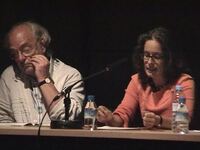
Round table: Colonialisism and images: an anthropological vision. Participants: Josep Lluís Mateo Dieste (anthropologist – Universitat Autònoma de Barcelona) Alberto López Bargados (anthropologist – Universitat de Barcelona) Lluís Mallart i Guimerà (ethnologist – Laboratoire d'ethnologie et de sociologie comparée, Paris X – CNRS) Moderator: Nadja Monnet, anthropologist – Contraplano LAD. A reflection on the role of images in the colonial system and their impact, given that, as we know, images played and continue to play and important role in spreading ideologies, in particular colonial ideology in the 20th century.
UntitledWhen tourists journey to the furthermost reaches of the Sepik River in Papua New Guinea, is it the indigenous tribes people or the white visitors who are the cultural oddity? This film explores the difference (and the surprising similarities) that emerge when "civilized" and "primitive" people meet.
UntitledTraces of the past and neglect gradually merge into spaces that leave new traces, ones that represent time regained and the search for meaning through communal life and the land as a bridge for human relationships. In December 2001, after 50 years of neglect, squatters move in to the ancient Masía of Can Masdeu and restore it as a home and rural-urban or “Rurban” social centre. The daily life of its 24 squatters unfolds in parallel to that of their neighbours, as they share the cultivation of the land and the defence of one of the last non-urbanized valleys on the slopes of Barcelona’s Collserola Park.
Traces of the past and neglect gradually merge into spaces that leave new traces, ones that represent time regained and the search for meaning through communal life and the land as a bridge for human relationships. In December 2001, after 50 years of neglect, squatters move in to the ancient Masía of Can Masdeu and restore it as a home and rural-urban or “Rurban” social centre. The daily life of its 24 squatters unfolds in parallel to that of their neighbours, as they share the cultivation of the land and the defence of one of the last non-urbanized valleys on the slopes of Barcelona's Collserola Park.
Can Baz is a film made from the perspective of a member of Alevi Kirmanc in East Anatolia, whose religious philosophy is expressed in the statement: What you seek, seek not in Mecca, not in Kaaba and not in Jerusalem, seek rather in yourself. The effects of the last massive annihilative attack, which began in 1994, can be refound in the example of Murat and Ahmet Öztürk, two brothers living in exile and addicted to drugs in Istanbul-Beyoglu. The film portrays their life with their band, Siya Siyabend; their friend Hasan Isik, an inhalant-sniffing street kid; and their pursuit of freedom by the wrong means.
UntitledA man planned to get married. From there, everything starts. A series of photos, which retrace his evolution (death, separation, distance and birth) in a fixed frame with a masculine voice in off which tells us the invisible stories behind the photos.
UntitledAn old building in Barcelona's historic Barrio Chino is the setting for this documentary. Real estate “mobbing” and the urban rehabilitation of the old city are the narrative thread, the economic machines that drive real estate speculation. They take over the neighbourhood, burying its history and memory.
UntitledBrazza deals with the history of the exploration of what would eventually become French Equatorial Africa. Robert Darène is perfect in the role of a lay missionary, a barefoot idealist, French by choice rather than birth, who is determined to spread the Republican gospel of civilisation, abolish slavery, and confront the world of ruffians (the already-rich Anglo Saxons). The story is told by another idealist, Léon Poirier, proud of his sobriquet "The African." A story with so much candour that it may make viewers smile sceptically, or even become outright angry. It is therefore essential to pay attention to the powerful, scathing analysis by Eric Deroo, an expert on colonial history. And the witty and sometimes indignant analysis of the film by two Batékés, who nonetheless admit to feeling a measure of respect for Brazza.
UntitledIn July 2005, the comic Leo Bassi took his Bassibus services to the city of Barcelona. In this political-tourism trip we came up close to the very heart of speculation and real estate violence, and met some of its main protagonists. Step right in and see... This tour has been possible thanks to the participation of people and groups who have been fighting for years to defend the territory and the dignity and rights of the people who live in it.