A compilation of Columbian film heritage material relating to indigenous communities. Patrimonio Fílmico Colombiano.Colección Acevedo (1932 -1948) , Marco Tulio Lizarazo (Guerrillero Guadalupe Salcedo, 1953).
Untitledovni 2006
67 Archival description results for ovni 2006
“I will show two videos: “Trobriand Cricket”, and “Les Maîtres Fous” to talk about what I will call “mimetic excess”. By this I mean a joy or "jouisance" in mimesis itself (Nietzsche talks about this in his description of Dionysus). An “excess” produced at the moment of de-Colonisation in the 1950s-1960s, with the encounter between the Indigenous and the European worlds; the first with its mimetic body, and the European world with its mimetic-machine (the camera). A question for us: Now, in 2006, what do we do with this "excess?"
Jamaica – a tropical, beautiful land, rich in milk and... banana's, But, at best, a prime example of the impact of economic globalization on a developing country. This startling and award-winning feature-length documentary provides a shocking insight into a Jamaica that we don't normally see as a tourist, and guides us through the film as though we were a visitor to the country. It portrays a troubled nation, robbed of its natural resources and dependent like a small child on the West.
UntitledMap compilation: The Palestine-Israel area. The Ottoman Empire. Ottoman provinces in the Middle East. Jewish and Arabic towns in Palestine under the Ottoman Empire. The Middle East divided up between France and Great Britain. The Palestine – Transjordan division. The UN partition of Palestine between Arabs and Jews. A Map of the main aquifers in the area. Jewish and Arab towns in Palestine before the partition decreed by the UN. The creation of the State of Israel. Maps of the area after successive wars and crises. The Israeli control matrix of the territory. Map of Greater Jerusalem reclaimed by the state of Israel. Those under Palestine autonomy acknowledged by Israel. Annexations by the wall.
At the beginning of the eighties a new road reached the most remote villages of Soraland, in the Ganjam District of Orissa. From then on, the Lanjia Sora, a tribe with their own special conception of illness, life and death, got in touch with the people from the plains and fell under the influence of the missionary activities of several Christian groups. This culture clash meant a structural change among the Lanjia Sora tribal society. Around 90% of the young people have currently converted to Christianity (Catholic, Baptist and Pentecostal) and they have completely abandoned the old rites and traditions.
UntitledAn extract from a dialog between Noam Chomsky and Michel Foucault in 1971. The topic: Human Nature: Justice versus Power. Foucault claims that “Power is not an institution, it's not a structure or a force available to some: it is the name given to a strategically complex situation in a given society”. If the centrality of a power that we can submit to or resist no longer exists, than it is impossible to seize power (if in the center there is nothing to seize). If power is reticulated, resistance must take place everywhere and in every way; if power is exercised at countless points, it must be challenged point by point.
UntitledTreichville is a poor suburb of Abidjah, the capital of Ivory Coast and the destination of the two protagonists in this docudrama by Jean Rouch. The two men in question are originally from Nigeria, and they call themselves Eddie Constantine and Edward G. Robinson, clear indications of who their heroes are. The perpetual conflict between traditional ways of life and new Western imports comes up several times as the two men continue on their daily rounds and reveal a little about their hopes for the future.
UntitledUnfolding without narration, Mother Dao, the Turtlelike is a spare and elegant film constructed entirely from archival footage... Luminous nitrate images are set against a simple soundtrack of birdcalls, bells and murmuring voices, punctuated occasionally by native poems and songs. The film's careful construction reveals the face of systematic colonization and the effect of economic expansion on a culture. There are stunning moments: a child leaves off breast-feeding to drag on a cigarette; crocodiles are lassoed in a round-up; a strange white snow floats in the air as workers beat their way through enormous mountains of fluff. Much of the footage, shot by white Dutchmen and meant as propaganda for their colonial causes, now seems both comical and ominous - especially the recurring image of the white-clad colonialist intent on improving native culture and forcing industry forward. The natives' songs and poems, on the other hand, are full of regretful laments against hunger and the drive for profit. A quiet yet pointed journey through the past, Mother Dao is both an informative time capsule and a moving tribute to a lost world. (Rachel Rosen, San Francisco Film Festival)
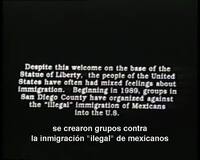
UntitledThe U.S.-Mexican Border is the site of a disturbing increase in violence and racial intolerance. Along the border there are now a number of autochthonous groups that have organized with the stated purpose of ending undocumented immigration. “Natives” follows the individuals involved in San Diego's anti-immigration movement. Relying principally on a direct cinema style and an eye for the absurd, the film critiques the autochthonous position by contrasting their professed love of country with their racist and anti-democratic attitudes. Though the US has long maintained a reputation as a haven for immigrants, there is nonetheless a strong tradition of xenophobia. In the decade of the 1990s, there was a new surge of anti-immigrant sentiment. This film examines the autochthonous discourse along the US-Mexico border, a place that brings issues of nationalism and intolerance into sharp focus.
UntitledJourneys and dreams in the mountains of Mexico's south east, the jungle and the city... Rituals, emotions and words for everyone!