In November 1969 a small group of Native American students and urban Indians began the occupation of Alcatraz Island in the San Francisco Bay. Eventually joined by thousands of Native Americans, they reclaimed 'Indian land' for the first time since the 1880s, forever changing the way Native Americans viewed themselves, their culture and their sovereign rights. For Native Americans all across the United States, the infamous Alcatraz is not an island... It is an inspiration.
UntitledNativos Americanos
12 Archival description results for Nativos Americanos
An epic journey across the U.S.A. in search of what is causing our unfolding global crisis. Pollution, droughts and diminishing resources now threaten the very engine driving these catastrophes: civilization itself. Massive dislocations are manifesting in or lifetime, and our world will never be the same. This is not a story of despair but rather a rallying effort to find our way back towards harmony with nature. Fall and Winter uncovers ingenious new strategies for the future while drawing on past wisdom; it is a survival guide for the 21st century.
UntitledOn December 18, 2005, Evo Morales was elected President of Bolivia. For the first time in history, an Indian reached a position of power in the country. The planters in the Chapare region have consolidated a sound organisation in support of planting coca leaf, a sacred plant of great cultural and economic relevance. Today, the coca planters participate actively in the national political arena, where the values of traditional native culture and contemporary social movements converge.
UntitledLance Henson, a Cheyenne poet who lives in Italy, returns to the US every year for poetry readings and to renew links with his tribe. This year he travels by car through native territories, where Peyote medicine heals and helps people to conduce their lives. He travels from the Cheyenne reservation at Concho, Oklahoma to the Conchos river in the Tarahumara Hills in Mexico. Lance writes a journey diary during the trip which includes Peyote Songs and poems.
Directed by Billy Luther, whose own mother was crowned Miss Navajo 1966, the film reveals the inner beauty of the young women who compete in this “celebration of womanhood.” Contestants must not only show the same poise and grace as in other pageants, they must also answer tough questions in Navajo and demonstrate proficiency in skills essential to daily tribal life: fry-bread making, rug weaving, and sheep butchering. For the past 50 years, Miss Navajo Nation has celebrated women and their traditional values, language and inner beauty. The film follows the path of 21-year-old Crystal Frazier, a not so fluent Navajo speaker and self-professed introvert, as she undertakes the challenges of the pageant. It is through Crystal's quiet perseverance that we glimpse the strength and power of Navajo womanhood. The film reveals the importance of cultural preservation, the role of women in continuing dying traditions, and the surprising role that a beauty pageant can play.
UntitledMonument Valley uses archival images from various sources, images related to the famous south-western USA landscape and tourist attraction, tourists and fragments from classic Western films. This video blurs the boundaries between past and present.
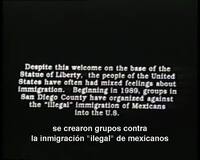
The U.S.-Mexican Border is the site of a disturbing increase in violence and racial intolerance. Along the border there are now a number of autochthonous groups that have organized with the stated purpose of ending undocumented immigration. “Natives” follows the individuals involved in San Diego's anti-immigration movement. Relying principally on a direct cinema style and an eye for the absurd, the film critiques the autochthonous position by contrasting their professed love of country with their racist and anti-democratic attitudes. Though the US has long maintained a reputation as a haven for immigrants, there is nonetheless a strong tradition of xenophobia. In the decade of the 1990s, there was a new surge of anti-immigrant sentiment. This film examines the autochthonous discourse along the US-Mexico border, a place that brings issues of nationalism and intolerance into sharp focus.
UntitledECOSYSTEMIC MEMORIES OF THE CITY
NON-SUBMISSIVE LANDSCAPES
ECOSYSTEMIC MEMORIES OF THE CITY
Collaboration with Bornlab (El Borne CCM) for a collective approach to the contemporary imaginary of natural resources and territory, based on the sharing of current geopolitical issues that have an echo in the city of Barcelona.
This edition of the community studies group "Ecosystemic memories of the city" proposes a series of sessions in which we collectively approach the contemporary imaginary of natural resources and territory, based on the sharing of some current geopolitical issues that have an echo in the city of Barcelona.
Natural resources and the territory, based on the sharing of some current geopolitical issues that have an echo in the city of Barcelona. Through the contributions of various entities and people who connect us with critical archives, social actions and cultural initiatives in the city, we will address the recovery of community forms of agricultural social organization in contemporary pedagogies, images and slogans of movements for the protection of the land, as well as the reflection, from various worldviews, on cultural heritage and in connection with environmental issues that affect different international contexts.
The programme is organised in a participatory methodology that includes working groups where knowledge is pooled and perspectives are shared between guests and participants. In the different meetings, cultural proposals are discussed to explore the relationship between memory, community and ecology through collaborative experimentation and public action, which are included in the fanzine that is distributed in the closing session.
The Community Studies Group is a proposal of Bornlab, the community mediation programme of Borne CCM with the support of community mediation programme of Borne CCM in collaboration with Coalició Prou Complicitat amb Israel, La Colectiva de Chilenas de Barcelona, Comunitat Palestina de Barcelona, Laboratorio Móvil, OVNI (observatori de Vídeo No identificat) , Ruangrupa i docents i investigadores de l’Institut Català d’Antropologia, el Col·legi de Psicòlegs de Barcelona, l’Escola Massana and la Universitat de Barcelona.
Further information and registration: elbornculturaimemoria
NON-SUBMISSIVE LANDSCAPES
Thursday 8.2.24 from 6 p.m. to 7.30 p.m.
Through the audiovisual archive, we will reflect on movements led by communities in Chiapas, Palestine and Ecuador who are
Chiapas, Palestine and Ecuador who are organising themselves against the deterioration of their ecosystems and claiming the right to use and protect their land.
1_ Land and traditions

Rod Coronado is a Yaqui Native American who explains how the massacre of his people went hand in hand with the massacre of animals. The two are deeply interrelated, with the same aggressor: a system, a predatory culture. This realization led him to take an active part in ALF actions to protect animals from cruelty, slavery and extermination: “There was no time for those animals suffering in labs and fur farms and factory farms to wait to exhaust more legal means. I could see already that people for many, many years had chosen that path and although it is effective at times, it was not bringing about results quick enough for those animals now suffering. So I became involved in direct action with the Animal Liberation Front.
UntitledOn a dusty road, somebody talks about the ideal of freedom, the horizon of the American dream. Images of the desert and metallic ruins.