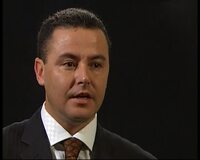
“The only crime that the inmates of Migrant Detention Centres (CIE) have committed is to cross some border or other, to be poor, and to be black, that's all. Remember that these people are the grandchildren of the slaves who were hunted down like animals and loaded onto ships...” Lamine Sarr. “Nobody sees the reality of Migrant Detention Centres, it's a hidden reality.” Aziz Faye.
Migration
30 Archival description results for Migration
Thousands of people visit London every summer. They fill the streets with shopping bags and cameras and enjoy all the possibilities of the capital. But amongst the crowd another type of visitor exists. Kwaku is a Ghanaian living in London. There, he finds himself dealing with loneliness and boredom. He is living on standby, dreaming of a full time job and also of a friend to count on.
UntitledDeparting from the title, the video establishes a divergent parallelism in between the wife of the Senegalese migrants’ and the Odysseus’ Penelope. The protagonist do not just take Penelope’s roll, but subvert it. Parallelism due the similarity in the long periods waiting for their husbands’ return home. Divergence because, here these women take the enunciation power, to tell us how they deal with their reality and they how negotiate with the social pressure surrounding them, that like in the Odysseus, would love relegating them into a second term.
- “It’s hard to come to terms with the fact that the supposedly civilised society that you fled to, seeking refuge, is so brutal.” -“People say: “get civilised”. But when you get civilised you realise that it’s the worst thing they could have taught you. Do you know what they mean by “getting civilised”? Have money, go shopping, spend money, and always keep in your head: I want more, more, more... Consume.” - the persistence of Eurocentrism in European dissidence. (*) Title of Pier Paolo Pasolini’s last interview.
Life in an Immigration Detention Centre is not life at all, it is waiting. Waiting and fear. Fear of deportation, fear of losing your direction while your life is limited to the four walls of the cell, fear of a future that could surely not be worse. The testimonies of former inmates of the Immigrant Detention Centre (CIE) at Zona Franca, Barcelona, offer us a glimpse of the reality of these illegal, covert prisons.
UntitledSin Papeles tells the story of the of a hunger strike staged by migrant workers, without papers (sin papeles), in a small church in Barcelona by bringing together a sound recording of its climax made in March 2001 and film footage of the location shot four years later to the day. The subjective account of the event made by the artist in the form of a sub-titled narration is a process of personal reflection de-objectifying the subject of migration for the purpose of work, displacement and social order. The film is a reflection on the implications and realities of the aspects of the EU project that have created a fortress of Europe.
The cycle From the Imagined to the Tangible, proposes to present abstract ideas that help us to reflect on the reality where we live, immediate, concrete and material. Toni Serra, co-director of the OVNI Archives presents different pieces of the more than 2000 that this audiovisual archive has gathered over 21 years, offering us an uncomfortable vision of the century where we live, but also the dreams and desires of societies that do not see each other reflected in the imaginary of corporate media. Museum of World Cultures, Barcelona. 4th October 2016.
A glimpse into the life of Barcelona's Pakistanis. They talk to us about their work, the journey that brought them to Barcelona and their families, among other things. We visit some of the places where they tend to congregate: the Rambla del Raval, telephone centers, Barceloneta beach and the three Chimneys.
UntitledOn Translation: Fear/Miedo is a televised intervention based on a video production that weaves together interviews with people who experience the tensions of the border zone on a daily basis, archival televised footage that makes reference to the idea of fear on the border between Mexico and the United States, and other documentary and journalistic material. The video aims to reveal how fear is a translated emotion, revealing itself in differing ways on both sides of the border as a cultural/sociological construction based on politics and economics. On Translation: Fear/Miedo was broadcast between August and November 2005 in four distinct locations that connect the centres of power/decision-making with the places where these policies are evident everyday: Tijuana, San Diego, Mexico City and Washington, DC.
UntitledIn a bid to reach a better life, hundreds of Moroccan kids sneak into Melilla, a Spanish enclave in the north of Morocco. This is the story of Said, a deaf Moroccan boy stuck in this Spanish portion of Africa, awed by a false sense of prosperity, tries to jump into one of the many boats that will take him to the peninsula and eventually to the fulfillment of his European dream.
Untitled