
Out of the mouths of rural boys, finding the incomparable Mulla Nasrudin in Afghanistan. After my first year of art school in San Francisco in 1978, I quit, and headed to the Banff School of Fine Arts to do a year long residency program. The instructor Hu Hohn got me hooked on Sufi stories such as, "The Exploits and Subtleties of the incomparable Mulla Nasrudin". Mulla Nasrudin is a Sufi wise-fool, trickster like figure. These books were chock full of funny little contemplative mediation stories. I would read these riding the bus at night and such, to get me through trying days. Later in 2008, I'm in the central highlands of Afghanistan, in Bamiyan, where the colossal Buddha statutes were destroyed by the Taliban. A stark, arid, severe, beautiful landscape, people scrapping by, subsistence farming, much like my grandparents did in Syria. I'm filming scruffy little country boys in a new school built by Western troops. The boys are speaking Hazaragi (a Farsi dialect), via my translator but never having the time to translate responses. At the end of each session, we ask them to tell a joke or a song, something other than the conversation we’ve tried to record. Six months later when I’m back home and the rough transcript translations have been sent to me from Quetta, I discover, lo and behold, then and there were the very same Sufi stories – thirty years later – being told by these scruffy little country boys at Laisa-e-Aali Zukoor boys school, Bamiyan, Hazarajat, Afghanistan. These few days I’ve been working with my Afghan collaborator, Khadim Ali, he’s based in Sydney currently. We’re trying to work through the time zones, which goes hand in hand with the other displacements of the overarching pandemic time and space. Many thanks to the impeccable Khadim Ali, and to the translator and eternal wunderkind Muzafar Sanji; to Mohammad Zia, our stalwart driver and safe-keeper who deftly transported us over unspeakable rutted goat trails aka roads; and to all who shared with us a mat to rest or sleep on, stories, food, curious minds, and warm hearts.
Memoria
6 Archival description results for Memoria
6 results directly related
Exclude narrower terms
ES ES-OVNI RSC-4315
·
Item
·
2008
Part of Non-Identified Video Observatory (OVNI)
ES OVNI RSC-1350
·
Item
·
2001
Part of Non-Identified Video Observatory (OVNI)
An intimate dialogue with Soha Bechara, ex-Lebanese National Resistance fighter, in her Paris dorm room. The interview was taped during the last year of the Israeli occupation, one year after her release from captivity in El-Khiam torture and interrogation center (South Lebanon) where she had been detained for 10 years—six in isolation. Revising notions of resistance, survival, and will, the overexposed image of the survivor speaks quietly and directly to the camera—not speaking of the torture, but of separation amd loss; of what is left behind and what remains.
Untitled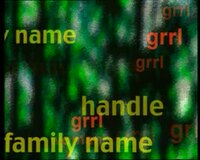
ES ES-OVNI CTX-S007-SS002-0007
·
Item
·
1998
Part of Non-Identified Video Observatory (OVNI)
A personal digression on telephone books, in which the author reflects, among others things on how women lose their surnames in many countries in the world, through descent and marriage, asking what becomes of these names. 6th Independent Vídeo & Interactive Phenomena Show
Untitled
ES ES-OVNI CTX-S009-SS004-0019
·
Item
·
2003
Part of Non-Identified Video Observatory (OVNI)
"It may indeed be questioned whether we have any memories at all from our childhood: memories relating to our childhood may be all that we possess. Our childhood memories show us our earliest years not as they were, but as they appeared at the later periods when the memories were aroused. In these periods of arousal, the childhood memories did not, as people are accustomed to say, emerge; they were formed at that time. And a number of motives, with no concern for historical accuracy, had a part in forming them, as well as in the selection of the memories themselves." Freud . This ten-part video strains childhood through a history of reproduction, culling pictures from the Lumiéres to the present day in order to find the future in our past. Here are children of pictures, as pictures, the ones who will walk on our graves, granted a legacy of framing and image making that have helped shape their lives, and their ability to grieve those no longer around to share them.a video in ten parts: In the Future (3 min), Jack (15 min), Last Thoughts (7 min), Portrait (4 min), Secret (2 min), In My Car (5 min), The Game (5.5 min), Scaling (5 min), Imitation of Life (21 min), Rain (3.5 min).

ES ES-OVNI CTX-S007-SS005-0011
·
Item
·
1997
Part of Non-Identified Video Observatory (OVNI)
"Being photographed is the only way to cheat death? I remember the camera we use when we fucked for the first time. You said this way our love will never end. But now I never see you, only on TV. " OVNI 2000 Community 6th Independent Vídeo & Interactive Phenomena Show
ES ES-OVNI RSC-542
·
Item
·
1998
Part of Non-Identified Video Observatory (OVNI)
"Dear Sis, I am sitting on the subway and all of a sudden I have this urge to write to you . . ." Here begins an apology letter written from one sister to another. Starting with the issue of sibling rivalry, the video is an examination of the connection and distinction between one person to the next -- taking us further to the greater subject of the humanity. The letter is an actual one I have written to my sister which was never sent. Images is filmed on subway train in New York City.
Untitled