Shadows are not always under the earth…
UntitledMemoria
67 Archival description results for Memoria
A captivating message for dark times
Music is there to be made 1
Void and music in the West
The Black Antisol - //Silence in the awakening of the worlds//
Invitation to the film-trance: Research project & Live Cinema with Vincent Moon
To interrupt the noise of the world, to be receptive, to listen, to open to the co-animation of the world.
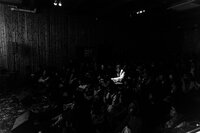
An exploration, a week of sound encounters, with a live cinema or film trance session at the CC Convent Agustí.
Faced with the monotonous and maddening barbarism of the media and the networks that make us see without seeing, that simplify reality by reducing it to spectacular events and violence, Vincent Moon invites us to stop the machines and go out to meet each other.
To interrupt the noise of the world, not to escape from the horror of the ongoing war or from the clear perception of a civilisation advancing towards the abyss.
Vincent Moon , independent filmmaker and sound explorer, who has been travelling the world for twenty years, will spend a week travelling with us between Barcelona and the mountains of the Pyrenees, encountering known and unknown music, and an invisible art of living and resisting.
The way we show the world helps to change the way we see it, changing the way we look helps to change a world flooded with images.
Vincent Moon says: "I long to rediscover, to rework a link with ancestral tonalities and rhythms, forms of trance...". From the Dhikr (remembrance) of Sufi tariqas in Chechnya, Ethiopia or Turkey; to months in the interior of Brazil or Peru, or incursions in Jakarta, Argentina or Morocco: "A kind of experimental ethnography, trying to hybridise all these genres of trance and music in different parts of the world (...) I think we are recording to gain a certain complexity (...) To reinvent life today we have to elaborate new forms of imagery. And it's very simple. You have to go out into the encounter (...) You break down the barriers to the encounter with the body more than with knowledge. This is what travelling taught me, to trust the memory of the body more than the memory of the brain. Respect is a step forward.
A poetic approach to the everyday. Exploring rhythm and tonality in the sound and visual resonance between beings and elements and things.
"Encounter is the fundamental thing. Meeting people, like the Troubadours (...) Film is an excuse to create a very special moment in the present, in the reality of now".
The Australian Aborigines used to say that "everything slumbers beneath the surface of the earth waiting to be called". - On the acoustic and visionary journey with Vincent Moon we go out to meet voices that continue to sing among the ruins, calling into existence another life, another reality, another truth.
"When I arrive at a place, I ask myself what is important to film today?" - Vincent Moon's visit is twofold: on the one hand to explore some experiences that are "important to film today"; on the other hand, a moment of encounter and projection in Barcelona, with his Live Cinema or Film-Trance - sound and visual exploration.
Vincent Moon's work connects with one of the investigations opened at the Unidentified Video Observatory : Silence in the awakening of worlds . At first, this research started from taking the visionary experience seriously and investigating the ways in which it unfolds, through the cracks of this world, from Surrealism to the current decline of naturalist secularism. In a second moment, which we have called first, during the immersion in the materials: The Mirror of the Night ("Mirrors: no one has yet described, knowing it,/ What you are in your being,/ You, like interstices of time,/ Filled only with holes of sieve. / You, still wasters of the empty room,/ At the hour of twilight, vast as forests..."); and now, at the moment of exposure and encounter: The black anti sun , which starts from taking seriously Rilke's intuition in the Sonnets to Orpheus: "Gesang ist Dasein" (To sing is to exist) .
«"But the great black anti-sols, wells of truth in the essential weft, in the grey veil of the curved sky, come and go and suck each other in, and people call them ABSENCES" (René Daumal). These splendours, the aim of the human being is to collect them (...). And it is precisely by fighting against the inertia of the body and the sleep of the soul, by practising techniques of awakening - physical awakening, spiritual awakening - a kind of "long, immense and thoughtful alteration of all the senses", that allows us to overcome the material and spiritual order of this world, in short, by leading a counter-life» (Jacques Lacarrière, Les gnostiques ).

A personal digression on telephone books, in which the author reflects, among others things on how women lose their surnames in many countries in the world, through descent and marriage, asking what becomes of these names. 6th Independent Vídeo & Interactive Phenomena Show
UntitledThe Purple Meridians III
The Purple Meridians III
Over the past two years, a total of 19 filmmakers based in the three countries have met, online and in person, to discuss obstacles they face as women and non-binary people in the audiovisual industry, to exchange ideas and resources, and to create together.
Preparations are underway in Italy , Turkey , Catalonia and the Basque Country for the third edition of The Purple Meridians 2023 , with the Gender Equality sponsorship by Eurimages .
This year, the project will have its public and main event at the Durango Book-Music-Cinema Fair on 7 December . Durango is a city in the Basque Country and has been chosen by the organizers of The Purple Meridians to expand even further – as is the purpose of this project – the connections among women filmmakers in Europe and beyond.
The choice of the Basque Country was therefore a ‘natural’ development as Basque filmmakers followed the first two Purple Meridians albeit ‘from a distance’. The program in the Basque Country will be possible thanks to the collaboration with the Durango Book Fair and Suargi Elkartea.
Two main themes would be the focus of this third event:
the difficulties, responses, proposals for women in the audiovisual industry to conjugate work and care work (maternity, care of children, care of elderly, care of ill partner/family member etc) and for women with disabilities.
These two themes will be discussed in a 2-session conference in Durango to be held on 7 December 2023.
Two filmmakers directly and most affected by this situation will be leading the discussion, Lisa Çalan and Ahu Ozturk . The two filmmakers, both Kurdish, will work with Basque filmmakers (who are exploring these issues in their films and who this year will be presenting a manifesto about ‘care’), as well as with the other filmmakers of The Purple Meridians (from Italy and Catalonia), not only in exposing the problems, but also in proposing answers, keeping in mind that one of the pillars of The Purple Meridians project is creating networks among women filmmakers in different countries.
The speakers will be:
Lisa Çalan, Ahu Öztürk (from Turkey, TPM), internationally acclaimed Basque actress Itziar Ituño (La Casa de Papel), Basque directors Ainhoa Olaso (winner of the Aukera program) and Estibaliz Urresola (awarded in Berlin 2023), Catalan director Lara Vilanova (TPM), Italian director Claudia Tosi (TPM), Argentine scriptwriter based in Belfast Luciana de Mello , Lebanese director Mary Jirmanus Saba , Kurdish director Sevinaz Evdike (Women Filmmakers Collective Kezi), and director Elli (Post Collective - Buriatia, Greece, Syria, Belgium).
The day will be accompanied by the screening at Irudienea (12:30h-13:30h) of Estibaliz Urresola's short film, Cuerdas , and a Work in Progress by Mary Jirmanus Saba.
At 19:00 h, the filmmakers will present to the press a summary of the conference's work.
The press conference will feature also an intervention by a Palestinian filmmaker.
The Visitor is an almost mythical account of the artist's audience with Oba Erediauwa, the current king of Benin (in southern Nigeria) and takes the form of a photo-essay. A local narrator follows the artist into the Oba's palace and recounts the conversation between the European visitor and the royal host and his court of chiefs. The exchange centers on the Benin Bronzes (which were famously looted by the British in 1897 and are now in over 500 museums and collections mainly in the West), on collective memory and the demand for restitution.
UntitledKhue, a Buddhist monk, the clown Phong and the young prostitute Thuy reflect on their personal experiences during three different decades of Vietnamese history. French colonialism, the Vietnam war and the current effects of globalization create an image of a Hanoi teetering between the influences of modern, Western ideas and traditional Asian values. The protagonists' fragmented memories draw a picture of Vietnamese day to day life but also deal with the social changes of the past 70 years.
UntitledThe voice of the tour guide takes the viewer through wobbly Super 8 pictures which Irshaid's Palestinian father took on a family trip to Palestine / Israel in the 1970s. An ironic portrait offering an alternative to the images in the mass media.
Bravo is the surname of the old lady portrayed in this video, the mother-grandmother of the author. Bravo also means brave, as though in reference to the encounter with the nude figure of the mother, revealed in desecrated images. 6th Independent Vídeo & Interactive Phenomena Show
UntitledAn intimate dialogue with Soha Bechara, ex-Lebanese National Resistance fighter, in her Paris dorm room. The interview was taped during the last year of the Israeli occupation, one year after her release from captivity in El-Khiam torture and interrogation center (South Lebanon) where she had been detained for 10 years—six in isolation. Revising notions of resistance, survival, and will, the overexposed image of the survivor speaks quietly and directly to the camera—not speaking of the torture, but of separation amd loss; of what is left behind and what remains.
UntitledOut of the mouths of rural boys, finding the incomparable Mulla Nasrudin in Afghanistan. After my first year of art school in San Francisco in 1978, I quit, and headed to the Banff School of Fine Arts to do a year long residency program. The instructor Hu Hohn got me hooked on Sufi stories such as, "The Exploits and Subtleties of the incomparable Mulla Nasrudin". Mulla Nasrudin is a Sufi wise-fool, trickster like figure. These books were chock full of funny little contemplative mediation stories. I would read these riding the bus at night and such, to get me through trying days. Later in 2008, I'm in the central highlands of Afghanistan, in Bamiyan, where the colossal Buddha statutes were destroyed by the Taliban. A stark, arid, severe, beautiful landscape, people scrapping by, subsistence farming, much like my grandparents did in Syria. I'm filming scruffy little country boys in a new school built by Western troops. The boys are speaking Hazaragi (a Farsi dialect), via my translator but never having the time to translate responses. At the end of each session, we ask them to tell a joke or a song, something other than the conversation we’ve tried to record. Six months later when I’m back home and the rough transcript translations have been sent to me from Quetta, I discover, lo and behold, then and there were the very same Sufi stories – thirty years later – being told by these scruffy little country boys at Laisa-e-Aali Zukoor boys school, Bamiyan, Hazarajat, Afghanistan. These few days I’ve been working with my Afghan collaborator, Khadim Ali, he’s based in Sydney currently. We’re trying to work through the time zones, which goes hand in hand with the other displacements of the overarching pandemic time and space. Many thanks to the impeccable Khadim Ali, and to the translator and eternal wunderkind Muzafar Sanji; to Mohammad Zia, our stalwart driver and safe-keeper who deftly transported us over unspeakable rutted goat trails aka roads; and to all who shared with us a mat to rest or sleep on, stories, food, curious minds, and warm hearts.