

Israel

Elements area

Taxonomy

Code

Scope note(s)

    Source note(s)

      Display note(s)

        Hierarchical terms

        Israel

          Equivalent terms

          Israel

            Associated terms

            Israel

              24 Archival description results for Israel

              24 results directly related Exclude narrower terms
              ES ES-OVNI CTX-S013-SS006-0009 · Item · 2008
              Part of Non-Identified Video Observatory (OVNI)

              At the beginning of the 1920s, the Austrian Leopold Weiss takes a journey to the Middle East. The desert fascinated him and Islam became his new spiritual home. He left his Jewish roots behind, converted to Islam and started calling himself Muhammad Asad. Becoming one of the most important Muslims of the 20th century he first started to work as an advisor at the king's court of Saudi-Arabia, later translated the Koran, became a co-founder of Pakistan and finally ambassador of the UN. The director finds a man who was not looking for adventures but rather wanted to act as a mediator between Orient and Occident. A Road To Mecca takes the chance to deal with a burning debate which is starting to gain more and more importance nowadays.

              Untitled
              ES ES-OVNI CTX-S012-SS005-0004 · Item · 2005
              Part of Non-Identified Video Observatory (OVNI)

              “Avenge But One of My Two Eyes” is a ramble between three arenas at the height of the “El Aqsa” Intifada: the practice of the Masada cult, reinvented in the mid-1940s and interwoven with the leading Zionist discourse, the condition of oppression and besiegement of the Palestinian people in the occupied territories, and the continuous religious and secular cult of Samson, aka “Samson the Hero”. Real places, times and situations penetrate one another and integrate, presenting the Israeli reality as it is: embroiled, violent, suicidal.

              Untitled
              ES ES-OVNI CTX-S013-SS006-0003 · Item · 2009
              Part of Non-Identified Video Observatory (OVNI)

              On January 15, 2008, Israeli tanks destroyed the Peace Park, the only public park in the Gaza Strip. It had been a donation from the city of Barcelona to the residents of the Gaza Strip. The documentary gathers the testimonies of the neighbours hours after the attack. If they need to recover their public spaces, do we have to simply pay what Israel breaks?

              ES ES-OVNI CTX-S010-SS007-0010 · Item · 2003
              Part of Non-Identified Video Observatory (OVNI)

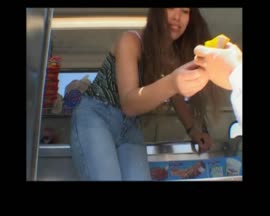
              See America from the point of view of the Israeli ice cream truck vendor. This film is a documentary that portrays the neighborhoods of America through the point of view of the Israeli ice cream truck vendor. The film follows several such vendors in the city of Charlotte, North Carolina . The film follows the characters in their daily routine in cross cutting (in a parallel narrative). Throughout the film we learn about the different neighborhoods of Charlotte, and America - some segregated, some mixed. We learn about the vast differences in behavior, mentality, culture and way of life ? but when the ice cream truck comes to the neighborhood, everyone acts the same and wants the same thing: ice cream

              Untitled
              ES ES-OVNI CTX-S010-SS003-0010 · Item · 2003
              Part of Non-Identified Video Observatory (OVNI)

              On December 26, 2003, the Israeli Defense Force (IDF) deliberately shot at Gil Namati, a 21 year old Israeli protestor that demonstrated against the separation fence/wall. Gil was shot in both legs by two live bullets. The incident created a media storm and raised many question . What would have happened if the IDF didn't lie about the shooting of Gil Namati/ Would it have justified the actions taken by the security forces? Is there a difference between shooting a Jew and a non-Jew? This film is divided into three parts, the first part presents the investigation which was shown at the press conference and proved the IDF was lying about the reasons for the shooting, the second part criticizes the investigation itself and how the media reacted and portrayed the incident and the separation barrier, and the third part is a propaganda piece about the "danger" anarchism poses in Israel.

              Untitled
              Galoot
              ES ES-OVNI CTX-S010-SS004-0012 · Item · 2003
              Part of Non-Identified Video Observatory (OVNI)

              Galoot (Exile in Hebrew) is an intimate saga that touches on the seeds of the pains and tragedies now transformed into the entrenched Palestinian/Israeli conflict. A temporary exile from his homeland allows an Israeli filmmaker to see the conflict with new and provocative eyes. Through his Palestinian and Israeli friends and through his and his wife's personal journeys, Galoot provides a reflective voyage through homes and deserted homelands in Israel, Palestine, Poland, Morocco and England.

              Untitled
              Happy birthday Mr. Mograbi
              ES ES-OVNI CTX-S010-SS003-0011 · Item · 1999
              Part of Non-Identified Video Observatory (OVNI)

              The birthday of this video's fictional filmmaker, Avi Mograbi (also the name of the real director), is the same day as the 50th jubilee anniversary of the founding of Israel, a day observed by Palestinians as "Al Nakba" or the Catastrophe. Mograbi is hired first by Israeli television to film the events leading up to the jubilee and then by a Palestinian producer who wants him to film the ruins of Palestinian villages and towns in Israel. To make matters worse, he is enmeshed in a real estate deal with his neighbours and enraged buyers arguing over property boundaries. The collision of these three anniversaries, two film jobs and a dispute over property lines takes this fictional "documentary" into the depths of Israeli and Palestinian daily life and a shared 50-year history.

              Untitled
              ES ES-OVNI CTX-S009-SS002-0016 · Item · 2001
              Part of Non-Identified Video Observatory (OVNI)

              Hay mish Eishi, features portraits of 8 Palestinian women from different social and religious backgrounds exploring how they live war and imagine peace in the profound depth of lived realities and felt pains. These are not unusual women, women leaders or exceptional women in the news media sense. They are media and theatre professionals, farming women, a cleaning woman, a boutique owner, a university student, a high school teenage girl, and housewives. These are the ordinary lives which make up the news and which the news makes invisible. They speak with passion, bewilderment, anger, rage and outrage?.they situate themselves in a life of dignity and productivity, where their lives and actions are not reduced to a bundle of fear.They speak of profound losses - of self and direction, livelihood, land, homes and family members. What they say so powerfully and directly through their hopes and wishes is that they want a life of meaning, of sharing, of giving, of routines and rituals, of loving and caring, of ordinariness with all its blessings and grace.They do not want the degrading, terrorizing drama of war

              Untitled