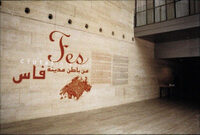
An initiatic journey Videos from an exhibition at the Centre de Cultura Comtemporània de Barcelona from March 26 to May 30, 2002 (a project by Albert Garcia-Espuche and Toni Serra). Into the innermost parts of the city of Fes.Using audiovisual recordings that illustrate some of the different anthropologic, sociologic, urbanistic and religious aspects that make up the fabric of the city. A journey that requires both objectivity (in the working method) and subjectivity (for the experience of the journey and immersion in another culture).

Islam
54 Archival description results for Islam
Video Concerning the Arab World
TransArab Itinerant 2003-2005
2003 / 2005 / 2006 / 2009 - TransArab
Video Concerning the Arab World
This programme is not intended to provide an overview of independent video in Arab and Islamic countries, nor does it seek to be representative in any way.
The works being presented, like the programme as a whole, reflect the notion of “slices of reality”, in the sense that they are subjective visions, aware of their partiality, which do not exclude contradiction or conflict. Visions that perceive a strong tension on their surface and take up these eddies of confusion and violence as cause for urgent reflection and knowledge.
Images and stories, realities in themselves, rhizomatic realities: interwoven without a centre or a fixed meaning. And for that very reason, instead of giving rise to cultural dualism based on opposition, they engender a web of underground connections.
Fourteen centuries after the revelation of the holy Qur'an to the Prophet Muhammad (peace be upon him), Islam today is the world's second largest and fastest growing religion. Muslim gay filmmaker Parvez Sharma travels the many worlds of this dynamic faith discovering the stories of its most unlikely storytellers: lesbian and gay Muslims. Filmed over 5 1/2 years, in 12 countries and 9 languages, "A Jihad for Love" comes from the heart of Islam. Looking beyond a hostile and war-torn present, this film seeks to reclaim the Islamic concept of a greater Jihad, which can mean 'an inner struggle' or 'to strive in the path of God'. In doing so the film and its remarkable subjects move beyond the narrow concept of 'Jihad' as holy war
UntitledAt the beginning of the 1920s, the Austrian Leopold Weiss takes a journey to the Middle East. The desert fascinated him and Islam became his new spiritual home. He left his Jewish roots behind, converted to Islam and started calling himself Muhammad Asad. Becoming one of the most important Muslims of the 20th century he first started to work as an advisor at the king's court of Saudi-Arabia, later translated the Koran, became a co-founder of Pakistan and finally ambassador of the UN. The director finds a man who was not looking for adventures but rather wanted to act as a mediator between Orient and Occident. A Road To Mecca takes the chance to deal with a burning debate which is starting to gain more and more importance nowadays.
UntitledJanata Bennuna is from Morocco; Hanan Al Shaykh is from Lebanon; and Nawal Al Saadawi is from Egypt. All three are authors of the Arab word, committed intellectuals who shed light on the complex social reality of the Arab world through their books. In their hands, literature becomes a weapon through which to draw attention to and denounce situations that they oppose. The three women, from a generation heavily influenced by Pan-Arabism, initially studied against the wishes of their families, but ended up gaining their support. In A Woman's Word, these three very different writers who nonetheless share a common ground talk about their lives and their work. By learning about them, we also gain an insight into the Arab world, which is much more complex than the Manichean and mostly malicious information on the subject that predominates in our own society today. They too are Arabs, women, who refuse the victim mentality, and demand their rights through their work and their commitment.
UntitledA Journey in Afghanistan. After two decades of chaos and destruction, a country searches for its identity. Eight places. A cinematic encounter with people and their realities. A nightclub, a school, a hospital, a taxi – the people there talk about daily life in Afghanistan beyond the war and the Taliban. The director observes people and incidents on his journey, starting in the northern province and eventually reaching the capital Kabul. The result is a mosaic, presented as episodes leaving out West-European commentary.
UntitledAl Barzaj [Between the worlds] is a poem about the halfway world, between the visible and the invisible, sleep and wakefulness... An inner journey through underground streets, secret gardens.
UntitledThe people of Pankisi Gorge believe that all the important issues of their lives and deaths should be solved through mediation of a favored authority. Altzaney is a woman who interferes in other people’s lives and takes responsibility for it. She mediates between conflicting sides and the two worlds. Altzaney is the only woman trusted to take care of the dead.What makes her so distinguished and authoritative in a totally patriarchal environment, and what is the price she has to pay for it? Altzaney gives an insight into a unique community of Pankisi Gorge.
UntitledThis video documentary charts how since the end of the Cold War, which culminated in the collapse of the Soviet Union, only two main ideologies remain - Islam and Capitalism. It explains how the Muslim Ummah has continued to embrace Islam despite the fact that is has been removed from their practical lives and the international sphere after the destruction of the Khilafah; and how in its absence, the standard bearer of Capitalism, America, has a initiated a dangerous campaign targeted at making Capitalism prevail in the world.
UntitledWith a unique and exclusive interview with His Highness the Aga Khan and with rare footage, this hour-long documentary reveals the history of the Ismailis, chronicles the Aga Khan's rise to power half a century ago, and examines his ongoing struggle to maintain the delicate balance between tradition and modernity. This is the first film on the Aga Khan in over forty-five years.
Untitled