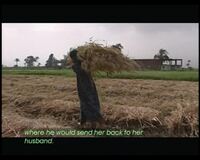
Janata Bennuna is from Morocco; Hanan Al Shaykh is from Lebanon; and Nawal Al Saadawi is from Egypt. All three are authors of the Arab word, committed intellectuals who shed light on the complex social reality of the Arab world through their books. In their hands, literature becomes a weapon through which to draw attention to and denounce situations that they oppose. The three women, from a generation heavily influenced by Pan-Arabism, initially studied against the wishes of their families, but ended up gaining their support. In A Woman's Word, these three very different writers who nonetheless share a common ground talk about their lives and their work. By learning about them, we also gain an insight into the Arab world, which is much more complex than the Manichean and mostly malicious information on the subject that predominates in our own society today. They too are Arabs, women, who refuse the victim mentality, and demand their rights through their work and their commitment.
UntitledIslam
18 Archival description results for Islam
Al Barzaj [Between the worlds] is a poem about the halfway world, between the visible and the invisible, sleep and wakefulness... An inner journey through underground streets, secret gardens.
UntitledThe Observatory Archives invites Pablo Beneito to reflect on this subject as a contribution to OVNI dis_Reality Pablo Beneito has a PhD in Arabic philology from Universidad Complutense de Madrid. He was professor in the Department of Arabic and Islamic Studies at the University of Seville, and currently holds the same post at the University of Murcia. He has been a guest lecturer at École Practique des Hautes Études de la Sorbona, Kyoto University (Asafas), Universidade Federal de Juiz de Fora (Brazil) and the Toledo School of Translators (2002-2003). An Islamologist specialising in the study of Sufism, he has published first editions and and translations of Ibn Arabí: Las contemplaciones de los misterios, El secreto de los nombres de Dios, in Spanish and French, and The Seven Days of the Heart, in English.
Gema Martín Muñoz, professora de Sociología del Mon Àrab a l'Universitat Autónoma de Madrid. Entre altres treballs, es autora del llibre "El Estado Árabe. Crisis de legitimidad y contestación islamista". (Bellaterra, 2000).
The urban and social structure of neighbourhoods in the medina is one of vast intricacy and complexity, being organized around a series of vital establishments for the everyday life of their inhabitants, such as the hammam or public baths, the bakery, schools and the foundouk, or caravanserai. Communal bakeries provide the heating for the public baths or hammam, fully active establishments that are very important for the cohesion of the city's social fabric. Foundouks are establishments where visiting merchants traditionally stayed and stored their products overnight. Most have now lost their original function and are adapted for other uses, such as dwellings or workshops.
In a time that is becoming difficult for bees (as for us) In a year of severe drought, in a country that is already often arid, taking the path of bees has been to make a journey through moors and mountains, but also through states of mind, obstacles and encounters .. until reach their generous garden. Video made for the BEEHAVE exhibition, Joan Miró Foundation 02/16/2018 - 05/21/2018. Available online until December 27th 2020.
An initiatic journey Videos from an exhibition at the Centre de Cultura Comtemporània de Barcelona from March 26 to May 30, 2002 (a project by Albert Garcia-Espuche and Toni Serra). Into the innermost parts of the city of Fes.Using audiovisual recordings that illustrate some of the different anthropologic, sociologic, urbanistic and religious aspects that make up the fabric of the city. A journey that requires both objectivity (in the working method) and subjectivity (for the experience of the journey and immersion in another culture).
A journey of initiation into a city and a its culture. The set of projections (10 screens) aimed to create a journey in the complex sense of the term: using audiovisual segments to illustrate aspects of the anthropological, sociological, urban and religious tissues of the city. A journey claiming both: a certain objectivity (in the working method), and the subjectivity (of the travel experience and approach to another culture). Moreover, the projections do not meet the criteria of a film with a beginning and an end, but rather the creation of a landscape, so the viewer choosed the time he/she wished to dedicated to each fragment. This made it possible to enjoy a deeper level of inquiry to specific fragments (artisans, rituals interviews, etc.). Consequently, the result of each visit to the exhibition gave an unique combinatorial fragments, since the total length of the projections would be about 6 hours. VideoInstallation 10 screens total lenght: 6h 40' Toni Serra , Albert García Espuche CCCB Centre de Cultura Contemporània de Barcelona 2002
UntitledThere is an anarchist essence inherent in Islam, which deserves our attention. Koranic cosmology states that a human being in the state of nature is a ‘slave (or serf) of Al-lâh, just as a sunflower is a slave of the sun, because they are organically linked. The concept of submission to a Single Reality (al- islam) does not translate into submission to human institutions, rather the reverse: it leads to a rejection of all external coercion as contrary to the nature of things. Muslims reject the limits that the market and the institutionalisation of life impose on their freedom, as an inner space in which intimacy with Creation becomes possible. The freedom that Muslims recognise is not political freedom under protection of the State, but an inner state/space that enables us to reject the world of representations, reject the fiction of power that some sheathe themselves in. This is based on idea that human beings are noble in essence, that their state of nature (fitrah) is superior to their state of culture. Ibn Jaldún says: “The political and educational order is contrary to the power of the soul because it embodies an instance of external control”.This point explains why Islam has been described as ‘mystical anarchy’. Abdennur Prado is a writer, president of the Catalan Islamic Council and co-director of the International Congress of Islamic Feminism.
Anonymous guide. Fes el Bali, the old medina of Fez founded in 809 by Idris II, is still completely contained within city walls. The gates (Bab Bou Jeloud, Bab Fteuh, Bab Er Rsif, Bab Guissa...) therefore retain all their social and symbolic value, associated with the different activities of the city and its inhabitants.