
Islam

Elements area

Taxonomy

Code

Scope note(s)

    Source note(s)

      Display note(s)

        Hierarchical terms

        Islam

          Equivalent terms

          Islam

            Associated terms

            Islam

              54 Archival description results for Islam

              54 results directly related Exclude narrower terms
              ES ES-OVNI RSC-1312 · Item · 2002
              Part of Non-Identified Video Observatory (OVNI)

              Fez is one of the North African cities to have had most madrassas, of great architectural beauty. Madrassas, former Koran schools and now open for visits as public monuments, formerly provided one of the functions that raised Fez to the height of its splendour: the study of Islamic tradition and the body of laws and regulations governing social life. They were also the home of the students. Madrassas: Bu Inaniyya (1350), al-Attarin (1323), Seffarin (1280), al-Sahri (1321).
              ES ES-OVNI RSC-1309 · Item · 2002
              Part of Non-Identified Video Observatory (OVNI)

              Fez is the Moroccan city with the liveliest tradition of artisans. Far from being "just a job", the activity of the artisan reflects a whole conception of the world and a way of experiencing time and giving it meaning. This native wisdom is passed down from parents to children, from the maalem, the master, to the apprentice.

              Looking for Muhyiddin
              ES ES-OVNI RSC-4140 · Item · 2013
              Part of Non-Identified Video Observatory (OVNI)

              A man (played by the filmmaker Nacer Khemir) returns home to Tunis to bury his mother. After the burial, his father gives him an "amana" to be handed to a certain Sheikh named Muhyiddin. Taken by his father's request, the man immediately sets out on an epic journey to find the long lost Sheikh and deliver the "amana." Throughout the trip, he is guided by a mysterious spiritual master and the many friends of the Sheikh he encounters along the way. As the adventure unfolds, we discover the rich life of this Sheikh and his uncompromising love for humanity. For under his teachings, different beliefs, faiths, and ways of life can only converge and become one The more we learn about Sheikh Muhyiddin, the more we understand why he is venerated across cultures and continents. Looking for Muhyiddin is a deeply lyrical odyssey into the soul of Islam through the life and work of one of its beloved mystics: Ibn Arabi

              Untitled
              ES ES-OVNI CTX-S017-SS001-0003 · Item · 2012
              Part of Non-Identified Video Observatory (OVNI)

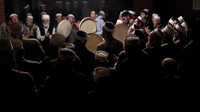
              collection Petites Planètes. ‘Jihad’ is a fundamental Arab concept. In these times of conflict and violence, we only hear the mass media version – the extreme meaning of the term, which has strayed from its original sense – while its deeper meaning is ignored. Jihad can be translated as effort, commitment, and struggle in the broad sense. It is a concept and an experience with two different levels, one subordinate to the other. On one hand there is the ‘small jihad’ which has to do with effort, with the communal struggle to attain a society that is fairer and more aware of the mystery of reality (Al-Haqq) and of life (Al Hayy), which are two of the names of Allah. And the other is the ‘great jihad’, which is considered more important, and which determines whether the success, failure, or digression of the small jihad. This great struggle is the inner quest, the effort to cleanse everything inside us that distances mankind from the real... everything that favours a world made up of separate, selfish entities, a world that is closed, appropriable, and doomed to conflict. One of the most beautiful and profoundly meaningful practices of the great jihad is the ritual ceremony of ‘dhikr’ (zikr), an Arabic word that means memory... and in this context refers specifically to the memory of Allah... a personal reencounter - within a collective ceremony - with the mystery of the Real... in other words, with that which is cannot be defined, represented, or appropriated... that which is beyond physical or rational measure. According to this tradition, only one organ is capable of accommodating such an immensity: the human heart. Sufism struggles to remain within the heart of Islam. And in suffering Chechnya, Sufism is the most widespread form of Islam. Vincent Moon and Bulat Khalylov recorded a beautiful, immersive form of the experience of this dhikr ceremony.

              Untitled
              La Família Chechena
              ES ES-OVNI CTX-S019-SS004-0001 · Item · 2015
              Part of Non-Identified Video Observatory (OVNI)

              Abubakar is 46 years old and participates in the Zikr - ritual dances performed by Chechen Sufi Muslims. At each Zikr he reaches a state of ecstasy. For Abubakar it is an exorcism, a form of liberation from everything that his people have suffered over so many years of occupation. It is an act of resistance where they reunite with their dead. An encounter with the Real.

              Untitled
              La Chine Est Encore Loin
              ES ES-OVNI CTX-S014-SS001-0085 · Item · 2008
              Part of Non-Identified Video Observatory (OVNI)

              On November 1, 1954, two French teachers and an Algerian Muslim leader fall victim to a mortar attack near the small Chaoui village of Ghassira. This event marks the start of the Argelian independence war. Fifty years later, Malek Bensmaïl takes his camera into this region considered “the cradle of the revolution” and questions its inhabitants about their relationship to its history and language and to France. Today's students bear witness to a different age, the contemporary Argelia that can be glimpsed between acceptance and rebellion. Between memory, the present and the future. November 1, 1954 near Ghassira, a small village nestled in the Aurès mountains. Two French teachers and an Algerian notable are the first civil victims of a war that will last for seven years and eventually lead to Algerian independence. More than fifty years later, Malek Bensmail returns to this village, which became "the cradle of the Algerian revolution," to film this chronicle of it and its inhabitants throughout the seasons, capturing the present and the past. The Algerian heartlands, larger than life, rich, poignant, confronted with its future. ?

              Untitled
              ES ES-OVNI RSC-4076 · Item · 2009
              Part of Non-Identified Video Observatory (OVNI)

              There is an anarchist essence inherent in Islam, which deserves our attention. Koranic cosmology states that a human being in the state of nature is a ‘slave (or serf) of Al-lâh, just as a sunflower is a slave of the sun, because they are organically linked. The concept of submission to a Single Reality (al- islam) does not translate into submission to human institutions, rather the reverse: it leads to a rejection of all external coercion as contrary to the nature of things. Muslims reject the limits that the market and the institutionalisation of life impose on their freedom, as an inner space in which intimacy with Creation becomes possible. The freedom that Muslims recognise is not political freedom under protection of the State, but an inner state/space that enables us to reject the world of representations, reject the fiction of power that some sheathe themselves in. This is based on idea that human beings are noble in essence, that their state of nature (fitrah) is superior to their state of culture. Ibn Jaldún says: “The political and educational order is contrary to the power of the soul because it embodies an instance of external control”.This point explains why Islam has been described as ‘mystical anarchy’. Abdennur Prado is a writer, president of the Catalan Islamic Council and co-director of the International Congress of Islamic Feminism.

              ES ES-OVNI CTX-S010-SS001-0004 · Item · 2004
              Part of Non-Identified Video Observatory (OVNI)

              The coalition forces before the launch of their war on Iraq promised the removal of a Saddam style dictatorship with the implementation of freedom and democracy. It was in the name of Freedom that Britain and America launched a brutal war on the people of Iraq who are predominantly Muslim. Far from accepting the occupation of the coalition forces, the people of Iraq have refused to be forced to accept democracy and freedom. In replacement of Saddam, America has installed a new dictator and continues its onslaught on cities and villages in Iraq that wish to remain independent. This powerful and moving documentary will question the justification of the whole war, expose the butchery inflicted upon the Iraqi people and set a vision (for action) for the Muslim communities in Britain and the West.

              Untitled
              ES ES-OVNI CTX-S013-SS007-0058 · Item · 2008
              Part of Non-Identified Video Observatory (OVNI)

              Elections Under Threat is a video documentary about the recent parliamentary elections in Iran. Produced for Aljazeera English, the documentary shows a side of Iranian politics rarely seen in the Western media. The film portrays the everyday people of Iran as well as the candidates running for Parliament as they debate and discuss the relevance of these elections, their economic conditions and the international pressures on their nation.

              Untitled