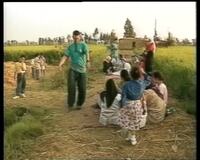
From the compilation "India's Quest". An exploration of the nature and scope of the crisis of modern India.
Visit Panama. For one dollar you can buy a gram of cocaine, a dose of crack and even try “El Pegón”, the new toxic substance -a mix of marijuana with battery acid, diesel, gasoline and other chemical components- that's invading the cities of Panama City. Ten years after the North American military operation called “Just Cause”, tonnes of weapons were found distributed among Panama's civil population. Since then, there have been confrontations between armed gangs of young people for the control of weapons and chemical drugs. Confrontations that are increasingly frequent and bloody. This film is divided into three parts. In the first the first part the soundtrack of the local rappers illustrates the daily violence in the ghettoes. The second part centers on Fat, a functionary that roams the city collecting corpses. Lastly we meet Lolo, leader of the Krazy Killa gang. We can see the inner workings of one of the most dangerous gangs, under police siege in the midst of a war to maintain supremacy.
Delightful musical made to promote color telephones as a decorator accessory in the home. The Prelinger Archives are a source of educational material, mainly ordered by theme, giving a vision of the dark side, the underbelly, perhaps naive of the American dream and the America that is often hidden behind the media curtain.
Two opposing September elevens and related cross. September 11th 1973, military push in Chile. The tape explores the trans-textuality of memory while making an implicit critique of mass media and their depiction of violence. The fissure between these two aspects, as well as the friction between present, memory and historical pass, is the site from which the video sets itself forth.
Untitled“On Translation: Miedo/Jauf is not a work on African/European emigration/immigration. Nor is it a work on religion or on terrorism. Two different realities separated not by the sea but by border fences and boundaries on both sides. The search for the north, with its man-made paradises that for many remain lost; fear as an emotion/sensation inserted in the decision of crossing. The construction of the south as a fiction/reality linked to phenomena of the unknown, exoticism and difference”.
UntitledOn Translation: Fear/Miedo is a televised intervention based on a video production that weaves together interviews with people who experience the tensions of the border zone on a daily basis, archival televised footage that makes reference to the idea of fear on the border between Mexico and the United States, and other documentary and journalistic material. The video aims to reveal how fear is a translated emotion, revealing itself in differing ways on both sides of the border as a cultural/sociological construction based on politics and economics. On Translation: Fear/Miedo was broadcast between August and November 2005 in four distinct locations that connect the centres of power/decision-making with the places where these policies are evident everyday: Tijuana, San Diego, Mexico City and Washington, DC.
Untitled“On the one hand, cooperation doesn't seem to make us free. On the other hand, living without cooperation doesn't make us free, either. How can we stay free in cooperation? What is free cooperation?” The concept of free cooperation is an attempt to base emancipation, political theory and left politics (once more) on free negotiations and equal negotiating power. Spehr doesn't believe in simple “non-hierarchical” or “free” structures - there are always rules, responsibilities, structures of decision making and so on... the question is, which ones. He insists on the option of refusal and the right of withdrawal from cooperation, as well as negotiation and renegotiation with corporate or state monsters, and explores how ideas of independence, equality, and freedom can be useful for alternative networks of learning (in or outside the institutions). To explore these issues, Spehr refers to Science-Fiction, drawing on the language of this genre which, by changing and shifting the face of reality as we know it, highlights the underlying structures of this reality. In his view, this language is a powerful vehicle to talk about possibilities, desires, emancipation and social change.

UntitledOn Power, Dissent and Racism documents a series of talks and conversations with writer and MIT professor Noam Chomsky in 2002 in New York City and Cambridge, Massachusetts. With rigorous analysis and humour, Chomsky presents his reflections on the motivations behind 9/11 and its consequences on the international system. In this one-hour documentary Chomsky starts with the principle that we need to think globally if we want to understand the word of today. He defines the notion of terrorism within its historical context and gives his thoughts on how we should fight without exercising the politics of the most powerful. Among many others topics, Chomsky also gives his personal views on the role of the media in the war on terrorism, and on racism against Arabs and Muslims since 9/11. On Power, Dissent and Racism documents a series of talks and conversations with writer and MIT professor Noam Chomsky in 2002 in New York City and Cambridge, Massachusetts, capturing Chomsky presenting with rigorous analysis and humor his reflections on the motivations behind 9/11 and its consequences on the international system. In this one-hour documentary Chomsky starts with the principle that we need to think globally when we want to comprehend the word of today. He defines the notion of terrorism within its historical context and gives his thoughts on how we should fight without exercising the politics of the most powerful. Among many others topics, Chomsky also gives his personal perspectives on the role of the media in the war on terrorism, and personal views on racism against Arabs and Muslims sice 9/11.
UntitledWith his leading protagonist and friend (Bassam Samra), Nasrallah takes us on an exquisite tour of a subject normally overdramatized by the West. Taking the debate beyond the simplistic approach and with familiarity rarely seen, young men and women talk about the ?hijab? and its social implications. Most of the youths regard the head scarf not primarily as a religious obligation, but as a social construction that symbolizes a girl's respectability or sexual innocence. When talking amongst themselves, however, the young men acknowledge the sexual double standard.