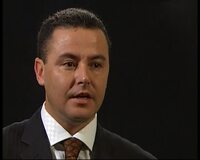
Thousands of people visit London every summer. They fill the streets with shopping bags and cameras and enjoy all the possibilities of the capital. But amongst the crowd another type of visitor exists. Kwaku is a Ghanaian living in London. There, he finds himself dealing with loneliness and boredom. He is living on standby, dreaming of a full time job and also of a friend to count on.
UntitledCatalunya

14 Archival description results for Catalunya
An Archives research and edit on several audiovisual documents from various sources dealing with the old Spanish colony of Equatorial Guinea, most of it created for information and educational purposes. Images that illustrate the colonial obsessions of the times: the idyllic image of Spain's civilizing task, nostalgia for imperial times, the sadistic element in the hunt for wild animals, the work of Christianisation, the militarization of a layer of the population in order to ensure the existence of “loyal natives”, the perpetuation of the African stereotype...
Six years after being bombed by NATO forces, Belgrade city still keeps some of the buildings as they were left by the bombs. Inside one of them, the same group of women that once use to clean and maintain it now gather together, acting and working again as if time had never moved.
UntitledOn Translation: Fear/Miedo is a televised intervention based on a video production that weaves together interviews with people who experience the tensions of the border zone on a daily basis, archival televised footage that makes reference to the idea of fear on the border between Mexico and the United States, and other documentary and journalistic material. The video aims to reveal how fear is a translated emotion, revealing itself in differing ways on both sides of the border as a cultural/sociological construction based on politics and economics. On Translation: Fear/Miedo was broadcast between August and November 2005 in four distinct locations that connect the centres of power/decision-making with the places where these policies are evident everyday: Tijuana, San Diego, Mexico City and Washington, DC.
UntitledIn Ecuador, the indigenous movement has one of the longest and most intense traditions of resistance in the history of modern Latin America. César Pilataxi, a Kichwa man from the Andean region, explains the reasons behind the confrontation between his community and Western interests.
A compilation of Columbian film heritage material relating to indigenous communities. Patrimonio Fílmico Colombiano.Colección Acevedo (1932 -1948) , Marco Tulio Lizarazo (Guerrillero Guadalupe Salcedo, 1953).
UntitledA French government report explaining the reasons why it was impossible to accept Algeria’s independence.
UntitledIn Benyounes forest, “la foret” as they called their habitants, was the last stage of a long trip for thousands of people coming from Sub-Saharan Africa. Close to the fence that divides Ceuta (Spain) from Morocco, they establish in a variable time, before flank the last obstacle in they way to Europe, looking for a better life. Sometimes running away from wars, politics persecutions, hunger or a precarious economy situation. Lots of times of all of this. In years, the migrants pass across this forest and after some weeks or months they manage to arrive to Ceuta. In finals of 2004, European union start agreements of subcontract Morocco in the control of the Spanish – Moroccan border. The habitants of the forest, started to feel the effects of this agreements: the increase of illegal devolutions, the abuses from the civil police, they install police controls near the forest, they forbid the access to current water, military attacks to the camps in with they made mass arrests and rapes as a war weapon. The border it's close. Systematic violation of human rights, financed with the tax of the democratic European Union citizens. The migrants organize themselves in spaces like this and construct spaces; support nets in Moroccan territory, confronting and resisting this way the European politics. In the forest of Benyounes, they organized themselves from origin communities. In February of 2005, decided between all the community's, record this video, to made visible their situation, in with they report the systematic violation of their human rights, the absolutely abandonment from the NGO's, Associations an Human Rights Institutions, an they demand their citizens condition and they require their rights as human beings.
Untitled1958 General De Gaulle pronunces -in a very convulse and tragic moment for an Argelia under rigorous represion and torture- its famous and demagogic “Je vous ai Compris” (I understand you). A reading on several audiovisual documents of that time gives to us an opposite meaning to that sentence. “Je vous ai Compris” now means and show us the real sense of the civilizational work of the western powers. Today so enthusiaticly renovated.