The Ancla2 Photography Cooperative, with the Venezuelan filmmaker and documentarian Rafael Lacau, carry out photography workshops in rural areas of South America, especially with children who have never had contact with a camera. The experience documented here is that of the youngest inhabitants of Tuñame, a town in the Venezuelan Andes. In this production, the children express how they see their community, how they understand problems - especially environmental problems - and what they feel about their reality and the solutions to face it. This documentary is part of the series "Venezuela seen by its children", presented on public television in that country.
Observatori de Vídeo No Identificat (OVNI)antropologia visual
11 Descripció arxivística resultats per al antropologia visual
The Ancla2 Photography Cooperative, with the Venezuelan filmmaker and documentarian Rafael Lacau, carry out photography workshops in rural areas of South America, especially with children who have never had contact with a camera. The experience documented here is that of the youngest inhabitants of Tuñame, a town in the Venezuelan Andes. In this production, the children express how they see their community, how they understand problems - especially environmental problems - and what they feel about their reality and the solutions to face it. This documentary is part of the series "Venezuela seen by its children", presented on public television in that country.
ANCLA2 Cooperativa de fotografíaA captivating message for dark times
Music is there to be made 1
Void and music in the West
The Black Antisol - //Silence in the awakening of the worlds//
Invitation to the film-trance: Research project & Live Cinema with Vincent Moon
To interrupt the noise of the world, to be receptive, to listen, to open to the co-animation of the world.
An exploration, a week of sound encounters, with a live cinema or film trance session at the CC Convent Agustí.
Faced with the monotonous and maddening barbarism of the media and the networks that make us see without seeing, that simplify reality by reducing it to spectacular events and violence, Vincent Moon invites us to stop the machines and go out to meet each other.
To interrupt the noise of the world, not to escape from the horror of the ongoing war or from the clear perception of a civilisation advancing towards the abyss.
Vincent Moon , independent filmmaker and sound explorer, who has been travelling the world for twenty years, will spend a week travelling with us between Barcelona and the mountains of the Pyrenees, encountering known and unknown music, and an invisible art of living and resisting.
The way we show the world helps to change the way we see it, changing the way we look helps to change a world flooded with images.
Vincent Moon says: "I long to rediscover, to rework a link with ancestral tonalities and rhythms, forms of trance...". From the Dhikr (remembrance) of Sufi tariqas in Chechnya, Ethiopia or Turkey; to months in the interior of Brazil or Peru, or incursions in Jakarta, Argentina or Morocco: "A kind of experimental ethnography, trying to hybridise all these genres of trance and music in different parts of the world (...) I think we are recording to gain a certain complexity (...) To reinvent life today we have to elaborate new forms of imagery. And it's very simple. You have to go out into the encounter (...) You break down the barriers to the encounter with the body more than with knowledge. This is what travelling taught me, to trust the memory of the body more than the memory of the brain. Respect is a step forward.
A poetic approach to the everyday. Exploring rhythm and tonality in the sound and visual resonance between beings and elements and things.
"Encounter is the fundamental thing. Meeting people, like the Troubadours (...) Film is an excuse to create a very special moment in the present, in the reality of now".
The Australian Aborigines used to say that "everything slumbers beneath the surface of the earth waiting to be called". - On the acoustic and visionary journey with Vincent Moon we go out to meet voices that continue to sing among the ruins, calling into existence another life, another reality, another truth.
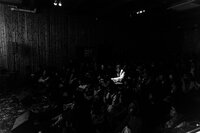
"When I arrive at a place, I ask myself what is important to film today?" - Vincent Moon's visit is twofold: on the one hand to explore some experiences that are "important to film today"; on the other hand, a moment of encounter and projection in Barcelona, with his Live Cinema or Film-Trance - sound and visual exploration.
Vincent Moon's work connects with one of the investigations opened at the Unidentified Video Observatory : Silence in the awakening of worlds . At first, this research started from taking the visionary experience seriously and investigating the ways in which it unfolds, through the cracks of this world, from Surrealism to the current decline of naturalist secularism. In a second moment, which we have called first, during the immersion in the materials: The Mirror of the Night ("Mirrors: no one has yet described, knowing it,/ What you are in your being,/ You, like interstices of time,/ Filled only with holes of sieve. / You, still wasters of the empty room,/ At the hour of twilight, vast as forests..."); and now, at the moment of exposure and encounter: The black anti sun , which starts from taking seriously Rilke's intuition in the Sonnets to Orpheus: "Gesang ist Dasein" (To sing is to exist) .
«"But the great black anti-sols, wells of truth in the essential weft, in the grey veil of the curved sky, come and go and suck each other in, and people call them ABSENCES" (René Daumal). These splendours, the aim of the human being is to collect them (...). And it is precisely by fighting against the inertia of the body and the sleep of the soul, by practising techniques of awakening - physical awakening, spiritual awakening - a kind of "long, immense and thoughtful alteration of all the senses", that allows us to overcome the material and spiritual order of this world, in short, by leading a counter-life» (Jacques Lacarrière, Les gnostiques ).

Ethnographic documentation of the possession rituals of Mina, the religion of African origin practiced in the city of Sâo Luis. Through fragments of public rituals celebrated in seven religious communities, the video shows the diversity and richness of rituals surrounding the controversial phenomenon of possession. 6th Independent Vídeo & Interactive Phenomena Show
Continues the story initiated in its first video, First Contact. Joe Leahy is the mixed race son of Australian miner Michael Leahy and a young highland girl. Joe, now in his fifties, is a wealthy coffee plantation owner. He lives in Western-style grandeur amidst his poorer Ganiga neighbours. The filmmakers lived in the highlands and filmed for eighteen months. They built a grass and thatch house on the edge of Joe Leahy's plantation, in the "no man's land" between Joe and the Ganiga. The film poignantly portrays both perspectives without value judgments or resolution for either side.
His Name Was Not Frankenstein
The fragmented face and the wrath of the clan
Faculty of Geography and History, room 409, Universitat de Barcelona, Montalegre 6
Why do we find the fragmented face of Frankenstein’s Monster so fascinating? The monster in the 1931film was certainly one of the most successfully characterisations in the history of cinema, but there issomething more: it raises a question that goes beyond the creen and has something to do with the idea of that spectre haunting Europe that opens The Communist Manifesto.
The workshop will dissect the film Dr. Frankenstein (1931) to try and understand how terror and dreams are connected in the logic of the fight against the master.
Every day, the kitchen of Sri Guru Ram Dass Sahib II serves 30000 free meals in the Golden Temple of Amritsar, India.
The idea for this short / interview arises from research work on youth and migration. From this interview, we want to focus on migration as a global and timeless phenomenon. Our intention is for the viewer to understand that young people share similar interests, expectations and objectives like access to studies, a job, a stable and safe home ... Even though the phenomenon of migration is complex and we must take many factors into account, with this video we want to continue eliminating prejudices and rejection of migrants from all over the world, understanding that their objectives are not different from those of ours, but that many times in their countries of origin their integrity is compromised and violated and their opportunities to access a better life are limited, and therefore it is necessary to undertake a trip. In this interview, Juliana tells us what prompted her migratory path, the unstable situation in which she lived, the opportunities she has had and her goals: to find a job, continue her studies, take care of her family ..., while she tells us how his grandfather was also a young migrant during World War II, in search of a better future. Showing us how cycles repeat themselves and that it is necessary to create mechanisms and networks so that young people can emigrate in dignified and safe conditions. This video is part of the Educational Agreement of collaboration between theOVNI Archives and the Department of Anthropology of the University of Barcelona - UAB , for the curricular external practices of the students, of the academic year 2020-2021. work pdf
The documentary "Between the book and the sword" portrays the Sikh community in the city of Barcelona and its surroundings, showing the contrast between the bustle and volatility of the city and a solid community with permanent social and cultural structures. Through the stories of some of its members, their flavors and the striking colors that fill the screen, we capture the intimacy of private space, the space of worship and prayer, and finally the occupation of public space. This film does not intend to show the totality of the Sikh community, but rather fragments of lived scenes that transport the viewer into an ethnographic experience. This video is part of the Educational Agreement of collaboration between the OVNI Archives and the Department of Anthropology of the University of Barcelona - UAB , for the curricular external practices of the students, of the academic year 2022-2023.
Entre el libro y la espada
The Cinema Hall of the UAB - Campus Universitat Autònoma de Barcelona.
June 1st from 16:00h to 18:00h
Screening of the documentary Entre el libro y la espada , by Laura Tapias, Guillem Vila and Mika Franganillo (2023).
The documentary " Between the book" and the sword" portrays the Sikh community in the city of Barcelona and its surroundings, showing the contrast between the bustle and volatility of the city and a solid community with permanent social and cultural structures. Through the stories of some of its members, their flavors and the striking colors that fill the screen, we capture the intimacy of private space, the space of worship and prayer, and finally the occupation of public space. This film does not intend to show the totality of the Sikh community, but rather fragments of lived scenes that transport the viewer into an ethnographic experience.
With the collaboration of:
Gurudwara Gurdarshan Sahib Ji – Dawit Contreras
Oficina d'Afers Religiosos (OAR)
Cultura en Viu – Departament d'antropologia social i Cultural (UAB)