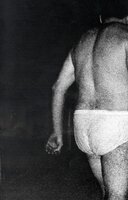
William Burroughs

Àrea d'elements

Taxonomia

Codi

Nota(es) d'abast

    Nota(es) sobre l'origen

      Mostra la nota(es)

        Termes jeràrquics

        William Burroughs

          Termes equivalents

          William Burroughs

            Termes associats

            William Burroughs

              19 Descripció arxivística resultats per al William Burroughs

              19 resultats directament relacionats Exclou els termes específics
              Chappaqua
              ES ES-OVNI CTX-S013-SS007-0109 · Item · 1966
              Part de Non-Identified Video Observatory (OVNI)

              This controversial, startling and hypnotic mix of music and visuals is a semi-autobiographical psycho-drama following one addict's journey from sickness to health, anguish to well being. The Chappaqua filmscape is polulated with counter-cultural icons: Allen Ginsberg and William S. Burroughs, Jean Louis Barrault and Ornette Coleman...

              Conrad Rooks
              Festin
              ES ES-OVNI CTX-S010-SS007-0064 · Item · 2002
              Part de Non-Identified Video Observatory (OVNI)

              How to escape from the trap? How to fight the monster of need that makes you lose your human shape, that itch that you can?t stop thinking about and makes that you dependent, a prisoner of consumption, a slave to an artificial paradise? All these questions are taken from the books of William Burroughs, a drug addict until he finally escaped the horrors of addiction at the age of 50. In his introduction to ?The Naked Lunch?, Gérard-Georges Lemaire, referring to Burroughs, wrote: "..he was wildly interested in control techniques in the widest sense, from the Maya Code, which he discovered in Mexico, to the manipulations of the mass media, the CIA and different American sects?. William Burroughs is a tireless defensor of the free will of human beings subject to all kinds of coercive systems, some totalitarian, others more subtle, more sophisticated, that take possession of the human being through perverse and intimate channels: such as desire, for example".

              Observatori de Vídeo No Identificat (OVNI)
              GLOBALIZATION
              ES ES-OVNI CTX-S006 · Series · 1999
              Part de Non-Identified Video Observatory (OVNI)

              Observatory Archives 1999

              / CONTEXT 1994 - 2020

              Observatory Archives 1999

              The theme of OVNI 1999 is the journey that goes from the social to the private and vice versa, with the understanding that they are part of the same continuous fabric. Memory/Collective Fiction. Dreams/Personal Memories. Standards and archetypes and individual irreducibility. Media paranoia and stories of schizophrenia. Social passions and love stories. The “American dream”, the “European dream”. Temporary Autonomous Zones and Other Worlds.

              Thematical screenings

              Hall and Auditorium.  Simultaneous Screenings

              Centre de Cultura Contemporània de Barcelona

              Montalegre 5. 08001 Barcelona

              IDENTITY vs MEDIA
              ES ES-OVNI CTX-S005 · Series · 1997
              Part de Non-Identified Video Observatory (OVNI)

              4th  Independent Vídeo Show & Interactive Phenomena

              / CONTEXT 1994 - 2020

              4th  Independent Vídeo Show & Interactive Phenomena

              IDENTITY vs MEDIA / 4th  Independent Vídeo Show & Interactive Phenomena / OVNI 1997

              The MVI&Fi presents an extensive theme-based programme that is not exclusively dedicated to new audio-visual productions. The Mostra is non-competitive and all the participants are paid for their contributions. These are the specific criteria that distinguish the Mostra from other festivals.

              As in previous editions the audio-visual works presented in the MVI&FI are selected in two ways. On the one hand, a rigorous selection of works received through a public call for entries and the other, works selected from a variety of archives and programmers or through direct contact with the authors.

              The theme of identity , once again, is of central importance in the Mostra; identity, in this cases, at the cross-roads of the social, sexual, emotional and familial with the interior world of madness, pain and the intimate, ...A spectrum amply illustrated in the four programmes of the Dark Night of the Soul .

              In this edition, for the first time, the Mostra presents two monographic sections: An extensive selection of the work of the Canadian Steven Reinke and more limited programme dedicated to Joe Gibbons.

              We are also presenting an extended version of the William Burroughs monographic programme that was projected at the MACBA, consisting of works that go beyond the strictly videographic, and representing both a way of understanding visual experimentation and a radical critique of contemporary culture and society. There are works in with Burroughs actively collaborated, such as the films of Antony Balch and Gus Van Sant and others in which his writings or voice served as a point of reference, such as the shorts of Francis Ford Coppola, Herbert Distel, Philip Hunt, ...

              We are especially pleased to be showing The Society of the Spectacle by Guy Debord , with Keith Sanborn ’s English translation.

              The 4MVI&FI also includes two programmes of Experimental Television compiled by Andy Davies and during the Mostra Barcelona Television will broadcast a especial programme of ambient tv by Park 4 dtv.

              This year the Mostra has two sections dedicated to Interactive Pieces and Quicktime Movies . The first is both wide-ranging and informative and the second, more specific, consists of multimedia works from ZKM – Zentrum für Kunst und Medientechnologie in Karlshure- Deutschland and 10 representative CD roms of the archaeology of mass media from the Rick Prellinger Archives in New York.

              Each the programmes that make up the MVI&FI work as a route intended to transport the viewer through a series of emotional and mental landscapes as if in a ritual or journey, in which each of the stages influence and alter the others. The programmes consist of works that are formally diverse, that flow in a way that excludes neither contradiction nor paradox, that may be read over and above the significance of each specific piece.

              Thematical screenings

              Hall and Auditorium.  Simultaneous Screenings

              Centre de Cultura Contemporània de Barcelona

              Montalegre 5. 08001 Barcelona

              MACBA 1996-1998
              ES ES-OVNI CTX-S004 · Series · 1996/1998
              Part de Non-Identified Video Observatory (OVNI)

              El Barri Xinès (work in progress) and other City films

              Mass Media Archaeology: A Selection from the Prelinger Archives

              Calling all Active Agents

              Low Tech : Strange Weather

              Each and Every One of You

              Jennifer Reeder - Sadie Benning

              / CONTEXT 1994 - 2020

              The Unidentified Video Observatory composed in the time by Nuria Canal, Joan Leandre and Toni Serra curated from 1996 until 1998 sixteen monthly and thematic video sessions in the Barcelona Museum of Contemporary Art, MACBA. The OVNI video programs at MACBA, were the very first of its kind in the museum and as an essential part of this initiative the Observatory curated and proposed as well the acquisition of a selection of video titles to start the early video library of the Museum.

              The OVNI sessions at MACBA were mostly but not only focused in the area of media identity and mass media criticism and they were a fine distillation of the programs OVNI was periodically organizing at the neighbor institution the CCCB Barcelona Contemporary Culture Center. The sessions introduced thanks to the work of the authors, early key concepts that were describing as much the analog media times as the future huge shock wave of the digital age to come.

              The programs of these sessions were often dealing with the notion of media archeology which was and still is is one of the conceptual pillars of the Unidentified Video Observatory. That is, to look back to “ephemeral” archival footage such as educational or propaganda films, to be able to better understand the present through it. Media archeology, media digest, media interpretations and media transgressions through the deconstructive use of appropriated mass media footage were among the main structural  arguments of the project since its foundation.

              One of the main Unidentified Video Observatory  goals specially in the decade of the 90s was to promote the huge communicative potentiality of video through its heterodox spectrum of possibilities. And so, in these sessions there was a wide range of authors and perspectives related to the generous and open use of the medium. Works such as the video diaries of George Kuchar and the modular and serial projects of Steve Reinke were already pointing to some sort of early “analog video blogging”, anticipating future uses and understandings of the video. Visionary initiatives like the Prelingers Archives founded by Rick Prelinger in New York and completely dedicated to the recovery and preservation of ephemeral media. Corporate mass media hacking projects like Spin in which the author Brian Springer gained access to internal and private broadcast television feeds or the first glimpses of culture jamming by Donald Goodes and Anne Marie Léger were included in this sessions. Following the tradition of scratch video based in the use of found footage, some authors such as Dara Birnbaum, Klaus von Bruch, Nam June Paik, Mathïas Muller, Craig Baldwin, Rafael Montáñez Ortiz, Herbert Distel, Peter Guyer and others were mainly having a strong "digestive" attitude towards media, recycling or deconstruction and so redirecting meanings from the media flow. In this mood the precursor and essential work of Bruce Conner was shown for the first time in Barcelona in the last program of the MACBA sessions.

              The balance of this video program sessions was found in one hand in the authors whose main concern was to use media and video as a contemporary tool of human insight and positioning, for instance the love-hate relation “identity vs media” in which the works of Peggy Ahwesh, Sadie Benning and Jennifer Reeder could be included, all of them often oscillating between gender identity and the mass media inertia, between the camera as an artifact and the human being in front and behind it. In the other hand balance was found in what  apparently seems to be the antipodes of the mostly media related conceptual approach in the MACBA sessions, through classic names such as Bill Viola and Gary Hill, already known names in Europe such as Francisco Ruiz Infante, foreign authors living in Barcelona and centering their work in the realities of the transformation of the city such as Adam Cohen and a special double program dedicated to the writer William Burroughs.

              The MACBA sessions were an essential step for the maturity and consolidation of the Unidentified Video Observatory it was an effort to find the essence of the project future continuity. They were developed with the help of Gloria Picazzo and Anna Guarro, both of them part of the MACBA staff. Some content of the sessions would have been impossible without the inspiration found in the work of Eugeni Bonet, Andy Davies and Rick Prelinger.