
visiones

Elements area

Taxonomy

Code

Scope note(s)

    Source note(s)

      Display note(s)

        Hierarchical terms

        visiones

          Equivalent terms

          visiones

            Associated terms

            visiones

              17 Archival description results for visiones

              2017 - The Unseen Workshop
              ES ES-OVNI TS-S001 · Series · 2017
              Part of Non-Identified Video Observatory (OVNI)

              2017 - The Unseen Workshop

              / TONI SERRA *) ABU ALI

              Toni Serra *) Abu Ali

              An activity in the framework of OVNI programme for 2017 at the Centre de Cultura Contemporània de Barcelona that proposes -with the help of videos and texts- to go in depth into the notion of the invisible. Given by Toni Serra (Abu Ali), the workshop goes from the political to the poetic, or from poetry to mysticism.

              From forced invisibility to permanent exhibition in the panopticon. The image as a veil. Tunnels of reality. The reality of the dream. Crossing the other side. On contemplation. The one and the multiple.

              You are asleep and your vision is a dream; all you are seeing is a mirage. (1)

              Capitalism’s gigantic audio-visual machine, like all its machines, is driven by an extractivist impulse: life as an infinite reservoir to be exploited. It makes sense to counter this instrumentalist drive with a method based on collaboration, immersion, and commitment that weaves together the creators of images and their environment, and does not turn them into mere agents at the service of that machine. However, there is a danger that this measure alone will be insufficient and reversible, unless it is accompanied by a radical critique of the notion of vision that has prevailed in the dominant global culture: if we do not consider vision’s capacity to extract but also to involve and project, if we do not deconstruct the visual language that implements the colonisation of time and of perception....

              We normally associate images with vision, but in the society of global capitalism the use of images as spectacle (2) has turned vision into a kind of blindness, creating an imaginary woven from a huge number of images that are renewed and also replicated unceasingly. A tissue that solidifies until it forms a dense veil of images that not only hinders vision and obstructs direct experience, but also tends to colonise our realities and dreams, while plundering deposits of fantasy (3) and personal or shared imaginaries. A dominant reality that threatens the fabric of other realities, that threatens to wipe out forms of knowledge, landscapes, people, ways of life, affects... As if a thousand libraries of Alexandria, still embedded in people’s daily lives, in their chores, their places, were already burning once again.

              Much has been said about the manipulative nature of media images, their capacity to deflect, distort, and distract the senses, creating a vision of reality that is completely biased on favour of the big economic powers. A huge, seemingly diverse, audio-visual production machine, in the hands of a few private, government, or hybrid corporations. But the real power of these images does not lie in denying, coercing, or manipulating (which always generate resistance and thus opposition), but in claiming to build, to constitute, to give space and make meaning. In other words, to create an imaginary and offer a place, an individual or creative role in that master film that will then be projected under the heading of “reality”. Of course it is no more real than a theme park or a shopping mall that simulates town squares, street musicians, and even action scenes...

              This spectacle-reality is forged in the constant, high centrifugation of labels: news, fiction, advertising, education, entertainment, training, and so on. Themes and concepts are mixed together, and so is the syntax of consumption, permutating them in time and space until they become indistinguishable or their differences become irrelevant, once they are consumed and absorbed as part of the same segment of experience.

              Audio-visual media have undergone radical change and hybridisation under the impetus of the new consumer, entertainment, and socialisation technologies. They have partly yielded the oligopoly of the means of audio-visual production, and are now complemented (and challenged) by the massive spread of devices for recording, editing, and disseminating images. They have hybridised with other media based on micro-segments of information and opinion..., creating a dense media ambience in which TV news, advertising, video games, film, advertorials, and social media are constantly in self-referential mode. Inspired by marketing strategies and informed by the personal information that is “voluntarily” provided on so-called social networks, critical voices also take on a spectacle-role. An implementation of a new version of the panopticon, given that any “social” element of these networks dissolves with the ownership, management, and use of the data they amass.

              Models are no longer simply projected onto passive viewers, like in the old Hollywood dream factory. Instead, what were formerly audiences are offered an “opportunity to participate”, a chance for interaction that gives them an active leading role in a pre-written script. Stories, feelings, private and shared dramas, aspirations, desires, dreams, fears, likes and dislikes, emotions and ideas, are the raw material that fuels the great accumulation machine, always geared towards obtaining and maintaining maximum profit in the form of financial or cognitive capital. In this context, as Pasolini saw, free participation and interaction paradoxically coexists with looting and plunder, with the exploitation of the enormous experiential and cultural reservoirs, the personal and collective realities of those who participate, whose reality either becomes productive or is cancelled. The “raw material” is used according to the financial logic of marketing and the politics of control. It is extracted, inserted into the timeline (4), filtered, and put back on screen in the form of the global imaginary.

              The dominant power presents itself in an outward-oriented imaginary, but this does not mean that it is only used on forms and surfaces. Rather, it provokes and forces the interior – anonymous, hidden, insignificant – to flow towards the surface, to be reduced to it, to show and advertise itself and ultimately become only that outwardness. Only thus can it be mapped in its entirety, its identities grouped and produced, experts assigned, and goods targeted to it.

              The sleep of our era is not a good sleep that provides rest. It’s an anxious sleep that leaves you feeling even more worn out (...) There is a narcosis that begs for an even deeper narcosis . (5)

              This is the sleep that gives rise to “capitalist realism” (6), which mainly affects people living in the central parts of the global system, where capitalism tends to seem unfair but unavoidable, with no conceivable alternative. Mark Fisher, who coined the term, describes it as the impossibility of there being space for an alternate possibility within a capitalist framework.

              Capitalist realism cannot be confined to art or the quasi-propagandistic way in which advertising functions. It is more like a pervasive atmosphere, conditioning not only the production of culture but also the regulation of work and education, and acting as a kind of invisible barrier constraining thought and action. (7)

              Capitalist realism, implemented as a hegemonic ideology, consists of the conviction that there is no alternative to the paradigm of capitalist social organisation, and also of its own means of reproduction and dissemination to most of the population.

              As we have seen, the image industry and the media are essential for projecting this capitalist realism onto the social screen. Two of its media strategies are notable for their capacity to go viral.

              The first, presented as “information” and “objectivity”, consists of what we could call the creation and export of the visual concept of poverty. Through images (preferably taken from countries on the global periphery), news and mainstream documentaries present decontextualised, re-situated visual segments that illustrate the dominant idea of poverty for “central” audiences and export it as a global imaginary. At the same time

              Al Barzaj
              ES ES-OVNI CTX-S014-SS001-0135 · Item · 2010
              Part of Non-Identified Video Observatory (OVNI)

              Al Barzaj [Between the worlds] is a poem about the halfway world, between the visible and the invisible, sleep and wakefulness... An inner journey through underground streets, secret gardens.

              Untitled
              Con la coda dell’occhio
              ES ES-OVNI RSC-4292 · Item · 2010
              Part of Non-Identified Video Observatory (OVNI)

              Out of the corner of the eye is the recording of a vision, sparked by the accounts of my grandfather, who lived in a small mountain village. The picking of blueberries and raspberries at dawn, in groups of people who kept in touch with songs and calls from one side of the valley to the other, made me think of a vastness of resounding sounds, filling the emptiness of space. I wanted to translate that soundscape into a video. The valley appears dotted with sparkles, glimmers that respond from one end to the other, from the bottom to the peaks. Thanks to the involvement of a group of more than twenty inhabitants of the valley, equipped with mirrors, I transformed a portion of the landscape into an expanded random choreography of presences amidst the woods, with coordination by radio.

              Untitled
              Les dormants: Excerpt
              ES ES-OVNI RSC-4277 · Item · 2009
              Part of Non-Identified Video Observatory (OVNI)

              The four stories in this film take us from Belgium to the banks of the Senegal River, from the French Ardennes to the mountains of the Western Sahara. What they have in common is that they lead us to meet the sleepers. Men and women moving between two worlds, that of the absent and that of the living, between two states, that of waking and that of sleep. In each of these stories lies a mystery free from all belief, all philosophy, all attempts at explanation. A mystery capable of reenchanting reality.  

              Untitled
              Mahu - Mactar Thiam Faal
              ES ES-OVNI DIF-S010-SS003-0002 · Item · 2013
              Part of Non-Identified Video Observatory (OVNI)

              A conversation at the microMeeting de Ru'a [visions] at the CCCBA. 05.17.2013 "Knowing the West with my own eyes ... Despite globalization, we never see images of the white man working ... We see that he is in a hurry, but who cleans his streets? ... My grandfather told me that the white man He deceives us, tells us that we are poor, but we are not! What happens is that he only knows one level of wealth, the most basic, the most ephemeral and material ... For him, everything that is not visible is madness or superstition ... "

              Path of Return
              ES ES-OVNI CTX-S019 · Series · 2018
              Part of Non-Identified Video Observatory (OVNI)

              / CONTEXT 1994 - 2020

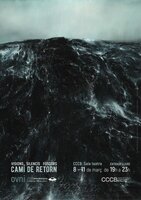
              Path of Return / OVNI 2018

              visions, silence, darkness

              A few years ago – just after OVNI The Border as Centre (and perhaps as a consequence of it) – we entered a period of introspection. And in that inward-looking space, certain images from Bela Tarr’s film The Turin Horse (1) kept returning over and over again. In particular, three sequences:

              In the first, an elderly man struggles to drive his horse and loaded cart through a fog-filled landscape. After a while, we begin to understand the need for so much effort: the driver is one-armed, and a cart intended for two horses is being pulled by just one. Something is missing in this soulless world. A profound lack of balance is causing it to crack and at the same time bringing it to a standstill. The mutilated substance of that which animates it, mutilated itself, is crushed under its own weight and sinks on its blind side. Every gesture, every task, even eating, is arduous.

              In the second scene, a character appears on screen and delivers a wild, lucid monologue about the course the world has taken: “everything has been debased that they’ve acquired (…) whatever they touch – and they touch everything – they’ve debased (…) Acquire debase, debase, acquire. Or I can put it differently if you like: to touch, debase and thereby acquire, or touch, acquire and thereby debase. It’s been going on like this for centuries (….) Because this is not some kind of cataclysm, coming about with so-called innocent human aid. On the contrary, it’s about man’s own judgement.”

              The cart driver’s answer is laconic: “Come off it, that’s rubbish”. (2)

              Then, the wind, the barren plain, the loneliness.

              In the third scene, near the end of the film… as night falls, the two main characters, father and daughter, try to light an oil lamp or at least a candle but they are unable to do so. Light has already left that world.

              Light is leaving the world.

              For months and months, as we were saying, these images played over and over inside us, suggesting a possible path but also imperceptibly plunging us into their dense fog. We tried to navigate inside it but we could barely see our hand stretched out before us. So we walked for a time through that invisible world, and little by little we learnt to trust that fog, that not-knowing, that not-seeing with our eyes, until we came, in a sense, to recognise ourselves in it… Once this state had stabilised we shared it with the rhizome that gives rise to ovni, and this was how a few people came to talk to us about death and deaths (3) … and how the “Path of Return” unexpectedly opened up in the fog, not denying it but rather incorporating it like a veil that protects the mystery that surrounds us and runs through us at every moment.

              And so this OVNI of fog takes us on a journey through the middle world, the experience of physical death and of the deaths of the ego.

              Instead of a regular video programme, it takes the form of a rite of passage in which visions (videos), texts, sounds, rituals, and breaths are interwoven with shared silence and darkness.

              To open up our vision (4), to open up to the awareness of that which we call film, video… those strange projections of light and shadow that portray worlds and lives, landscapes and feelings that arise in the dark cave of the screening room. It is there, in that shared or solitary darkness, that visions of worlds are incubated… before the emergence of boundaries between the real and the unreal, wakefulness and sleep, life and death… Visions on a white screen that will remain white once the visions of the worlds have disappeared. (5)

              Perhaps an old wound in our culture and our lives is thus healed, the hemispheres come together, other eyes open, and the Turin horse is no longer beaten. (6)

              So as not to separate death from life, each day’s journey will begin by passing through the gates of dreams – death’s twin – and trance, exploring the rituals of farewell and dissolution of the body… A contemplation of dissolution that will lead us to the grateful contemplation of life.

              So Path of Return unfolds as a rite of passage, a journey that we recommend making in full each day (*), to aid in a good crossing through intense and sometimes difficult inner landscapes that may perhaps help us to regain the perception of the unlimited, inappropriable, unrepresentable nature of the Real.

              (*) OVNI will take place from 7 to 11pm each day.

              The CCCB Theatre will open at 7pm. Once the programme starts the doors will remain closed, opening at least twice more in the course of each evening. The Lobby of the Theatre will be open from 7 to 11pm, and a room nearby will be fitted out and equipped with audio recordings for those waiting.

              The Turin Horse ( A torinói ió in the Hungarian original) is a 2011 film directed by Béla Tarr and Ágnes Hranitzky.

              Transcription of the monologue from The Turin Horse :

              The people who come to mind are Palmar Álvarez Blanco, Marco Antonio Regueiro, … and also all those who have already left us during this long period of searching

              Abu Ali, Abrir la Visión, 2016

              http://www.al-barzaj.org/2016/10/abrir-la-vision.html

              This image is often used by Ramana Maharashi.

              According to the oft-repeated story, Nietzsche was in Piazza Carlo Alberto when he noticed the driver of a hansom cab flogging his stubborn horse. Nietzsche ran towards them, threw his arms around the horse’s neck to protect him, and then collapsed on ground.

              March 2018, 8th - 11th / 19:00h - 23:00h

              Image de Thierry DE CORDIER, “MER GROSSE”.

              Perro Corazón
              ES ES-OVNI CTX-S010-SS007-0072 · Item · 1998
              Part of Non-Identified Video Observatory (OVNI)

              1998, Tangier. Conversations in the bar La Poste with Tangerian writer Mohammed Chukri and New York poet Ira Cohen, stories of death, separation and loss under the mantle of friendship.