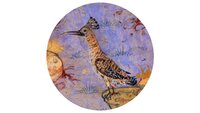
visiones

Elements area

Taxonomy

Code

Scope note(s)

    Source note(s)

      Display note(s)

        Hierarchical terms

        visiones

          Equivalent terms

          visiones

            Associated terms

            visiones

              17 Archival description results for visiones

              17 results directly related Exclude narrower terms
              Winter’s End
              ES ES-OVNI CTX-S020 · Series · 2020
              Part of Non-Identified Video Observatory (OVNI)

              Observatory Archives 2020

              / CONTEXT 1994 - 2020

              Observatory Archives 2020

              Founded in 1994, OVNI (Observatorio de Video No Identificado) is a video-based research project that focuses on the analysis and critique of a significant part of contemporary culture. Created by video makers rather than cultural managers or curators, OVNI has always shunned the stereotype of the competitive festival and new releases. It is a project run by creators about creators who use the medium of independent video, in which creative practice has always been imperative. With the birth of the Observatory Archives in 1999 as one of its milestones, OVNI has witnessed three crucial decades, observing the birth of the internet, the transition from analogue to digital, and the tectonic shifts in the political and spiritual strata of contemporary culture. All of which have been reflected in its archives.

              In 2020, OVNI offers a collectively mapped itinerary through this period. Under the title “ WINTER'S END ”, it presents four sessions of video-reverie, in a programme that subtly speaks of being adrift in the present moment and of memory. The title refers to a notion that is evocative, but also, more specifically, given the dates of the sessions, to the last days of winter and the transition to lightness. A concreate reference in overly volatile times, an evocation in times of loss.

              Winter's End is held in memory of Toni Serra-Abu Ali, who met with death on 21 November 2019. Co-founder of OVNI and author of an important and extensive video oeuvre, the OVNI 2020 programme is guided by some of his works: each session begins and ends with one of his videos, in line with the thematic thread of each day’s programming. But it also includes many of his lesser-known titles, some made under a pseudonym, others anonymously.

              Winter 's End- OVNI 2020, is not a retrospective or a representative survey of the Observatory Archives: that would be entirely impossible given the extent of the collection. However, at a moment in its history very much marked by Toni’s death, twenty-seven years after its foundation the Observatory is taking its extensive collection as a starting point for a particular reading. A look at fundamental questions and fragments, witnesses, and landscapes from these decades, which connect and establish a dialogue with a chaotic present presided by loss.

              Without focusing on a clearly defined theme, Winter's End contemplates the drifting of the present in a programme marked by loss, in a space of time of attentive reading and of slowness, based on a desire to recover an intimate relationship with images.

              Sensing the Twilight (day 1)

              The first session of OVNI 2020 presents video portraits from the 1980s and 1990s, video diaries, people who talk to and with the camera on their own, in the low resolution and slower pace of analogue times. We observe video as it was then, more naïve, and therefore with a greater sense of freedom in relation to the media, through works made in pre-digital times, when the explosive spread of social media was still undreamt of. Pieces like Iñaki Álvarez’s El Dolor (1996), in which a group of people talk about their notion of pain, alone except for the camera; Xavier Hurtado’s Interview Agency (1992), a project in post-Olympic Barcelona that reveals the tension between the interviewer-cameraman and the interviewee, between transparency and manipulation, ideology and neutrality. Works that were particularly significant at the time, also in OVNI programmes in the 1990s, as was Ardele Lister’s Split (1981), in which a teenager talks about running away from home, and It Happens to the Best of Us (1989) in which she looks back on the episode as a young woman eight years later.

              Crossing Mirages (day 2)

              The second day of OVNI 2020 is a session that moves between loss and oblivion, illusion, and, finally, recognition in the essence. It includes important works like Marcos on Media (1996), which addresses the role of the independent media in the decade of globalisation; Una Cruz en la Selva (2006), a look back at colonised Guinea through historical archival materials, and Now I Become Death (2012), a reconsideration of Openheimer’s words after the first nuclear test, both edited by Toni Serra under a pseudonym. This second session swings between dreamlike moments and more concrete references situated in specific historical and geopolitical realities. But they all lead to the dissolution of materiality in Satsanga, en compañía de la realidad (2012), Toni Serra’s study on the non-dualistic nature of reality based on archival footage of Sri Nisargadatta Maharaj. This fundamental questioning of experience and its origin in unity is one of the core themes of the research at the heart of the Observatory Archives over the years.

              Arriving at Memory (day 3)

              A third session rounds off the main section of the End of Winter trilogy of programmes: a spectrum ranging from the notion of the personal relationship with the image, the media versus intimacy, and the days of “analogue naivety”, to the period of the consolidation of globalisation and the digital boom, by way of the true nature of reality and the exploration beyond the drifting moment in which we all find ourselves in one way or another, individually or collectively. On this third day, works like Toni Serra’s 7 Contemplaciones (2016), Till Passo’s Mast Qalandar (2005), and Dee Dee Halleck’s Bronx Baptism perhaps share a sense of devotion, community in unity, and contemplation as the path to becoming the other.

              There is a fourth programme that we like to call the “Opening” session. Perhaps an opening up to times and spaces that will come in our interaction and continuity with the world. In any case, it is a session dedicated to Toni Serra-Abu Ali, with his works Al Barzaj (2010) and En el Camino de las Abejas (2018), which was his last video, made for the exhibition Beehave at the Fundació Joan Miró, OVNI 2020 Opening also presents two special titles in the archive, Xavier Hurtado’s Pi'txi (Acompañante) (2010) and Keith Sanborn’s For the Birds (2000).

              OVNI Archives – Observatorio de Vídeo No Identificado

              Rosa Llop, Simona Marchesi, Joan Leandre.
              ES ES-OVNI DIF-S016 · Series · 2023
              Part of Non-Identified Video Observatory (OVNI)

              Unidentified Video Observatory Constellations

              Presentation at the MACBA 2023-2024 IEP

              Una eina per a explorar

              L'Observatori de Vídeo No Identificat és una potent eina per a la incursió entre els «oasis» que resisteixen a l'extensió del desert. Incursió en el sentit d'exploració i viatge, alhora físic i iniciàtic, obertura a l'encontre amb l'inaudit que mai deixa igual.

              «Tornar a obrir el camp de l'experimentació»

              A la seva manera modesta, situada, funambulista amb la Institució — una de les pràctiques que ovni ha perseguit des del principi ressona amb aquesta veu indígena que es va alçar amb força, en la mateixa meitat dels '90, des del cor de la selva: Veu de les comunitats sense veu, que no ha cessat, veu emmascarada, on la màscara es torna una manera de comparèixer que subverteix des del principi la unificació global tecnocapitalista i els seus «mecanismes per a separar aquesta cria de la terra de la seva mare» (Ailton Krenak) (1). Aquesta pràctica consisteix a «tornar a obrir el camp de l'experimentació» — tornar a recuperar l'obertura, l'incisiu, la proximitat i la commoció crítica que havia tingut el vídeo en els seus inicis. Tornar a portar el documental independent, el testimoniatge, la visió poètica, el treball d'arxiu (2).

              Per tant, el treball d'ovni–desorg va més enllà de les consideracions banals sobre el vídeo i l'audiovisual, la diferència amb el cinema o les qüestions tècniques. El projecte és una eina brutal perquè al llarg dels anys es torna més i més evident que el vídeo, l'arxiu, la imatge són, en la societat de la imatge en què vivim, eines fonamentals que ajuden a pensar el present . — Pensar, deia DH Lawrence, no consisteix, com es creu, a recuperar dades obsoletes i extreure conclusions falses. Pensar consisteix en un descobriment, que es fa amb tot el cos i el començament del qual és generalment dolorós (3). Descobriment dolorós quan trenca l'aparent normalitat unívoca, la closca que ens tanca i ens encega, esquerda (4) — íntima i poètica o política i comunitària— que obre a formes més vitals, més amables, més reparadores i més riques d'habitar, els «oasis» (5).

              Vivim una època de guerra sense fi. Una guerra l'objectiu de la qual és perpetuar-se i perpetuant-se imposar un «eix temporal global» unificat, com deia Kader Attia al final de la seva conferència (6). O dit amb les paraules de Ailton Krenak: «Mentre la humanitat va distanciant-se del seu lloc, un munt d'astutes corporacions va ensenyorint-se de la Terra. Nosaltres, la humanitat [que ens han dit que som, aïllant-nos d'aquest organisme del qual som part, la Terra] viurem en ambients artificials produïts per les mateixes corporacions que devoren selves, muntanyes i rius.» (7)

              Però a l'interior d'aquest procés es produeixen ruptures (8), ruptures que a vegades ocorren, que trenquen el temps lineal, el temps d'una repetició normalitzada que es vol eterna. Ruptures que pleguen el temps de la subjectivitat i de les coses, ruptures intempestives i insospitades que obren el camp del possible — i deixen advenir veus d'Egipte, Líban, el Marroc o el poble Palestí en l'exili (9), veus de la selva i els ancestres, testimoniatges i visions des de l'Índia o des de Gènova o l'Argentina en la revolta, veus de la Frontera i de les Colònies, cosmovisions indígenes o africanes, Aymara o Quítxua o del Senegal— veus, presències i experiències de ruptura que també emergeixen aquí, a Barcelona, decolonials, feministes, o de pura revolta contra el capital i el seu món.

              Una constel·lació contra l'oblit

              Com a projecte de recerca i creació, l'Observatori és en el sentit més profund un arxiu de les ruptures i, per tant, quan l'arxiu és —com s'inclou en els debats contemporanis— una eina de la història i la història l'escriuen els vencedors, com deia Walter Benjamin,  l'Observatori és també una ruptura dels arxius (10), doncs, com també deia Benjamin, «Ni tan sols els morts estaran fora de perill si l'enemic venç… I aquest enemic no ha cessat de vèncer» (11). Ovni és així una constel·lació contra l'oblit — és una invitació a prosseguir —de manera artística, poètica o experimental— el que s'ha obert en les ruptures de l'època — que són també moments de bifurcació de continents perceptius — on la realitat està en joc.

              És el que vèiem l'altre dia amb l'Elvira Espejo Ayca (12), on enfront del tipus de «saber» occidental, que contínuament "talla" o separa (emoció i raó, art i ciència, naturalesa i cultura) per a situar-se des de dalt com a domesticació i dominació de l'ésser humà, ens presentava la potència de la «criança mútua» com a desplegament de «interconnectivitats» i «cura i atenció màxima», on s'aprèn a través de la retina, el tacte, la sensació de tot el cos, donant lloc a una sensibilitat i una manera de viure on ja no ets «tu» l'important, sinó que la vitalitat de la Terra és l'important —«The Earth» de la qual parlava Achille Mbembe a partir d'ontologies Yoruba i Dogon (13)— cuidar el que et cuida, protegir el que et protegeix, mutar amb el que muta, atendre al que contínuament emergeix...

              Ovni és una constel·lació contra l'oblit perquè els moments de ruptura o les fulguracions visionàries tornen a tancar-se sota la inèrcia de la normalitat, però queden traces, petjades, veus. I si des d'algun lloc val la pena continuar pensant és des d'aquests moments que esquerden el continuum de la història recent, des de l'experiència més alta.

              Una invitació a l'encontre

              Pensar avui és pensar no sols amb paraules, és pensar amb la gestualitat del cos i amb els cossos sonors, és pensar amb imatges que ens fereixen o ens encoratgen, o amb purs enigmes del temps, és convocar als espectres en el llindar de la nostra participació en el món. Pensar avui és pensar des de l'escolta i des de l'obertura a l'encontre amb l'inaudit no sols humà. Com a amic i col·laborador extern de desorg.org , veig que una dimensió fonamental del projecte, que jo he trobat en el seu centre, està en la invitació a l'encontre — com a manera de continuar el que s'obre amb la ruptura — que està en el cor del pensar, del delirar, del tractar de portar endavant pràctiques de llibertat.

              Invitació a trobar-se que començava amb projectes d'autoria —també anònima o sense-identificar— que enviaven coses per a projectar des de molts llocs, pròxims i llunyans, i que seguia amb la invitació a l'encontre amb el que s'anava a buscar i que ressonava amb el que arribava. Invitació a l'encontre amb les veus i projectes que a Barcelona emergien en ruptura o en dissonància amb la monoforma, amb l'«eix temporal global» on «There is no alternative». Des d'Espai en Blanc a la Confraria Sufí senegalesa dels Baye Fall, 15M bcnTV o el grup de «Ciutat Morta». — L'objectiu exotèric no era capturar-los per a neutralitzar-los en la Institució Cultural , sinó, des dels seus marges, tibar la Institució per a fer sortir de polleguera la seva tendència a tancar-se sobre si mateixa i tornar-se irrespirable, sota la seva epistemologia d'experts i els seus procediments entre el management i la burocràcia. — Però l'objectiu no quedava només allí, no era per a res exterior. L'objectiu esotèric era i continua sent el viatge mateix de la recerca i de la trobada, prosseguir i ampliar la conversa, i l'experimentació. Com deia Hölderlin: «La vida de l'esperit entre amics, el pensament que es forma en l'intercanvi de paraula per escrit i de viva veu són necessaris als que busquen. Fora d'això som per nosaltres mateixos sense pensament. Pensar pertany a la figura sagrada que junts figurem» (14).

              — Paradoxalment la possibilitat dels encontres és més intensa com més desllorigat està el temps, com més gran és la interrupció i l'alteració del temps lineal homogeni. No obstant això, el viatge continua, els llaços segueixen aquí.

              — Arxiu de les ruptures, no sols com a testimoniatge d'aixecaments radicals i comunitaris, sinó també de disrupcions de la percepció i la sensibilitat, de la presència ín

              Toni Serra *) Abu Ali
              ES ES-OVNI TS · Subfonds
              Part of Non-Identified Video Observatory (OVNI)

              Archivo de Proyectos 1994-2026

                      Búsqueda

              CatalàEnglishEspañol

              CA EN ES 

              Toni Serra *) Abu Ali


              / ... /

              / CONVERSACIONES /

              / VIDEO ENSAYO 2001-2016 /


              / ... /

              / THE BLACK TAPES / TV CODE /

              / BABYLON ARCHIVES /


              / ... /

              / 1989-1994 /

              / ARCHIVOS DE TANGER /

              / EL HAMDULILLAH TAPES * PIRATE UTOPIAS & EUROPEAN RENEGADOES /

              / FEZ CIUDAD INTERIOR /

              / LA VIGILIA Y EL SUEÑO /


              / DUAR MSUAR /

              / LA LLUVIA EN DUAR MSUAR /


              / ... /

              SOBRE PAJAROS Y VISIONES


              Imagenes Previstas

              Abrir la visión

              No solo un cambio.

              Migra Visions 2.0

              Migra Visions

              La Gente Invisible

              Entre el Agora y la Frontera

              Soviet Derviche

              Broken Films

              Fez, Ciudad Interior


              www.al-barzaj.net

              Toni Serra *) Abu Ali
              / TONI SERRA *) ABU ALI

              Los hatillos de trigo esconden los pinchos del azufa

              Toni Serra *) Abu Ali
              ES ES-OVNI TS-S002 · Series · 2019
              Part of Non-Identified Video Observatory (OVNI)

              Toni Serra *) Abu Ali

              / VIDEO ESSAY 2001-2016 /

              / THE BLACK TAPES / TV CODE /

              / EL HAMDULILLAH TAPES * PIRATE UTOPIAS & EUROPEAN RENEGADOES /

              / THE RAIN IN DUAR MSUAR /

              Entre el Agora y la Frontera

              Toni Serra *) Abu Ali

              / TONI SERRA *) ABU ALI

              The sheaves of wheat hide the thorns of the jujube... drops of blood are sown in the dust

              the woman's belly enters full moon... announcing a still-distant October

              the harvest is a time of Remembrance, of gratitude.

              The Purple Meridians
              ES ES-OVNI EXP-S003 · Series · 2021
              Part of Non-Identified Video Observatory (OVNI)

              The public presentation

              The Purple Meridians is a joint project by three organisations in Spain, Italy and Turkey that brings together eighteen women filmmakers, six from each country, to debate the difficulties faced by women working in the filmmaking industry and wider screen sector. The aim is to share strategies for overcoming common obstacles and set up a support and exchange network for future partnerships crisscrossing Europe from east to west.

              The project is made up of three workshops, an online roundtable, onsite screenings in Barcelona, Turin and Diyarbakır and an online programme featuring a selection of films by the participating filmmakers. The films, subtitled in English, will be made available on the streen.org platform, free of charge on the first day (to be decided on the basis of the onsite screenings) and then on a pay-per-view basis for three months.

              Once the onsite and online workshops have been held in Barcelona, Turin and Diyarbakır,  each group will watch the videos of the workshops held by the other two groups and draw up a set of conclusions to share at the online international roundtable.

              The filmmakers resident in Catalonia ( Anna Giralt Gris, Raquel Marques, Pilar Monsell , Ro Caminal, Lara Vilanova i Lili Marsans) will meet at the Centre Cívic Pati Llimona , where they will connect with Turin (as part of the Torino Film Festival) and Diyarbakır (Turkey).

              OVNI, Mostra de Films de Dones i l’Alternativa will present a programme of films made up of two films by each of the eighteen participating filmmakers.

              The remaining shorts will be screened on the same day on a continuous loop on a monitor at the Pati Llimona Civic Centre.

              All the films will be available from 3 December in their original language with English subtitles on purplemeridians.org .

              1- Spain Workshop (onsite)

                   Monday 15 November , 4 pm to 8 pm

                  Sala Raval, CCCB, Not open to the public

              2- Spain Workshop (online)

                  Monday 22 November , Not open to the public

              3- International Roundtable (online)

                  Saturday 27 November, 11 am to 12.30 pm

                  Open to the public, The roundtable will be held in English

              4- The Purple Meridians Screenings

                  Thursday 2 December , 6.30 pm to 8.30 pm

                  Centre Cívic Pati Llimona, Free admission

                  Films in their original language with Catalan subtitles

              The Purple Meridians is a joint project by three organisations in Spain, Italy and Turkey with the support of 2021 Eurimages Gender Equality Sponsorship.

              http://purplemeridians.org/

              http://purplemeridians.org/

              Sol de Medianoche
              ES ES-OVNI CTX-S020-SS003-0005 · Item · 2016
              Part of Non-Identified Video Observatory (OVNI)

              "In the universe, there are things that are known, and things that are unknown, and in between, there are doors..." [William Blake] An old pilgrim dressed in rags observes a flower in the dark of the night ... The old man is a door between the things that are known and unknown ... symbolizes the decline and the end of what we have taken for real, and now it is perceived as ephemeral and inconsistent, as the poverty of his clothes dragged by time. The proximity of death as an unavoidable truth gives his own vision; a new and deeper insight not limited to visual perception, and beyond logic and laws of the world. Maybe that's why in the dark of night can contemplate the beauty of a flower.

              REWEND
              ES ES-OVNI EXP-S004 · Series · 2022
              Part of Non-Identified Video Observatory (OVNI)

              Practical information

                         A presentation of Kurdish films by the Rojava Kurdistan Film Commune (Northern Syria)

              OVNI has collaborated with the Rojava Film Commune in a project aimed at researching, screening, and promoting their work in Spain, Italy, and France. A process of investigation through videos, texts, and meetings, in order to listen to their voices and understand their struggle together. We have created a website that you can visit link.

              Komîna fîlm a Rojava (Rojava Film Commune) is a collective of filmmakers founded in 2015, based in the autonomous Rojava region in the Federation of Northern and Eastern Syria. The Commune is actively working in the region to rebuild and reorganise filmmaking and film education infrastructures.

              The Rojava Film Commune was established to promote local film culture by organising film screenings, facilitating discussions on the role of film within society, producing new films, and setting up a Film Academy. Following the 1960 fire in Rojava’s only cinema in the city of Amude—which saw the death of 298 children trapped inside—the Commune aims to reclaim film as a central space for reimagining society, by democratising and revolutionising the imagination itself.

              The Commune has educated a new generation of Rojava filmmakers, organized screenings in cities and villages, and produced new films. It seeks to represent the values and ideals of the Rojava Revolution, but also to mediate and depict the daily struggles in the Syrian civil war and Rojava’s collective attempt to build a new society.

              The Rojava Film Academy provides education for aspiring filmmakers in Northern Syria. Founded in 2015, it offers one-year programmes, with courses on international film history, Kurdish film history, film theory, photography, cinematography, script writing, editing, and sound design, taught by local and international film professionals.

              The Academy is self-organized and non-hierarchical, encouraging students to participate in every aspect of its organization. Exchange networks have also been set up with other academic, media, and news platforms, and with civil society organizations, in order to engage in broad discussions and create screening possibilities. Considering the influx of foreign filmmakers and journalists to Rojava, it is important for the Commune to reclaim the representation and imagination of the revolution.

              After decades of oppression of Kurdish language and culture, the Rojava Film Academy aims to revitalize local film culture, reclaiming the power to narrate and imagine one’s dreams and realities. After the Syrian Civil War started, the predominantly Kurdish northern region declared the Autonomy Administration, creating structures based on grassroots democracy, women’s liberation, and cultural diversity.

              The Academy bases its methodology on ‘revolutionary realism’, i.e. a realism that does not merely reveal the current reality in a new way, but also restructures the reality of the possible . As well as finding forms to express things as-they-are, it creates the opportunity to imagine the not-yet-present, the ‘eternal becoming’ that is the revolution itself.

              https://rewend.desorg.org/

              https://rewend.desorg.org/

              Perro Corazón
              ES ES-OVNI CTX-S010-SS007-0072 · Item · 1998
              Part of Non-Identified Video Observatory (OVNI)

              1998, Tangier. Conversations in the bar La Poste with Tangerian writer Mohammed Chukri and New York poet Ira Cohen, stories of death, separation and loss under the mantle of friendship.

              Path of Return
              ES ES-OVNI CTX-S019 · Series · 2018
              Part of Non-Identified Video Observatory (OVNI)

              / CONTEXT 1994 - 2020

              Path of Return / OVNI 2018

              visions, silence, darkness

              A few years ago – just after OVNI The Border as Centre (and perhaps as a consequence of it) – we entered a period of introspection. And in that inward-looking space, certain images from Bela Tarr’s film The Turin Horse (1) kept returning over and over again. In particular, three sequences:

              In the first, an elderly man struggles to drive his horse and loaded cart through a fog-filled landscape. After a while, we begin to understand the need for so much effort: the driver is one-armed, and a cart intended for two horses is being pulled by just one. Something is missing in this soulless world. A profound lack of balance is causing it to crack and at the same time bringing it to a standstill. The mutilated substance of that which animates it, mutilated itself, is crushed under its own weight and sinks on its blind side. Every gesture, every task, even eating, is arduous.

              In the second scene, a character appears on screen and delivers a wild, lucid monologue about the course the world has taken: “everything has been debased that they’ve acquired (…) whatever they touch – and they touch everything – they’ve debased (…) Acquire debase, debase, acquire. Or I can put it differently if you like: to touch, debase and thereby acquire, or touch, acquire and thereby debase. It’s been going on like this for centuries (….) Because this is not some kind of cataclysm, coming about with so-called innocent human aid. On the contrary, it’s about man’s own judgement.”

              The cart driver’s answer is laconic: “Come off it, that’s rubbish”. (2)

              Then, the wind, the barren plain, the loneliness.

              In the third scene, near the end of the film… as night falls, the two main characters, father and daughter, try to light an oil lamp or at least a candle but they are unable to do so. Light has already left that world.

              Light is leaving the world.

              For months and months, as we were saying, these images played over and over inside us, suggesting a possible path but also imperceptibly plunging us into their dense fog. We tried to navigate inside it but we could barely see our hand stretched out before us. So we walked for a time through that invisible world, and little by little we learnt to trust that fog, that not-knowing, that not-seeing with our eyes, until we came, in a sense, to recognise ourselves in it… Once this state had stabilised we shared it with the rhizome that gives rise to ovni, and this was how a few people came to talk to us about death and deaths (3) … and how the “Path of Return” unexpectedly opened up in the fog, not denying it but rather incorporating it like a veil that protects the mystery that surrounds us and runs through us at every moment.

              And so this OVNI of fog takes us on a journey through the middle world, the experience of physical death and of the deaths of the ego.

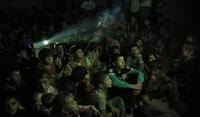
              Instead of a regular video programme, it takes the form of a rite of passage in which visions (videos), texts, sounds, rituals, and breaths are interwoven with shared silence and darkness.

              To open up our vision (4), to open up to the awareness of that which we call film, video… those strange projections of light and shadow that portray worlds and lives, landscapes and feelings that arise in the dark cave of the screening room. It is there, in that shared or solitary darkness, that visions of worlds are incubated… before the emergence of boundaries between the real and the unreal, wakefulness and sleep, life and death… Visions on a white screen that will remain white once the visions of the worlds have disappeared. (5)

              Perhaps an old wound in our culture and our lives is thus healed, the hemispheres come together, other eyes open, and the Turin horse is no longer beaten. (6)

              So as not to separate death from life, each day’s journey will begin by passing through the gates of dreams – death’s twin – and trance, exploring the rituals of farewell and dissolution of the body… A contemplation of dissolution that will lead us to the grateful contemplation of life.

              So Path of Return unfolds as a rite of passage, a journey that we recommend making in full each day (*), to aid in a good crossing through intense and sometimes difficult inner landscapes that may perhaps help us to regain the perception of the unlimited, inappropriable, unrepresentable nature of the Real.

              (*) OVNI will take place from 7 to 11pm each day.

              The CCCB Theatre will open at 7pm. Once the programme starts the doors will remain closed, opening at least twice more in the course of each evening. The Lobby of the Theatre will be open from 7 to 11pm, and a room nearby will be fitted out and equipped with audio recordings for those waiting.

              The Turin Horse ( A torinói ió in the Hungarian original) is a 2011 film directed by Béla Tarr and Ágnes Hranitzky.

              Transcription of the monologue from The Turin Horse :

              The people who come to mind are Palmar Álvarez Blanco, Marco Antonio Regueiro, … and also all those who have already left us during this long period of searching

              Abu Ali, Abrir la Visión, 2016

              http://www.al-barzaj.org/2016/10/abrir-la-vision.html

              This image is often used by Ramana Maharashi.

              According to the oft-repeated story, Nietzsche was in Piazza Carlo Alberto when he noticed the driver of a hansom cab flogging his stubborn horse. Nietzsche ran towards them, threw his arms around the horse’s neck to protect him, and then collapsed on ground.

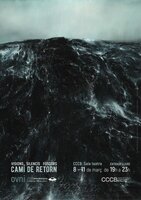
              March 2018, 8th - 11th / 19:00h - 23:00h

              Image de Thierry DE CORDIER, “MER GROSSE”.

              Mahu - Mactar Thiam Faal
              ES ES-OVNI DIF-S010-SS003-0002 · Item · 2013
              Part of Non-Identified Video Observatory (OVNI)

              A conversation at the microMeeting de Ru'a [visions] at the CCCBA. 05.17.2013 "Knowing the West with my own eyes ... Despite globalization, we never see images of the white man working ... We see that he is in a hurry, but who cleans his streets? ... My grandfather told me that the white man He deceives us, tells us that we are poor, but we are not! What happens is that he only knows one level of wealth, the most basic, the most ephemeral and material ... For him, everything that is not visible is madness or superstition ... "