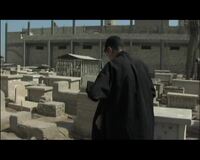
Soraida is a Palestinian woman who lives in Ramallah, in the occupied territories. This video captures her personal struggle to retain her humanity in the midst of oppression. In her neighbourhood, the women do not all wear veils, the men do not rattle off empty political slogans, and the young people do not have bombs strapped to their belts. Life goes on despite the curfews and checkpoints that confine the people in a barless cage. Soraida invites us into her world, and that of her family and neighbours. Through their simple, everyday actions, we discover the worst thing about living under a state of siege: the loss of control over one's own life. In this vibrant plea against the occupation, Soraida shares her reflections on life in Palestine and her refusal to give in to the hate and violence.
UntitledViolencia
46 Archival description results for Violencia
A story of the war in Iraq from a perspective rarely seen. The primary point of view is Iraqi - a family grieving the tragic death of its eldest son. After years of hard work, Ra'ad, an Iraqi portrait photographer, has saved enough money to open his own shop. On the night of the opening, while volunteering to guard the ancient mosque in Kadhimiya, Ra'ad is shot and killed by an American patrol.
UntitledA video about Mumia Abdul Jamal, an Afro-American journalist condemned to death for an incident that has never been cleared up.
This film, shot in the war zones of the Democratic Republic of Congo (DRC), shatters the silence that surrounds the use of sexual violence as a weapon of conflict. Many tens of thousands of women and girls have been systematically kidnapped, raped, mutilated and tortured by soldiers from both foreign militias and the Congolese army. filmmaker Lisa F. Jackson travels through the DRC to understand what is happening and why.
UntitledAn autobiographical tape about the mother-daughter relationship which explores their desire, house-works, illness, violence and the ways the social is inscribed in the body.
A 20 minute short movie-presentation of the insurrection of December 2008 in Greece through the words and actions of people that took part in it. The video was created in Thessaloniki in January 2009 and its first presentation took place before an open discussion-review of the insurrection in the squatted public library of Ano Poli.
UntitledThe film tells of the lives of four young men in a refugee camp who dream of inviting Rogers Waters (Pink Floyd) to give a concert in their camp, thus giving us an insight into the lives of these young men, their struggles and the daily hardships they face in order to survive.
Untitled“Hello, I'm going to read a declaration of war. Within the next 14 days we will attack a symbol of American justice”. - Former Underground Member Bernardine Dohrn. Thirty years ago, with these words, a group of young American radicals announced their intention to overthrow the U.S. government. Fueled by outrage over the Vietnam War and racism in America, they went underground during the 1970s, bombing targets across the country that they felt symbolized “the real violence” that the U.S. government and capitalist power were wreaking throughout the world. From pitched battles with police on Chicago's city streets, to bombing the U.S. Capitol building, to breaking acid-guru Timothy Leary out of prison, this carefully organized clandestine network attempted to incite a national revolution, while successfully evading one of the largest FBI manhunts in history.
UntitledThe title Time Like Zeros is taken from a comment by one of eight female prisoners who narrate the film, as she contemplates the life sentence stretching ahead of her. It is echoed visually in the camera movement that encircles the prison, and in the circles of razor wire that whiz by as the scene moves from the exterior fence to the darkest cells of the prison. A sense of community and compassion can be sensed in the women's voices, yet contrasts with the footage shot by guards as they chain down a woman in the segregation unit.
UntitledWhile the social construction of femininity has been widely examined, the dominant role of masculinity has until recently remained largely invisible. Tough Guise examines the relationship between pop-cultural imagery and the social construction of masculine identities in the U.S. at the dawn of the 21st century.
Untitled