
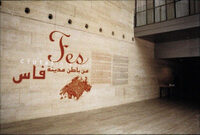
An initiatic journey Videos from an exhibition at the Centre de Cultura Comtemporània de Barcelona from March 26 to May 30, 2002 (a project by Albert Garcia-Espuche and Toni Serra). Into the innermost parts of the city of Fes.Using audiovisual recordings that illustrate some of the different anthropologic, sociologic, urbanistic and religious aspects that make up the fabric of the city. A journey that requires both objectivity (in the working method) and subjectivity (for the experience of the journey and immersion in another culture).

Vida en la Medina
15 Archival description results for Vida en la Medina
Video Concerning the Arab World
TransArab Itinerant 2003-2005
2003 / 2005 / 2006 / 2009 - TransArab
Video Concerning the Arab World
This programme is not intended to provide an overview of independent video in Arab and Islamic countries, nor does it seek to be representative in any way.
The works being presented, like the programme as a whole, reflect the notion of “slices of reality”, in the sense that they are subjective visions, aware of their partiality, which do not exclude contradiction or conflict. Visions that perceive a strong tension on their surface and take up these eddies of confusion and violence as cause for urgent reflection and knowledge.
Images and stories, realities in themselves, rhizomatic realities: interwoven without a centre or a fixed meaning. And for that very reason, instead of giving rise to cultural dualism based on opposition, they engender a web of underground connections.
This film is a cry from the heart of the Medina of Casablanca for its inhabitants and their memory but, above all, for a more humanitarian world. At night, the Medina is embodied by the figure of a draped woman who rides through the alleys. Her mysterious voice comes out of the silence, speaking to the world she once welcomed with open arms; a world which has betrayed her through a stifling economic environment. Her testimony and that of its inhabitants will feed the narrative structure of the film in a poetic way, mixing magic and reality.
UntitledThe urban and social structure of neighbourhoods in the medina is one of vast intricacy and complexity, being organized around a series of vital establishments for the everyday life of their inhabitants, such as the hammam or public baths, the bakery, schools and the foundouk, or caravanserai. Communal bakeries provide the heating for the public baths or hammam, fully active establishments that are very important for the cohesion of the city's social fabric. Foundouks are establishments where visiting merchants traditionally stayed and stored their products overnight. Most have now lost their original function and are adapted for other uses, such as dwellings or workshops.
We follow the director's camera into the kitchens and living rooms of a community of Moroccan women. inside the walls of their apartment in Casablanca's old Medina, the women cook, clean, take care of their families and help each other. With their hands in the dough, in the soap whilst washing the laundry, doing the house chores, in the market or at the hammam, between laughter and tears ("We are housewives, that's all. ... Our sport? House cleaning!"). These courageous women, proud of their role, talk about their miserable lives with a great sense of awareness, but without self-pity. They show a surprising vitality, curiosity for life and solidarity. These house-proud housewives may not all know how to read, but they know exactly what would improve their lives: equal rights for women and men, more money, and a better future for their children so they wouldn't have to emigrate to support the family. A sense of hope and the possibility of change radiate out of the everyday lives of these heroines ("batalett").
An initiatic journey Videos from an exhibition at the Centre de Cultura Comtemporània de Barcelona from March 26 to May 30, 2002 (a project by Albert Garcia-Espuche and Toni Serra). Into the innermost parts of the city of Fes.Using audiovisual recordings that illustrate some of the different anthropologic, sociologic, urbanistic and religious aspects that make up the fabric of the city. A journey that requires both objectivity (in the working method) and subjectivity (for the experience of the journey and immersion in another culture).

A journey of initiation into a city and a its culture. The set of projections (10 screens) aimed to create a journey in the complex sense of the term: using audiovisual segments to illustrate aspects of the anthropological, sociological, urban and religious tissues of the city. A journey claiming both: a certain objectivity (in the working method), and the subjectivity (of the travel experience and approach to another culture). Moreover, the projections do not meet the criteria of a film with a beginning and an end, but rather the creation of a landscape, so the viewer choosed the time he/she wished to dedicated to each fragment. This made it possible to enjoy a deeper level of inquiry to specific fragments (artisans, rituals interviews, etc.). Consequently, the result of each visit to the exhibition gave an unique combinatorial fragments, since the total length of the projections would be about 6 hours. VideoInstallation 10 screens total lenght: 6h 40' Toni Serra , Albert García Espuche CCCB Centre de Cultura Contemporània de Barcelona 2002
UntitledPeople and places citylife in Casablanca. 6th Independent Vídeo & Interactive Phenomena Show - OVNI 2000 Moroccan video panorama.
UntitledA conversation with a woman who washes and massages the women who go to the hammam (public baths), helps bring the neighbourhood children into the world, and to wash the dead.
Anonymous guide. Fes el Bali, the old medina of Fez founded in 809 by Idris II, is still completely contained within city walls. The gates (Bab Bou Jeloud, Bab Fteuh, Bab Er Rsif, Bab Guissa...) therefore retain all their social and symbolic value, associated with the different activities of the city and its inhabitants.