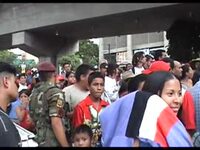
A thirty minute documentary that captures the actions of the Caracas peoples' movements that pulled down the detested statue of Christopher Columbus (Cristobal COLÓN in Spanish) in Plaza Venezuela on the 12th of October 2005. Through its simplicity, this small but historic event opened up new paths in the anti-COLONial subjectivity of the people by provoking a controversy that led to complex debate. Their action opened up thousands of discussions, not just about the depth of the COLONial aculturalisation that we have been subject to as peoples, but also about the danger that the Bolivarian Revolution be used as an alibi by the bureaucratic processes that deny the people their collective and sovereign power to act. This documentary gives voice to the people's struggle for autonomy and continental rebellion that has been gestating for centuries in the belly of Pachamerika.
Calle y Media CooperativaVenezuela
22 Descripció arxivística resultats per al Venezuela
Infiltrating videoclubs.The Zulú and Clear and Present Danger trailers are part of Nascimento/Lovera's edits-inserts video project. By inserting their re-edited versions of commercial films in rental video chain stores, inter-city buses, public television and the black market, they are able to anonymously maximise the distribution of their work, while also questioning the symbolic mechanisms of power which are no longer located in traditional centres of cultural production, but spread throughout everywhere.
Comuna en construcción (Comuna Under Construction) “Influential media's fixation on a charismatic personality such as Hugo Chávez unfortunately means that the countless interesting processes taking place in the country remain hidden.” Oliver Ressler's programmatic remark on his previous film 5 Factories – Worker Control in Venezuela (2006) also applies to his third work produced in Venezuela in collaboration with Dario Azzellini. Comuna Under Construction reveals what the “Socialism of the twenty-first century” propagated by Chávez might mean in practice. In the mode of a simple listening and looking at various gatherings in the poor neighborhoods of the capital Caracas, and also in rural areas, the film accompanies—without comment or interview—a stage of a fascinating process that has taken hold of large segments of the country. Tens of thousands consejos comunales (communal councils) have been founded in Venezuela in the spirit of the new constitution, which greatly emphasizes political participation. These basis democracy neighborhood gatherings attend to housing refurbishment, health care, and garbage pick-up routes, with financial support of the state, and to a great extent do so independently of the local administration. They can, however, also found communal enterprises and decide on the priorities in the city district. Bit by bit, the film uncovers the phenomenon, which might appear from an affluence-accustomed perspective as a compensatory one in the face of a lacking or corrupt administration, as a prospering parallel structure ultimately intended to entirely replace the old state: several councils can join to a commune, several communes, in the end, to a communal town. Comuna Under Construction puts forth for discussion the practice of a—by no means conflict-free—revolution that is not exhausted in the takeover of power, but rather, is defined as a complex construction process leading to the goal of self government of the citizens.

This film aims to reinstate the political experience of organisation and struggle of the Venezuelan people by exploring the history of a barrio in Caracas: 23 de Enero. From the moment it was founded, the popular organisations of 23 de Enero have been major players in the political events that shaped Venezuela's history and led the country into a new kind of revolutionary process with Hugo Chávez's coming into power.
Nuria Vila AlabaoChavez, elected president of Venezuela in 1998, is a colourful, unpredictable folk hero, beloved by his nation's working class and a tough-as-nails, quixotic opponent to the power structure that would see him deposed. Two independent filmmakers were inside the presidential palace on April 11, 2002, when he was forcibly removed from office. they were also present 48 hours later when, remarkably, he returned to power amid cheering aides. Their film records what was probably history's shortest-lived coup d'état. It's a unique document about political muscle and an extraordinary portrait of the man the wall street journal credits with making Venezuela "Washington?s biggest Latin American headache after the old standby, Cuba."
Donnacha O'BrienThrough images, testimonies, press articles, music, demonstrations and traditions, the community of La Vega, an established neighbourhood of the capital, narrates the story of its progress, expansion and consolidation. The foundations for their consistent and self-managed organisation can be found in a deep sense of belonging marked by the manifestations of its indigenous, black and revolutionary roots.
Marc VilláThe application of the new Land Laws, ferociously opposed by livestock farmers and landowners, poses a problematic obstacle for the Bolivarian process in Venezuela. The spiral of demands and paramilitary repression has begun and may end up defining the course of the Bolivarian experience.