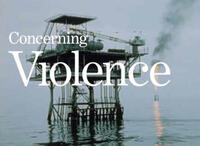
A film by Göran Hugo Olsson Based on Frantz Fanon’s The Wretched of the Earth Narrated by Ms. Lauryn Hill Preface by Gayatri Chakravorty Spivak Including appearances by Thomas Sankara Amílcar Cabral Tonderai Makoni Robert Mugabe FRELIMO MPLA. Concerning Violence is both an archive-driven documentary covering the most daring moments in the struggle for liberation in the Third World, as well as an exploration into the mechanisms of decolonization through text from Frantz Fanon’s The Wretched of the Earth. Fanon’s landmark book, written over 50 years ago, is still a major tool for understanding and illuminating the neocolonialism happening today, as well as the violence and reactions against it. In the middle of the Cold War, radical Swedish filmmakers set out to capture the anti-imperialist liberation movements in Africa first hand. With their 16mm footage, found in the Swedish Television archives, filmmaker Göran Hugo Olsson draws on his experience making The Black Power Mixtape (2011) to create a visual narrative from Africa - images of the pursuit of freedom, the Cold War and Sweden. Swedish filmmakers, with their sense of solidarity with anti-imperial and socialist struggles around the world at the time, created images and stories which still resonate today, and can change and deepen our impression of the globalized world we live in. The people captured by these filmmakers fought with their lives at stake, for their and others’ freedom. The unique archival footage features a nighttime raid with the MPLA in Angola, interviews with the guerrilla soldiers of FRELIMO in Mozambique, as well as with Thomas Sankara, Amílcar Cabral and other African revolutionaries. The imagery is fantastic: clear, crisp and unique films that convey a sense of urgency and dedication that was at the heart of the decolonization movements. ”National liberation, national renaissance, the restoration of nationhood to the people: whatever may be the headings used or the new formulas introduced, decolonization is always a violent phenomenon.” In pictures and interviews, as well as with a narrating voice guiding the audience through the material with the words of Frantz Fanon. Concerning Violence tells the story of the people and ideas behind one of the most urgent struggles for freedom and change in the 20th century. The organization of the film into nine chapters connects quite abstract ideas with concrete images and real people who embody and carry the story. Crafting a form that is unique in its blend of cinematic essay and archival footage documentary, Concerning Violence re-introduces Fanon’s humanist, post-colonial vision through a cinematic journey that brings us face to face with the people for whom Fanon’s writings on decolonization were not just rhetoric, but a reality. In layering Fanon’s text with archive footage, graphic design and music in a contemporary tone, filmmaker Göran Hugo Olsson presents a new generation of audiences with a re-examination of the machinery of colonialism that is at the root of much of the violence we see breaking out in parts of the world today. About the story and production Concerning Violence combines incredible footage from a pivotal time with an iconic text by Frantz Fanon, first published in 1961. A psychiatrist from Martinique who played an active role in the Algerian struggle for liberation, Fanon was a major intellectual voice in support of the decolonization struggles taking place after the Second World War. Fanon’s writings were central to the formation of African thought, which was being crafted during this period of upheaval in the continent by the visionaries of the new African nations - some of whom appear in the featured archive material in the film. Reading The Wretched of the Earth today is an amazing yet unsettling experience, because of how accurate it was in predicting the world today. This text explains the destructive dynamics between the rich and the Third World (a term first coined in the English translation of this book), like nothing else. With absolute precision, Fanon paints an image of an abstract mechanism in the relation between two worlds and sometimes two persons, the colonizer and the ‘native’, but also in relation to international corporations and people living off land containing the natural resources that such corporations seek to exploit – a situation that clearly has contemporary resonance. Fanon also made the critical point that decolonization is something that has to happen in both directions – both the colonized and the colonizer need to be decolonized. As a psychiatrist, he recognized the deep implications of this, as well as the enormous adjustments this would require. He also saw that this would not happen without a tremendous struggle that could take many forms, including what he referred to very controversially as “therapeutic violence”. In a nod to Jean-Paul Sartre’s 1961 preface to The Wretched of the Earth, the film is placed within a contemporary social and historical context in a cinematic preface by Gayatri Chakravorty Spivak, one of the world’s most renowned philosophers and a central theorist of postcolonial consciousness that Fanon helped set into motion - and which is today shaped by developments that he, in his short lifetime, did not witness. In its essence, Concerning Violence is a film about how deeply twisted the relationship is between “Third World” Africa and Europe - in its modern form of neo-imperialism this includes the USA, China, and the Gulf States - and how much harm and injustice this is causing. It is an attempt to understand the profound hypocrisy at the centre of the Western values that underpin our current world order. This text explores what poverty and oppression does to a mind, and why a human being exposed to such exploitation and violence eventually erupts in what to us at a remove may seem like an irrational reaction. In a time of globalization, it is very interesting to explore the extraordinary violence of colonization both ideologically and in practice, and to see that in the context of that legacy, many of the tensions of our time were mapped out long ago. The explosion of violence and contemporary conflict situations in Africa and elsewhere were perhaps entirely predictable. Fanon’s text is narrated in the film by Ms. Lauryn Hill - a respected and socially engaged musical contemporary with an ability to speak to a new generation living in a postcolonial world.