United States of America

Elements area

Taxonomy

Code

Scope note(s)

    Source note(s)

      Display note(s)

        Hierarchical terms

        United States of America

          Equivalent terms

          United States of America

            Associated terms

            United States of America

              746 Archival description results for United States of America

              746 results directly related Exclude narrower terms
              ES ES-OVNI RSC-3387 · Item · 2005
              Part of Non-Identified Video Observatory (OVNI)

              There can be no witnesses to this war. There can be no witnesses because it is based on lies. The only journalists that the Americans allow in Fallujah are embedded with their troops. In spite of this, images such as the one of a marine shooting a wounded, unarmed fighter inside the Mosque at Fallujah have been beamed out to the world. And precisely because these images have gone out, although nobody knows how, and circulated all over the world, the NBC journalist that captured them was immediately expelled from the ranks of embedded journalists. Fallujah, The Hidden Massacre is a documentary by Sigfrido Ranucci and Maurizio Torrealta which first aired on Italy's RAI state television network on November 8, 2005. It testifies to the use of weapons that the film claims are chemical weapons, in particular incendiary bombs, and alleges indiscriminate use of violence against civilians and children by United States of America military forces in the city of Fallujah in Iraq during the November 2004 Fallujah Offensive.

              Untitled
              FEMA Camp Footage
              ES ES-OVNI CTX-S011-SS006-0025 · Item · 1993
              Part of Non-Identified Video Observatory (OVNI)

              Covertly taken footage of a FEMA (Federal Emergency Management Agency) concentration camp under construction. Black Hawk helicopters and trains, surveillance cameras and barbed wires...

              Finally Destroy Us
              ES ES-OVNI RSC-4131 · Item · 1991
              Part of Non-Identified Video Observatory (OVNI)

              This piece continues Kalin's poetic and interpretative use of music married to vision, drawing on a range of images and textures to create a romantic reverie of a relationship between two men. With music by Annie Lennox (composition of Cole Porter) and on a quote from Virginia Woolf. Kalin's short video works function both as visual poems and as alternative music videos. With their astute conjunctions of image, music and text, these tapes respond to issues of sexuality and human interaction in the 1990s, more than a decade into the AIDS crisis. In finally destroy us, Kalin uses found film footage, home movies, and haunting pop music (Annie Lenox singing Cole Porter) to poignantly recall moments of love, shared and lost. The title is taken from Virginia Woolf: "But these meetings, these partings, finally destroy us."

              Untitled
              Fire Under the Snow
              ES ES-OVNI CTX-S013-SS007-0075 · Item · 2008
              Part of Non-Identified Video Observatory (OVNI)

              Palden Gyatso, a Tibetan Buddhist monk since childhood, was arrested by the Chinese communist army in 1959. He spent the next 33 years in prison for the “crimes” of demonstrating peacefully and refusing to falsely denounce his teacher as an Indian spy. He was tortured, starved and forced to perform hard labor. He watched his nation and culture destroyed, his teachers, friends and family displaced, jailed or killed by the Chinese occupiers. Despite this, he remained unbroken, keeping the flame of his spirit ablaze.

              Untitled
              Fit to Be Tied
              ES ES-OVNI CTX-S008-SS003-0008 · Item · 1995
              Part of Non-Identified Video Observatory (OVNI)

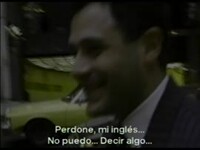
              "Fit To Be Tied" is an individual portrait of the political community, "brokers" and businessmen in the city of Chicago, through a brief interview in which the only question is "Why wear a tie?". The answers, of a rich variety, places us before an individual analyzing their own representation, though less explicitly the portrait is about the link each of these individuals establishes with the camera and with the one who holds it, often recognized as a foreigner.

              Untitled