
ES OVNI RSC-1559
·
Item
·
2000
Part of Non-Identified Video Observatory (OVNI)
United Kingdom (Great Britain)
158 Archival description results for United Kingdom (Great Britain)
158 results directly related
Exclude narrower terms
ES ES-OVNI CTX-S015-SS003-0003
·
Item
·
1989
Part of Non-Identified Video Observatory (OVNI)
Having been tricked by Power and humiliated by the arrogance of those who now wield it, the Pandavas are forced into exile even though they still harbor a desire for justice. They face twelve years of banishment in the wilderness, and a further year during which they must live in disguise and avoid being discovered. The Mahabharata, portrays this exile as a period of extreme hardship in which death is always present – but so is the growing awareness of its opposite. To abandon the palace and swap the city for nature also leads them to renew direct contact with life, embark on a search for knowledge, start a process of cleansing and strengthen the bond of brotherhood. Nevertheless, this strengthening seems to lead back towards war. Part two ends with the famous reflections of the Baghavad Gita in which Krishna responds to the doubts of Arjuna.
Untitled
ES ES-OVNI CTX-S015-SS004-0001
·
Item
·
1989
Part of Non-Identified Video Observatory (OVNI)
After the reflections from the Bhagavad Gita, the war begins: a tragedy that pits brother against brother and sucks up whole families, people of great courage. It is a war of devastating consequences, which does not just threaten the survival of one of the two sides, but the continuity of life on earth. “Even the blades of grass tremble in fear.” A battle in which the clashing sides do not hesitate to use the ultimate weapons. Vishnu himself exclaims: “Now I am become Death, the destroyer of worlds.” This is a war that is also played out inside every human being.
Untitled
ES ES-OVNI CTX-S015-SS002-0003
·
Item
·
1989
Part of Non-Identified Video Observatory (OVNI)
The Mahabharata is one of the world’s greatest books. It is also the longest poem ever written. It was written in Sanskrit, and is about fifteen times the length of the Bible. “Maha” in Sanskrit means “great” or “complete”, “Bharata” is primarily the name of a legendary character, then that of a family or clan. So the title can be understood as “The Great history of the Bharatas”. However in a extended meaning “Bharata” can mean “Hindu”, and, even more generally “Man”. So the Mahabharata could be translated as “The Great history of Mankind”. According to most scholars, the events recounted in The Mahabharata probably have a historical source. Others maintain that the correct interpretation of the poem lies entirely in the direction of myth. Yet others point out the importance of the teaching books in the epic - political, social, moral and religious - and see The Mahabharata as a long treatise of government initiation “As far as we were concerned, this immense poem, which flows with the majesty of a great river, carries an inexhaustible richness which defies all structural, thematic, historic and psychological analysis. Doors are constantly opening which lead to other doors. It is impossible to hold the Mahabharata in the palm of your hand. Layers of subtext, sometimes contradictory, follow upon one another and are interwoven without losing the central theme. The theme is a threat: we live in a time of destruction - everything points in the same direction. Can this destruction be avoided?” Jean-Claude Carrière In our interview with Carrière, he talked about what he sees as the core of the Mahabharata: it is a poem on oblivion. Mankind seems to constantly forget the source of its true nature. Indian tradition says: “Everything in the Mahabharata is elsewhere. What it is not there is nowhere”. Part one, "The Game of Dice", shows us a growing confrontation between two sides battling for power. One side is clearly closer to the idea of dharma than the other, which barely bothers to respect it. To avoid direct hostilities, they decide to play a game of dice; but the game is rigged. Playing with power is a rigged game.
Untitled
ES ES-OVNI CTX-S015-SS007-0011
·
Item
·
1989
Part of Non-Identified Video Observatory (OVNI)
The Mahabharata is one of the world’s greatest books. It is also the longest poem written. It was written in Sanskrit, and is about fifteen times the length of the Bible. “Maha” in Sanskrit means “great” or “complete”, “Bharata” is primarily the name of a legendary character, and then that of a family or clan. So the title can be understood as “The Great history of the Bharatas”. However in an extended meaning “Bharata” can mean “Hindu”, and, even more generally “Man”. So the Mahabharata could be translated as “The Great history of Mankind”. According to most scholars, the events recounted in The Mahabharata probably have a historical source. Others maintain that the correct interpretation of the poem lies entirely in the direction of myth. Yet others point out the importance of the teaching books in the epic - political, social, moral and religious - and see The Mahabharata as a long treatise of government initiation. “As far as we were concerned, this immense poem, which flows with the majesty of a great river, carries an inexhaustible richness which defies all structural, thematic, historic or psychological analysis. Doors are constantly opening which lead to other doors. It is impossible to hold the Mahabharata in the palm of your hand. Layers of subtext, sometimes contradictory, follow upon one another and are interwoven without losing the central theme. The theme is a threat: we live in a time of destruction - everything points in the same direction. Can this destruction be avoided?” Jean-Claude Carrière. In our interview with Carrière, he pointed out what he thinks is the core of the Mahabarata: it is a poem on oblivion. Mankind seems to constantly forget the source of their truly nature. Indian tradition says: “Everything in the Mahabharata is elsewhere. What it is not there is nowhere”.
Untitled
ES ES-OVNI RSC-1580
·
Item
·
2004
Part of Non-Identified Video Observatory (OVNI)
ES ES-OVNI RSC-4314
·
Item
·
2017
Part of Non-Identified Video Observatory (OVNI)
A Green Ray that never features. Instead, we sense it – seeing beyond our own eyes, beyond the hills – we sense it for an instant. We are plunged into the unknowable, beyond the horizon, beyond seeing altogether. In a single 11 minute take, the film takes us from lush sunsets, to beyond the green ray, and into the gloaming, into the heavy night's darkness, where we await the impending storm.
Untitled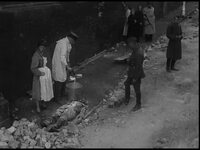
ES ES-OVNI CTX-S015-SS007-0013
·
Item
·
1960
Part of Non-Identified Video Observatory (OVNI)
n this amateur work, Peter Watkins reenacts episodes of the 1956 Hungarian Revolution and continues to develop the methods he had used in The Diary of an Unknown Soldier. As Watkins himself claims, he studied many photographs of this historic event and this probably had an effect on the number of characters who stare directly into the camera, a trait that would eventually become one of the more memorable elements of Watkins’ cinematic language. Watkins breaks away from one of the traditional conventions of cinema: the fiction that the actors aren’t aware of the camera. Paradoxically, it is precisely the reaction of the characters in front of the camera that emphasises the act of filming and destroys the illusion of the film as being faithful to reality, and produces the impression that the action that unfolds is authentic documentary. The camera shakes in the moments of violence and the image is out of focus, adopting the aesthetics of television news reports.
Untitled
ES ES-OVNI CTX-S012-SS007-0054
·
Item
·
1962
Part of Non-Identified Video Observatory (OVNI)
William Burroughs was undoubtedly one of the most influential artists of the twentieth century. Amongst those who cite him as an influence are Clive Barker, Patti Smith, REM, U2, David Bowie, Lou Reed, Laurie Anderson, Cabaret Voltaire and the late Kurt Cobain, many of whom he collaborated with. His extensive literary legacy is constantly reprinted as each new generation study the man who influenced modern contemporary literature more than any other writer.
ES ES-OVNI RSC-4308
·
Item
·
2012
Part of Non-Identified Video Observatory (OVNI)
A silent short, focusing on the beauty and melancholia of seeing horses in the cold fog, and the metaphors that manifest, as time passes.
Untitled