Sweden

Elements area

Taxonomy

Code

Scope note(s)

    Source note(s)

      Display note(s)

        Hierarchical terms

        Sweden

          Equivalent terms

          Sweden

            Associated terms

            Sweden

              18 Archival description results for Sweden

              Beauty Refugee
              ES ES-OVNI CTX-S014-SS001-0053 · Item · 2009
              Part of Non-Identified Video Observatory (OVNI)

              Twenty-eight members of filmmaker Claudia Lisboa's family have been operated at least once by her brother, who is a plastic surgeon in Belo Horizonte, Brazil. Her sister Juliana can't look angry thanks to her anti-wrinkle injections, Sergio himself has undergone four nose reductions, and their mother has had so many facelifts she is ageless. Claudia is the only one who has been spared the knife, and that's a real eyesore for the rest of them. She calls herself a “beauty refugee” and lives in Sweden, far away from the obsessions of her Brazilian family. In this personal documentary the filmmaker tries to reconstruct her youth and explores her own penchant for perfection.

              Bullshit
              ES ES-OVNI CTX-S012-SS004-0011 · Item · 2005
              Part of Non-Identified Video Observatory (OVNI)

              Her opponents call her “The Green Killer”. They gave her “The Bullshit Award” for sustaining poverty. TIME says she is a hero of our times, an icon for youngsters all over the world. In this documentary, the filmmakers follow Vandana Shiva over a two-year period, from her organic farm at the foot of the Himalayas to institutions of power all over the world. Here Vandana Shiva does battle with one of her toughest opponents, Monsanto, a huge American biotech company, when they try to patent an ancient Indian strain of wheat.

              ES ES-OVNI CTX-S017-SS001-0001 · Item · 2014
              Part of Non-Identified Video Observatory (OVNI)

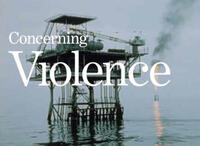
              A film by Göran Hugo Olsson Based on Frantz Fanon’s The Wretched of the Earth Narrated by Ms. Lauryn Hill Preface by Gayatri Chakravorty Spivak Including appearances by Thomas Sankara Amílcar Cabral Tonderai Makoni Robert Mugabe FRELIMO MPLA. Concerning Violence is both an archive-driven documentary covering the most daring moments in the struggle for liberation in the Third World, as well as an exploration into the mechanisms of decolonization through text from Frantz Fanon’s The Wretched of the Earth. Fanon’s landmark book, written over 50 years ago, is still a major tool for understanding and illuminating the neocolonialism happening today, as well as the violence and reactions against it. In the middle of the Cold War, radical Swedish filmmakers set out to capture the anti-imperialist liberation movements in Africa first hand. With their 16mm footage, found in the Swedish Television archives, filmmaker Göran Hugo Olsson draws on his experience making The Black Power Mixtape (2011) to create a visual narrative from Africa - images of the pursuit of freedom, the Cold War and Sweden. Swedish filmmakers, with their sense of solidarity with anti-imperial and socialist struggles around the world at the time, created images and stories which still resonate today, and can change and deepen our impression of the globalized world we live in. The people captured by these filmmakers fought with their lives at stake, for their and others’ freedom. The unique archival footage features a nighttime raid with the MPLA in Angola, interviews with the guerrilla soldiers of FRELIMO in Mozambique, as well as with Thomas Sankara, Amílcar Cabral and other African revolutionaries. The imagery is fantastic: clear, crisp and unique films that convey a sense of urgency and dedication that was at the heart of the decolonization movements. ”National liberation, national renaissance, the restoration of nationhood to the people: whatever may be the headings used or the new formulas introduced, decolonization is always a violent phenomenon.” In pictures and interviews, as well as with a narrating voice guiding the audience through the material with the words of Frantz Fanon. Concerning Violence tells the story of the people and ideas behind one of the most urgent struggles for freedom and change in the 20th century. The organization of the film into nine chapters connects quite abstract ideas with concrete images and real people who embody and carry the story. Crafting a form that is unique in its blend of cinematic essay and archival footage documentary, Concerning Violence re-introduces Fanon’s humanist, post-colonial vision through a cinematic journey that brings us face to face with the people for whom Fanon’s writings on decolonization were not just rhetoric, but a reality. In layering Fanon’s text with archive footage, graphic design and music in a contemporary tone, filmmaker Göran Hugo Olsson presents a new generation of audiences with a re-examination of the machinery of colonialism that is at the root of much of the violence we see breaking out in parts of the world today. About the story and production Concerning Violence combines incredible footage from a pivotal time with an iconic text by Frantz Fanon, first published in 1961. A psychiatrist from Martinique who played an active role in the Algerian struggle for liberation, Fanon was a major intellectual voice in support of the decolonization struggles taking place after the Second World War. Fanon’s writings were central to the formation of African thought, which was being crafted during this period of upheaval in the continent by the visionaries of the new African nations - some of whom appear in the featured archive material in the film. Reading The Wretched of the Earth today is an amazing yet unsettling experience, because of how accurate it was in predicting the world today. This text explains the destructive dynamics between the rich and the Third World (a term first coined in the English translation of this book), like nothing else. With absolute precision, Fanon paints an image of an abstract mechanism in the relation between two worlds and sometimes two persons, the colonizer and the ‘native’, but also in relation to international corporations and people living off land containing the natural resources that such corporations seek to exploit – a situation that clearly has contemporary resonance. Fanon also made the critical point that decolonization is something that has to happen in both directions – both the colonized and the colonizer need to be decolonized. As a psychiatrist, he recognized the deep implications of this, as well as the enormous adjustments this would require. He also saw that this would not happen without a tremendous struggle that could take many forms, including what he referred to very controversially as “therapeutic violence”. In a nod to Jean-Paul Sartre’s 1961 preface to The Wretched of the Earth, the film is placed within a contemporary social and historical context in a cinematic preface by Gayatri Chakravorty Spivak, one of the world’s most renowned philosophers and a central theorist of postcolonial consciousness that Fanon helped set into motion - and which is today shaped by developments that he, in his short lifetime, did not witness. In its essence, Concerning Violence is a film about how deeply twisted the relationship is between “Third World” Africa and Europe - in its modern form of neo-imperialism this includes the USA, China, and the Gulf States - and how much harm and injustice this is causing. It is an attempt to understand the profound hypocrisy at the centre of the Western values that underpin our current world order. This text explores what poverty and oppression does to a mind, and why a human being exposed to such exploitation and violence eventually erupts in what to us at a remove may seem like an irrational reaction. In a time of globalization, it is very interesting to explore the extraordinary violence of colonization both ideologically and in practice, and to see that in the context of that legacy, many of the tensions of our time were mapped out long ago. The explosion of violence and contemporary conflict situations in Africa and elsewhere were perhaps entirely predictable. Fanon’s text is narrated in the film by Ms. Lauryn Hill - a respected and socially engaged musical contemporary with an ability to speak to a new generation living in a postcolonial world.

              Untitled
              Eduard Munch
              ES ES-OVNI RSC-4085 · Item · 1973
              Part of Non-Identified Video Observatory (OVNI)

              "EDVARD MUNCH is the most personal film I have ever made. Its genesis lies in a visit to the Edvard Munch Museum in Oslo, in 1968, during the time of a screening of several of my films by the Oslo University. I was awestruck by the strength of Munch’s canvases, especially those depicting the sad life of his family, and was very moved by the artist’s directness - with the people in his canvases looking straight at us. I also felt a personal affinity with his linking of past and present, e.g., in the large painting showing the anguish of his family as his sister Sophie is dying: the artist and his brothers and sisters are depicted as adults -as they were in the 1890s when he painted this scene - even though the event had taken place ca. 20 years earlier. On another occasion, I was also very moved by Munch’s masterpiece Death of a Child, hanging in the National Gallery in Oslo; in this painting the artist is broken, and has, in an almost desperate frenzy, blurred the form of his earlier depiction of Sophie’s death. This painting, in its time, was attacked as being “incomplete” - a charge which branded certain of his other works as well". Peter Watkins

              Untitled
              Gitmo
              ES ES-OVNI CTX-S012-SS007-0103 · Item · 2005
              Part of Non-Identified Video Observatory (OVNI)

              After two years of production, “Gitmo - The New Rules Of War” has its movie release. The film starts with a pleasant visit to the prison camp of Guantanamo Bay and embarks on a journey to Washington, Stockholm, Bucharest then to Abu Ghraib in Iraq and slowly.... a new scary world reveals itself.

              Untitled
              Goodnight Beijing
              ES ES-OVNI CTX-S012-SS002-0011 · Item · 2006
              Part of Non-Identified Video Observatory (OVNI)

              A documentary about the city of Beijing which is undergoing enormous changes during the preparations for the summer Olympics 2008. A brand new Beijing, with a vision for the future, is replacing the old imperial capital. In a series of close-ups, we meet the people of Beijing who will lose their homes and face an uncertain future. They have raised their voices against the destruction of their homes and the loss of their city's history for ever.

              Untitled
              Like a Pascha
              ES ES-OVNI RSC-3632 · Item · 2010
              Part of Non-Identified Video Observatory (OVNI)

              "When you feel your teeth hurt, you go to the dentist. And when you need sex, or just to talk to someone... you come here." Welcome to the biggest brothel in europe, a clear blue eleven story high house in the middle of Cologne, Germany. More than 200 women from all over the world work here. If you ask them why, they will tell you it's the way it's always been. More than 700 men come here every day. Inside these walls, no daylight ever reach in. “Orgasm guaranteed” a sign says. ”Only 30 EURO.” This is a world of it's own with their own payment system, hairdresser, manicure, doctor and a 24 hour open staff restaurant. But what is it that is for sale here, really? Is it an orgasm or something else? According to Sonia, prostitute since ten years, a lot of her customers cry with her. Is true satisfaction and closeness really for sale? ”Like a Pascha” seeks out for answer to a question never before answered: why is sex so important for men?

              ES ES-OVNI CTX-S012-SS007-0102 · Item · 2001
              Part of Non-Identified Video Observatory (OVNI)

              After a year of guerrilla warfare in Bolivia with a small group of 52 comrades, Che was now dead. His dream of uniting Latin America through armed revolution had come to an end. The person who, more than any other, has gone down in history as guilty of Che's death is his former lieutenant, Ciro Bustos. When captured, he drew Che's portrait for the Bolivian army. Since then he has been living in silence. He now appears for the first time in a documentary film. His version of the events raises questions about how history is written.

              Untitled
              Steal this Film
              ES ES-OVNI CTX-S012-SS002-0008 · Item · 2006
              Part of Non-Identified Video Observatory (OVNI)

              Documenting the steadfast movement against intellectual property, Part 1 of Steal This Film takes account of the prominent players in the Swedish piracy (copyright infringement) culture: The Pirate Bay, Piratbyrån (Piracy Bureau), and The Pirate Party. It includes a critical analysis of the legal action taken by the Hollywood film industry to leverage economic sanctions by the United States government on Sweden through the WTO, in order to pressure Swedish police into conducting an illegal search and seizure for the purpose of disrupting a competitive distribution channel: The Pirate Bay tracker for P2P Internet file sharing with the BitTorrent protocol.

              Untitled
              ES ES-OVNI CTX-S012-SS004-0007 · Item · 2003
              Part of Non-Identified Video Observatory (OVNI)

              Consumer confidence is what makes the world go round. It is also a destructive force that will eventually bring the earth to ecological collapse. Yet there's hope: a new spectre is haunting the Western World - the spectre of Consumer Unconfidence. Why is the lifestyle of consumerism a source of such rage today? How come the privilege of buying goods does not automatically lead to happiness? Why all this emptiness despite our wealth?

              Untitled