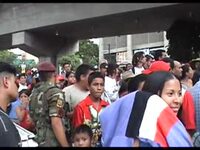
The Ancla2 Photography Cooperative, with the Venezuelan filmmaker and documentarian Rafael Lacau, carry out photography workshops in rural areas of South America, especially with children who have never had contact with a camera. The experience documented here is that of the youngest inhabitants of Tuñame, a town in the Venezuelan Andes. In this production, the children express how they see their community, how they understand problems - especially environmental problems - and what they feel about their reality and the solutions to face it. This documentary is part of the series "Venezuela seen by its children", presented on public television in that country.
Non-Identified Video Observatory (OVNI)Sur America
8 Archival description results for Sur America
The Ancla2 Photography Cooperative, with the Venezuelan filmmaker and documentarian Rafael Lacau, carry out photography workshops in rural areas of South America, especially with children who have never had contact with a camera. The experience documented here is that of the youngest inhabitants of Tuñame, a town in the Venezuelan Andes. In this production, the children express how they see their community, how they understand problems - especially environmental problems - and what they feel about their reality and the solutions to face it. This documentary is part of the series "Venezuela seen by its children", presented on public television in that country.
UntitledThe Bolivarian Revolution of Venezuela as connected to the worldwide movement against capitalist globalization. The evolution of the popular movement in Venezuela from the "Caracazo" riots of 1989 to the massive actions that brought revolutionary president Hugo Chávez back to power, 48 hours after a U.S.-led military coup in 2002. The main theme is how the Bolivarian Revolution, thanks to its incredible grassroots and networking power, is a revolution that transcends the national frontiers of Venezuela and contributes with concrete alternatives to the fight against neoliberal capitalism.
UntitledTo Exist is to Resist is the testimony of a fight that goes beyond the borders of the country where it takes place: the fight for a home. The film offers a reflection on private property from the perspective of those who have already taken over more than 160 buildings in the country of the Bolivarian Revolution. Throughout the film, we are taken into the heart of the “National Committee for the Homeless” by means of its main protagonists, dreamer-soldiers, “tomadores”, who take abandoned buildings in order to give them back to the people who built their ceilings and walls, and could only look at the locked door from the outside...
Kim, Harold, Miguel Duque, Ratablanca y Cross-T “We say there is social war when everything gets reduced to a plan. All of the possibilities for creation and existence that all of us want for ourselves, what we call life, require the availability of resource this purpose. Symbolic, imaginary, actual, physical resources. If this doesn't happen, then what is democracy? Democracy is a potentiality. Is the urge towards creativity and complexity, which exists as potential in every life, fulfilled or is it not fulfilled' If it is not fulfilled, then what is democracy? The way we see it, democracy means that those who produce the world can produce it entirely. Not that some produce it, and the rest obey”. Colectivo Situaciones, Argentina.
Through images, testimonies, press articles, music, demonstrations and traditions, the community of La Vega, an established neighbourhood of the capital, narrates the story of its progress, expansion and consolidation. The foundations for their consistent and self-managed organisation can be found in a deep sense of belonging marked by the manifestations of its indigenous, black and revolutionary roots.
UntitledChavez, elected president of Venezuela in 1998, is a colourful, unpredictable folk hero, beloved by his nation's working class and a tough-as-nails, quixotic opponent to the power structure that would see him deposed. Two independent filmmakers were inside the presidential palace on April 11, 2002, when he was forcibly removed from office. they were also present 48 hours later when, remarkably, he returned to power amid cheering aides. Their film records what was probably history's shortest-lived coup d'état. It's a unique document about political muscle and an extraordinary portrait of the man the wall street journal credits with making Venezuela "Washington?s biggest Latin American headache after the old standby, Cuba."
UntitledA thirty minute documentary that captures the actions of the Caracas peoples' movements that pulled down the detested statue of Christopher Columbus (Cristobal COLÓN in Spanish) in Plaza Venezuela on the 12th of October 2005. Through its simplicity, this small but historic event opened up new paths in the anti-COLONial subjectivity of the people by provoking a controversy that led to complex debate. Their action opened up thousands of discussions, not just about the depth of the COLONial aculturalisation that we have been subject to as peoples, but also about the danger that the Bolivarian Revolution be used as an alibi by the bureaucratic processes that deny the people their collective and sovereign power to act. This documentary gives voice to the people's struggle for autonomy and continental rebellion that has been gestating for centuries in the belly of Pachamerika.
Untitled