Sufismo

Elements area

Taxonomy

Code

Scope note(s)

    Source note(s)

      Display note(s)

        Hierarchical terms

        Sufismo

          Equivalent terms

          Sufismo

            Associated terms

            Sufismo

              27 Archival description results for Sufismo

              ES ES-OVNI DIF-S002 · Series · 2003/2009
              Part of Non-Identified Video Observatory (OVNI)

              Video Concerning the Arab World

              TransArab Itinerant 2003-2005

              2003 / 2005 / 2006 / 2009 - TransArab

              Video Concerning the Arab World

              This programme is not intended to provide an overview of independent video in Arab and Islamic countries, nor does it seek to be representative in any way.

              The works being presented, like the programme as a whole, reflect the notion of “slices of reality”, in the sense that they are subjective visions, aware of their partiality, which do not exclude contradiction or conflict. Visions that perceive a strong tension on their surface and take up these eddies of confusion and violence as cause for  urgent reflection and knowledge.

              Images and stories, realities in themselves, rhizomatic realities: interwoven without a centre or a fixed meaning. And for that very reason, instead of giving rise to cultural dualism based on opposition, they engender a web of underground connections.

              7 Contemplaciones
              ES ES-OVNI CTX-S020-SS003-0007 · Item · 2016
              Part of Non-Identified Video Observatory (OVNI)

              “You can see a bird in flight and watch to observe it, or feel that you are flying with it. That is contemplation, becoming the other.” Hafiz. Despite (or because of) its apparent calmness, contemplation is the state that most radically dissolves and liberates the self. Through contemplation, the other gradually seeps into us like gentle rain ... without realising it, we suddenly start to see ... the world is not outside us and nothing is lifeless ... images appear and disappear over the silence of that which has no name or form ... like the blinking of something that isn’t our eyes... perhaps then the inner teacher will appear intimately... you will recognise him because all that has withered blooms again ... then we will know that the sky can also be stone and feet can walk on clouds and ... But make sure you do not name him ... for he will vanish.

              Al Barzaj
              ES ES-OVNI CTX-S014-SS001-0135 · Item · 2010
              Part of Non-Identified Video Observatory (OVNI)

              Al Barzaj [Between the worlds] is a poem about the halfway world, between the visible and the invisible, sleep and wakefulness... An inner journey through underground streets, secret gardens.

              Untitled
              Between Worlds *1
              ES ES-OVNI DIF-S009 · Series · 2021
              Part of Non-Identified Video Observatory (OVNI)

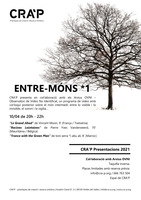
              CRA’P in collaboration with the Archives OVNI – Observatory of Video Not Identified, presents a video program with a subsequent discussion about the intermediate world: between the visible and the invisible, sleep and wakefulness ...

              “ Le Grand Jihad” by Vincent Moon, 9’ (France / Chechnya). No dialogue.

              One of the most beautiful and significant practices of the great jihad is the ritual ceremony of dhikr (zikr). Arabic word that means memory ... an intimate reconnection - but within a collective ceremony - with the mystery of the Real ... that is, with the indefinable, un-representable, inappropriate ... beyond all measure, physical or rational.

              “ Racines Lointaines“ by Pierre Yves Vanderweerd, 70’ (Mauritania / Belgium). VO. Arabic, French.

              Subtitles in Spanish.

              Travel through Mauritania in search of a tree. Throughout the journey, encounters with men and women who share their ways of seeing the world and life. For some, the tree is a sign from the invisible world, or a call from the light ... for others it is a tree only seen when you get lost.

              “ Trance with the Green Man” by toni serra *) abu ali, 8’ (Morocco). No dialogue.

              A search for Al-Jádir الخضر, the inner master. Al-Jádir, literally means the one who grows green, inhabits the intermediate world, the no man's land. The fine gap between the real and the unreal, life and death, sleep and wakefulness.

              Limited places with prior reservation: info@cra-p.org / 666 763 504

              CRA'P - pràctiques de creació i recerca artística

              08100 Mollet del Vallès

              http://www.cra-p.org/

              http://www.cra-p.org/

              ES ES-OVNI CTX-S017 · Series · 2015
              Part of Non-Identified Video Observatory (OVNI)

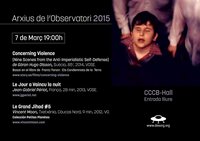
              Concerning Violence / Le Grand Jihad / Le Jour a Vaincu la Nuit

              / CONTEXT 1994 - 2020

              Observatory Archives 2015

              March 7th 2015 19:00h

              OVNI opens up public access to the Intranet of the Observatory Archives, founded in 1993. To launch this new phase, we will screen a programme of videos that establish the two poles of this project, which span from social critique at one end, to personal exploration at the other. Concerning Violence by Göran Hugo Olsson with texts by Frantz Fanon, Le Grand Jihad by Vincent Moon , a ritual around memory, and Le Jour a Vaincu la nuit, by Jean-Gabriel Périot, another around dreams.

              OVNI Archives Intranet.

              OVNI opens up public access to the Intranet of the Observatory Archives, founded in 1993, at the CCCB. The collective behind OVNI considers that audiovisual creation (video art, documentary, and media archaeology) is more than just a creative, innovative, and aesthetic discourse... it is the most contemporary and non-elitist reflection on today’s culture and society.

              It is a collective visual thinking that reflects social, personal, poetic and political realities... flowing smoothly from reality to fiction. And its specificity makes it both a device for the construction of imaginaries and a tool for deconstruction.

              In The Society of the Spectacle, Guy Debord wrote that when reality is captured and turned into mere images, these images become reality: a mechanism that consolidates the unreal core of our reality. It seem to us then, as a counterpoint, that reality itself is at stake in the creation and dissemination of images. This is why it is necessary to develop an independent audiovisual discourse: independent of commissioning dynamics, independent in regard to the choice of subject matter and the approach, and above all independent of the prefabricated norms and grammars of the audiovisual industry and its consumption and production criteria. This entails a differential defence of the perception of reality. The mechanisms of cloning and the monoform (Peter Watkins) are countered by a rhizome of unique approaches, overlapping coincidences and disparities that do not exclude contradiction, but instead value it as the presence of reality in the images.

              Fortunately, the same market logic that flooded the landscape with banal images and with devices for recording, editing, and spreading images has also enabled the democratisation of access to the means of production and has broken the audiovisual oligopoly, downplaying the importance of the big mainstream channels.

              However, we need to take advantage of this window of possibility, which may remain open for a shorter time than we imagine. He have to go beyond the fog of compulsive images that flood the networks, and pierce the veil of media images, the master copy of the film that aims to reduce reality to the order of representation, and individuals to a handful of stereotypes.

              This process of audiovisual dissidence and resistance has been, and remains, fundamental. The mirror of representation has shattered into thousands of fragments: pieces that are deep cuts in reality and at the same time reflections of it.

              We suddenly enter a complex rhizome (Deleuze_Guattari) of stories that reflect plural reality. A discourse in which the principal values are heterogeneity, contradiction, and subjectivity. An antidote to the cloning and repetition of the corporate mass media. In this rhizome made up of disparate visions, the vision that the mass media presents as objective reality is deconstructed, and revealed as the subjective imaginary of the dominant discourse.

              We could say that there is a conflict of imaginaries. On one side, the omnipresent, formidable machine for the production and dissemination of prefabricated messages, creating a range of versions based on the same basic pattern as any other consumer product: to maximise profits and ensure its own continuity. On the other side, a kind of artisan patchwork of personal or collective experiences, a patchwork that has been torn in places and is full of life.

              Fragment of the article-interview on OVNI by the magazine:

              Intertartive [a platform for contemporary art and thought]. Herman Bashiron

               http://interartive.org/2011/04/ovni/

              “In an age where show business – too often mistaken for the world of culture - has become a model for real life, where fiction and reality melt into the one solution, and where physical and mental solidity dissolve into a continuous flow of images and appearances, here, in this intricate and complex mutation of reality, the work of OVNI offers an antidote to the poisons of contemporary information and communication. For over twenty years, it has been a “Temporary Autonomous Zone” – as Hakim Bey, collaborator of one of the editions of OVNI, would say –, presenting an intense programme of video art, independent documentary and mass media archaeology at the CCCB in Barcelona and beyond. The in-depth research carried out by OVNI clearly shows how independent audiovisual productions are gaining increasing visibility and international recognition and, at the same time, they are devices that are highly critical of contemporary culture and society."

              The Intranet Archives.

              The launch of this Intranet of the OVNI Archives at the CCCB makes approximately 2000 audiovisual works – the entire holdings of the Archives – available to the public. A collection of works that we will continue to build on with new acquisition, as in the case of the works screened at the launch, which will be incorporated into the archive.

              The Observatory Archives: A tool.

              Over the last few years, various developments have forced us to review our project, leading us to closely examine the real characteristics and functionalities of other parallel projects: how they work and how they are used.

              It is necessary to think critically about what archives are, and about the value of an archive. This is the case now more than ever, against the backdrop of the compulsive creation of numerous Archives over the past ten years, most of which are based on accumulative criteria: either the accumulation of existing dominant values (a "who's who" of a particular audiovisual scene) or simply a quantitative accumulation. In contrast, the OVNI Archives are the result of specific reflection on a continuum of themes that have been crucial in recent decades; a reflection that has been woven into the works themselves, in a kind of meta search. We could say that they are archives with a thesis; they have gone against the flow of dominant thinking and fads.

              At the same time, there is only limited value in archives that can be consulted but are isolated and fossilised. Archives become valuable when they can be read, when they can create meanings, suggest transversal readings and intersections. Being accessible to the public is one condition that allows this, but it does not guarantee or facilitate it. It is the knowledge generated by the Archives, and above all, the knowledge that has been generated through them, that makes it possible to make the most out of them: as a base from which to organise workshops, debates, specific programmes... This is the project that we are working on; the launch of this Intranet is only the first step.


              des_Realidad, Pablo Beneito
              ES ES-OVNI CTX-S014-SS001-0133 · Item · 2011
              Part of Non-Identified Video Observatory (OVNI)

              The Observatory Archives invites Pablo Beneito to reflect on this subject as a contribution to OVNI dis_Reality Pablo Beneito has a PhD in Arabic philology from Universidad Complutense de Madrid. He was professor in the Department of Arabic and Islamic Studies at the University of Seville, and currently holds the same post at the University of Murcia. He has been a guest lecturer at École Practique des Hautes Études de la Sorbona, Kyoto University (Asafas), Universidade Federal de Juiz de Fora (Brazil) and the Toledo School of Translators (2002-2003). An Islamologist specialising in the study of Sufism, he has published first editions and and translations of Ibn Arabí: Las contemplaciones de los misterios, El secreto de los nombres de Dios, in Spanish and French, and The Seven Days of the Heart, in English.

              En el camino de las abejas
              ES ES-OVNI CTX-S020-SS003-0006 · Item · 2018
              Part of Non-Identified Video Observatory (OVNI)

              In a time that is becoming difficult for bees (as for us) In a year of severe drought, in a country that is already often arid, taking the path of bees has been to make a journey through moors and mountains, but also through states of mind, obstacles and encounters .. until reach their generous garden. Video made for the BEEHAVE exhibition, Joan Miró Foundation 02/16/2018 - 05/21/2018. Available online until December 27th 2020.

              For the Birds
              ES ES-OVNI CTX-S008-SS002-0014 · Item · 2000
              Part of Non-Identified Video Observatory (OVNI)

              Part three of a cycle of digital video works I'm beginning to call -after Bataille- "Theory of religion, theory of ecstasy." The other two parts are Mirror and The Zapruder Footage. This tape is inspired by the 11th century Sufi mystical text The Conference of the Birds. It is a text which explores transparency and opacity, multiplicity and unity, narrative and insight, the mundane and the ecstatic. I include a postscript from the text which I included at the end of the tape, and perhaps best responds to the attempt to phrase it: "Seek the trunk of the tree and do not worry whether the branches do or do not exist."

              ES ES-OVNI CTX-S017-SS001-0003 · Item · 2012
              Part of Non-Identified Video Observatory (OVNI)

              collection Petites Planètes. ‘Jihad’ is a fundamental Arab concept. In these times of conflict and violence, we only hear the mass media version – the extreme meaning of the term, which has strayed from its original sense – while its deeper meaning is ignored. Jihad can be translated as effort, commitment, and struggle in the broad sense. It is a concept and an experience with two different levels, one subordinate to the other. On one hand there is the ‘small jihad’ which has to do with effort, with the communal struggle to attain a society that is fairer and more aware of the mystery of reality (Al-Haqq) and of life (Al Hayy), which are two of the names of Allah. And the other is the ‘great jihad’, which is considered more important, and which determines whether the success, failure, or digression of the small jihad. This great struggle is the inner quest, the effort to cleanse everything inside us that distances mankind from the real... everything that favours a world made up of separate, selfish entities, a world that is closed, appropriable, and doomed to conflict. One of the most beautiful and profoundly meaningful practices of the great jihad is the ritual ceremony of ‘dhikr’ (zikr), an Arabic word that means memory... and in this context refers specifically to the memory of Allah... a personal reencounter - within a collective ceremony - with the mystery of the Real... in other words, with that which is cannot be defined, represented, or appropriated... that which is beyond physical or rational measure. According to this tradition, only one organ is capable of accommodating such an immensity: the human heart. Sufism struggles to remain within the heart of Islam. And in suffering Chechnya, Sufism is the most widespread form of Islam. Vincent Moon and Bulat Khalylov recorded a beautiful, immersive form of the experience of this dhikr ceremony.

              Untitled