
Sueños

Elements area

Taxonomy

Code

Scope note(s)

    Source note(s)

      Display note(s)

        Hierarchical terms

        Sueños

          Equivalent terms

          Sueños

            Associated terms

            Sueños

              16 Archival description results for Sueños

              16 results directly related Exclude narrower terms
              2017 - The Unseen Workshop
              ES ES-OVNI TS-S001 · Series · 2017
              Part of Non-Identified Video Observatory (OVNI)

              2017 - The Unseen Workshop

              / TONI SERRA *) ABU ALI

              Toni Serra *) Abu Ali

              An activity in the framework of OVNI programme for 2017 at the Centre de Cultura Contemporània de Barcelona that proposes -with the help of videos and texts- to go in depth into the notion of the invisible. Given by Toni Serra (Abu Ali), the workshop goes from the political to the poetic, or from poetry to mysticism.

              From forced invisibility to permanent exhibition in the panopticon. The image as a veil. Tunnels of reality. The reality of the dream. Crossing the other side. On contemplation. The one and the multiple.

              You are asleep and your vision is a dream; all you are seeing is a mirage. (1)

              Capitalism’s gigantic audio-visual machine, like all its machines, is driven by an extractivist impulse: life as an infinite reservoir to be exploited. It makes sense to counter this instrumentalist drive with a method based on collaboration, immersion, and commitment that weaves together the creators of images and their environment, and does not turn them into mere agents at the service of that machine. However, there is a danger that this measure alone will be insufficient and reversible, unless it is accompanied by a radical critique of the notion of vision that has prevailed in the dominant global culture: if we do not consider vision’s capacity to extract but also to involve and project, if we do not deconstruct the visual language that implements the colonisation of time and of perception....

              We normally associate images with vision, but in the society of global capitalism the use of images as spectacle (2) has turned vision into a kind of blindness, creating an imaginary woven from a huge number of images that are renewed and also replicated unceasingly. A tissue that solidifies until it forms a dense veil of images that not only hinders vision and obstructs direct experience, but also tends to colonise our realities and dreams, while plundering deposits of fantasy (3) and personal or shared imaginaries. A dominant reality that threatens the fabric of other realities, that threatens to wipe out forms of knowledge, landscapes, people, ways of life, affects... As if a thousand libraries of Alexandria, still embedded in people’s daily lives, in their chores, their places, were already burning once again.

              Much has been said about the manipulative nature of media images, their capacity to deflect, distort, and distract the senses, creating a vision of reality that is completely biased on favour of the big economic powers. A huge, seemingly diverse, audio-visual production machine, in the hands of a few private, government, or hybrid corporations. But the real power of these images does not lie in denying, coercing, or manipulating (which always generate resistance and thus opposition), but in claiming to build, to constitute, to give space and make meaning. In other words, to create an imaginary and offer a place, an individual or creative role in that master film that will then be projected under the heading of “reality”. Of course it is no more real than a theme park or a shopping mall that simulates town squares, street musicians, and even action scenes...

              This spectacle-reality is forged in the constant, high centrifugation of labels: news, fiction, advertising, education, entertainment, training, and so on. Themes and concepts are mixed together, and so is the syntax of consumption, permutating them in time and space until they become indistinguishable or their differences become irrelevant, once they are consumed and absorbed as part of the same segment of experience.

              Audio-visual media have undergone radical change and hybridisation under the impetus of the new consumer, entertainment, and socialisation technologies. They have partly yielded the oligopoly of the means of audio-visual production, and are now complemented (and challenged) by the massive spread of devices for recording, editing, and disseminating images. They have hybridised with other media based on micro-segments of information and opinion..., creating a dense media ambience in which TV news, advertising, video games, film, advertorials, and social media are constantly in self-referential mode. Inspired by marketing strategies and informed by the personal information that is “voluntarily” provided on so-called social networks, critical voices also take on a spectacle-role. An implementation of a new version of the panopticon, given that any “social” element of these networks dissolves with the ownership, management, and use of the data they amass.

              Models are no longer simply projected onto passive viewers, like in the old Hollywood dream factory. Instead, what were formerly audiences are offered an “opportunity to participate”, a chance for interaction that gives them an active leading role in a pre-written script. Stories, feelings, private and shared dramas, aspirations, desires, dreams, fears, likes and dislikes, emotions and ideas, are the raw material that fuels the great accumulation machine, always geared towards obtaining and maintaining maximum profit in the form of financial or cognitive capital. In this context, as Pasolini saw, free participation and interaction paradoxically coexists with looting and plunder, with the exploitation of the enormous experiential and cultural reservoirs, the personal and collective realities of those who participate, whose reality either becomes productive or is cancelled. The “raw material” is used according to the financial logic of marketing and the politics of control. It is extracted, inserted into the timeline (4), filtered, and put back on screen in the form of the global imaginary.

              The dominant power presents itself in an outward-oriented imaginary, but this does not mean that it is only used on forms and surfaces. Rather, it provokes and forces the interior – anonymous, hidden, insignificant – to flow towards the surface, to be reduced to it, to show and advertise itself and ultimately become only that outwardness. Only thus can it be mapped in its entirety, its identities grouped and produced, experts assigned, and goods targeted to it.

              The sleep of our era is not a good sleep that provides rest. It’s an anxious sleep that leaves you feeling even more worn out (...) There is a narcosis that begs for an even deeper narcosis . (5)

              This is the sleep that gives rise to “capitalist realism” (6), which mainly affects people living in the central parts of the global system, where capitalism tends to seem unfair but unavoidable, with no conceivable alternative. Mark Fisher, who coined the term, describes it as the impossibility of there being space for an alternate possibility within a capitalist framework.

              Capitalist realism cannot be confined to art or the quasi-propagandistic way in which advertising functions. It is more like a pervasive atmosphere, conditioning not only the production of culture but also the regulation of work and education, and acting as a kind of invisible barrier constraining thought and action. (7)

              Capitalist realism, implemented as a hegemonic ideology, consists of the conviction that there is no alternative to the paradigm of capitalist social organisation, and also of its own means of reproduction and dissemination to most of the population.

              As we have seen, the image industry and the media are essential for projecting this capitalist realism onto the social screen. Two of its media strategies are notable for their capacity to go viral.

              The first, presented as “information” and “objectivity”, consists of what we could call the creation and export of the visual concept of poverty. Through images (preferably taken from countries on the global periphery), news and mainstream documentaries present decontextualised, re-situated visual segments that illustrate the dominant idea of poverty for “central” audiences and export it as a global imaginary. At the same time
              ES ES-OVNI CTX-S006-SS002-0001 · Item · 1996
              Part of Non-Identified Video Observatory (OVNI)

              Stories of dreams and memories of Japanese women. In this award winning documentary, Shelly Silver presents an intimate portrait of a group of Japanese women ranging in age from 15 to 82, talking about their lives, families and society. In these stories one can begin to see, from very personal and individual perspectives, the societal changes that have occurred over the last three generations for women in Japan, bringing an exciting and often conflicting array of choices and positions. Many of the stories revolve around the relationships these grandmothers, mothers and daughters have with each other, filled with respect, rebellion, loss and love.  

              ES ES-OVNI CTX-S017 · Series · 2015
              Part of Non-Identified Video Observatory (OVNI)

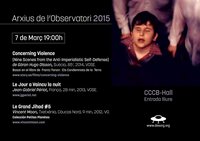
              Concerning Violence / Le Grand Jihad / Le Jour a Vaincu la Nuit

              / CONTEXT 1994 - 2020

              Observatory Archives 2015

              March 7th 2015 19:00h

              OVNI opens up public access to the Intranet of the Observatory Archives, founded in 1993. To launch this new phase, we will screen a programme of videos that establish the two poles of this project, which span from social critique at one end, to personal exploration at the other. Concerning Violence by Göran Hugo Olsson with texts by Frantz Fanon, Le Grand Jihad by Vincent Moon , a ritual around memory, and Le Jour a Vaincu la nuit, by Jean-Gabriel Périot, another around dreams.

              OVNI Archives Intranet.

              OVNI opens up public access to the Intranet of the Observatory Archives, founded in 1993, at the CCCB. The collective behind OVNI considers that audiovisual creation (video art, documentary, and media archaeology) is more than just a creative, innovative, and aesthetic discourse... it is the most contemporary and non-elitist reflection on today’s culture and society.

              It is a collective visual thinking that reflects social, personal, poetic and political realities... flowing smoothly from reality to fiction. And its specificity makes it both a device for the construction of imaginaries and a tool for deconstruction.

              In The Society of the Spectacle, Guy Debord wrote that when reality is captured and turned into mere images, these images become reality: a mechanism that consolidates the unreal core of our reality. It seem to us then, as a counterpoint, that reality itself is at stake in the creation and dissemination of images. This is why it is necessary to develop an independent audiovisual discourse: independent of commissioning dynamics, independent in regard to the choice of subject matter and the approach, and above all independent of the prefabricated norms and grammars of the audiovisual industry and its consumption and production criteria. This entails a differential defence of the perception of reality. The mechanisms of cloning and the monoform (Peter Watkins) are countered by a rhizome of unique approaches, overlapping coincidences and disparities that do not exclude contradiction, but instead value it as the presence of reality in the images.

              Fortunately, the same market logic that flooded the landscape with banal images and with devices for recording, editing, and spreading images has also enabled the democratisation of access to the means of production and has broken the audiovisual oligopoly, downplaying the importance of the big mainstream channels.

              However, we need to take advantage of this window of possibility, which may remain open for a shorter time than we imagine. He have to go beyond the fog of compulsive images that flood the networks, and pierce the veil of media images, the master copy of the film that aims to reduce reality to the order of representation, and individuals to a handful of stereotypes.

              This process of audiovisual dissidence and resistance has been, and remains, fundamental. The mirror of representation has shattered into thousands of fragments: pieces that are deep cuts in reality and at the same time reflections of it.

              We suddenly enter a complex rhizome (Deleuze_Guattari) of stories that reflect plural reality. A discourse in which the principal values are heterogeneity, contradiction, and subjectivity. An antidote to the cloning and repetition of the corporate mass media. In this rhizome made up of disparate visions, the vision that the mass media presents as objective reality is deconstructed, and revealed as the subjective imaginary of the dominant discourse.

              We could say that there is a conflict of imaginaries. On one side, the omnipresent, formidable machine for the production and dissemination of prefabricated messages, creating a range of versions based on the same basic pattern as any other consumer product: to maximise profits and ensure its own continuity. On the other side, a kind of artisan patchwork of personal or collective experiences, a patchwork that has been torn in places and is full of life.

              Fragment of the article-interview on OVNI by the magazine:

              Intertartive [a platform for contemporary art and thought]. Herman Bashiron

               http://interartive.org/2011/04/ovni/

              “In an age where show business – too often mistaken for the world of culture - has become a model for real life, where fiction and reality melt into the one solution, and where physical and mental solidity dissolve into a continuous flow of images and appearances, here, in this intricate and complex mutation of reality, the work of OVNI offers an antidote to the poisons of contemporary information and communication. For over twenty years, it has been a “Temporary Autonomous Zone” – as Hakim Bey, collaborator of one of the editions of OVNI, would say –, presenting an intense programme of video art, independent documentary and mass media archaeology at the CCCB in Barcelona and beyond. The in-depth research carried out by OVNI clearly shows how independent audiovisual productions are gaining increasing visibility and international recognition and, at the same time, they are devices that are highly critical of contemporary culture and society."

              The Intranet Archives.

              The launch of this Intranet of the OVNI Archives at the CCCB makes approximately 2000 audiovisual works – the entire holdings of the Archives – available to the public. A collection of works that we will continue to build on with new acquisition, as in the case of the works screened at the launch, which will be incorporated into the archive.

              The Observatory Archives: A tool.

              Over the last few years, various developments have forced us to review our project, leading us to closely examine the real characteristics and functionalities of other parallel projects: how they work and how they are used.

              It is necessary to think critically about what archives are, and about the value of an archive. This is the case now more than ever, against the backdrop of the compulsive creation of numerous Archives over the past ten years, most of which are based on accumulative criteria: either the accumulation of existing dominant values (a "who's who" of a particular audiovisual scene) or simply a quantitative accumulation. In contrast, the OVNI Archives are the result of specific reflection on a continuum of themes that have been crucial in recent decades; a reflection that has been woven into the works themselves, in a kind of meta search. We could say that they are archives with a thesis; they have gone against the flow of dominant thinking and fads.

              At the same time, there is only limited value in archives that can be consulted but are isolated and fossilised. Archives become valuable when they can be read, when they can create meanings, suggest transversal readings and intersections. Being accessible to the public is one condition that allows this, but it does not guarantee or facilitate it. It is the knowledge generated by the Archives, and above all, the knowledge that has been generated through them, that makes it possible to make the most out of them: as a base from which to organise workshops, debates, specific programmes... This is the project that we are working on; the launch of this Intranet is only the first step.

              Dreaminess 1
              ES ES-OVNI DIF-S011 · Series · 2022
              Part of Non-Identified Video Observatory (OVNI)

              CRA'P - pràctiques de creació i recerca artística

              25 March from 19:30h to 21:30h

              • “Les Dormants“ by Pierre-Yves Vanderweerd , 65’ (Belgium) (2009). VO. French. Subtitles in Spanish.

              The four stories in this film transports us from Belgium to the banks of the Senegal River, from the French Ardennes to the mountains of the Western Sahara.

              What they have in common is that they lead us to meet the sleepers. Men and women moving between two worlds, that of the absent and that of the living, between two states, that of awake and that of sleep.

              In each of these stories lies a mystery free from all belief, all philosophy, all attempts at explanation. A mystery capable of re-enchanting the reality.

              • “La vida en armonia” by Toni Serra *) Abu Ali, 15’ (Morocco) (2018). VO. Arabic. Subtitles in Spanish.

              A conversation with a woman who washes and massages the women who go to the hammam (public baths), helps bring the neighbourhood children into the world, and to wash the dead.

              Limited places, early booking: info@cra-p.org / 666 763 504

              CRA'P - pràctiques de creació i recerca artística ( creation practices and artistic research )

              Anselm Clavé 67, 3r - 08100 Mollet del Vallès

              Dreaminess 2
              ES ES-OVNI DIF-S013 · Series · 2022
              Part of Non-Identified Video Observatory (OVNI)

              CRA'P - pràctiques de creació i recerca artística ( creation practices and artistic research )

              4th November from 7:30pm to 9:30pm

              • “Le jour a vaincu la nuit” by Jean-Gabriel Périot , 28’ (France) (2013). VO. French. Subtitles in Spanish.

              Eight portraits, eight dreams, eight escapes.

              • “Solitude at the end of the World”   by Carlos Casas, 52’ (Argentina) (2002). VO. Spanish.

              In one of the least populated regions of the world, a few men lead lives in total solitude, spending months and months alone. This documentary tells the story of three of these men. Isolated from the world for different reasons, they survive in a suspended time of their own in one of the harshest environments of the world.

              • “How to be a recluse” by Laurel Swenson, 4’ (Canada) (1998). VO. English. Subtitles in Spanish.

              A series of ‘advices’ on how to gain independence and control in the face of the difficulties implicit in human relationships

              Limited places, early booking: info@cra-p.org / 666 763 504

              CRA'P - pràctiques de creació i recerca artística ( creation practices and artistic research )

              Anselm Clavé 67, 3r - 08100 Mollet del Vallès - Barcelona

              ES ES-OVNI RSC-2402 · Item · 2006
              Part of Non-Identified Video Observatory (OVNI)

              July in Mittimatalik, a small and remote Inuit community on Baffin Island, north of the Arctic Circle. The sun doesn't set for almost three months. The glaciers run into the sea, the ice fields crack and float off, pushed by the wind. This is the blank page on which the stories of the dreams we collected are written – dreams of life, death, motherhood, anxiety and isolation. They are raw stories. There is no deciphering. Ties are unnoticeably woven between the dreamers and their world. A fragile balance is struck and the dialogue continues.

              Untitled
              Les dormants: Excerpt
              ES ES-OVNI RSC-4277 · Item · 2009
              Part of Non-Identified Video Observatory (OVNI)

              The four stories in this film take us from Belgium to the banks of the Senegal River, from the French Ardennes to the mountains of the Western Sahara. What they have in common is that they lead us to meet the sleepers. Men and women moving between two worlds, that of the absent and that of the living, between two states, that of waking and that of sleep. In each of these stories lies a mystery free from all belief, all philosophy, all attempts at explanation. A mystery capable of reenchanting reality.  

              Untitled
              ES ES-OVNI RSC-566 · Item · 2002
              Part of Non-Identified Video Observatory (OVNI)

              He was starting to unbutton her shirt on the night of 7-8 February, 2000, when the room became suddenly dark: What happened' Most likely, Israel has once more attacked the power stations?. The nocturnal is not reserved for the night in Lebanon: even during daylight, doesn't a shade of the night appear every time the electricity is off due to electricity-rationing? Through this additional period of darkness during which they do not sleep, the Lebanese have turned into quasi insomniacs. The spells of periodic cut off of electricity have allowed me, who is otherwise not an insomniac, to better appreciate my insomniac friend the filmmaker and writer Ghassan Salhab.

              Untitled