Ceuta, which has always been governed by the right, is the door to Europe for thousands of sub-Saharan migrants. This was the first demonstration supporting migrants in Ceuta, one of the North African enclaves in Spain, organized by many different European organizations and individuals after the murder by shooting of more than 14 black Africans as they tried to cross the border fence.
Subshariano
12 Archival description results for Subshariano
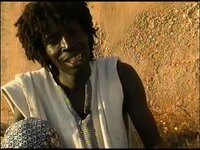
Under the guise of a traditional African oral tale, a storyteller from Senegal tells us a story that is not a legend or traditional fairy tale, but his own life.
UntitledThe last four years the city of Barcelona has implemented a model cornering those who are outside the triumphalist paradigm of modernity, Europeism and prosperity. The best example of this discourse is the district of 22 @. An area of the city built atop the old industrial neighborhood of Poble Nou, located on the northern edge of the city. It is in this space that we find the settlement. This is home of about 300 people of different ages and nationalities. There are sub-Saharan immigrants living here with or without papers, Romanian’s, South American’s, Maghreb’s and also Spanish. Many of them with a common history. A few years or months ago they had home and work. But with the crisis the work ended and they had to leave their homes. People went to the settlement, although many did not like the place, because its better than sleeping in the street. There is more security, there are chances of surviving with the collecting of junk and then selling it for recycling the metal, and also a sense of community. Junk has become the main income for the inhabitants living. In the settlement three bars have been opened, these supply, at reasonable prices, food for the community and a comforting coffee or beer at the end of the day. In the middle of all this struggle to keep breathing, in July 2012 things turned a little more dificult. Because of the complaint of the foundation “Maite Iglesias Baciana”, who owns the land where the settlement is and its main job is to send humanitarian aid to countries like Africa and Honduras, a police eviction was declared and scheduled for July 16 of that year. Not happy with this hypocrite behavior they also refused to negotiate with the lawyers that the Poblenou neighborhood residents had managed to find to defend the inhabitants of the settlement.
UntitledSomething happened on the Spanish-Moroccan border in Autumn 2005. A thing that is still happening today in other places and in other ways. Hundreds of sub-Saharans used ladders to cross a European border. Weapons, rubber bullets, death. Thousands were deported to the Sahara desert. Death. Spanish television broadcast images of an accelerated war. Just bodies, not individuals. Something we watched. Returning to the place where it all happened we find nothing but empty space. A landscapes without traces. What remains, that fence. How is it possible to create new representations that don't get lost in the oversaturation of images that present migrants as victims? Others had already asked themselves the same question. A group of Congolese refugees is stuck in Morocco waiting to reach Europe. They have created a theatre piece based on their experiences of migration. In the room where they live each day, it takes shape as a self-representation of each step along the path. But it is not a finished work. There is no audience and no stage, just a work waiting for its ending.
June 2005, the forest of Benyounes in Morocco, 2 km from the fence that separates Ceuta from Morocco. As happens every week, we come across African citizens who are hoping that here they will find an opportunity to cross into Spanish territory, into Europe. Two people from our collective meet with our working group and we talk about many things that worry and affect us. After sharing our stories, we decide to make a documentary that will show the realities that we experience in Morocco as a country of transit.
A former industrial warehouse in Barcelona’s Poblenou provides a place to live and work to a group of people, most of them originally from black Africa. In this video, they denounce their living and working conditions, and the segregation and attacks that they suffer. And they give us a lucid vision of the society that discriminates against them: “They ask us be to be civilized, to become civilized… I ask myself, what does it mean to be civilized? To spend money, to buy things… to consume.
UntitledIn Benyounes forest, “la foret” as they called their habitants, was the last stage of a long trip for thousands of people coming from Sub-Saharan Africa. Close to the fence that divides Ceuta (Spain) from Morocco, they establish in a variable time, before flank the last obstacle in they way to Europe, looking for a better life. Sometimes running away from wars, politics persecutions, hunger or a precarious economy situation. Lots of times of all of this. In years, the migrants pass across this forest and after some weeks or months they manage to arrive to Ceuta. In finals of 2004, European union start agreements of subcontract Morocco in the control of the Spanish – Moroccan border. The habitants of the forest, started to feel the effects of this agreements: the increase of illegal devolutions, the abuses from the civil police, they install police controls near the forest, they forbid the access to current water, military attacks to the camps in with they made mass arrests and rapes as a war weapon. The border it's close. Systematic violation of human rights, financed with the tax of the democratic European Union citizens. The migrants organize themselves in spaces like this and construct spaces; support nets in Moroccan territory, confronting and resisting this way the European politics. In the forest of Benyounes, they organized themselves from origin communities. In February of 2005, decided between all the community's, record this video, to made visible their situation, in with they report the systematic violation of their human rights, the absolutely abandonment from the NGO's, Associations an Human Rights Institutions, an they demand their citizens condition and they require their rights as human beings.

UntitledA video that denounces the situation of more than 300 people who lived in the Nave del Poblenou in Barcelona, and the eviction order that was acted upon at 6am on 23 July 2012.
UntitledThis documentary explores migration to Spain from the Senegalese point of view.
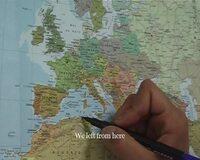
A series of videos that trace the routes of several African immigrants through Italy to France where they have ultimately joined the French Foreign Legion. An emigrant draws on a map of the world the route he has followed. In this way, creates a bridge between the feelings of an emigrant being tossed back and forth and the superficiality of a geographical map.
Untitled