The Egyptian army brutally repressed a demonstration on December 17, 2011. Images from independent sources show the harshness of this murderous repression. Then, mainstream media reports show us a supposedly “balanced” view.
UntitledRevolución
35 Archival description results for Revolución
Interview with Marcello Tarì.
Kim, Harold, Miguel Duque, Ratablanca y Cross-T “We say there is social war when everything gets reduced to a plan. All of the possibilities for creation and existence that all of us want for ourselves, what we call life, require the availability of resource this purpose. Symbolic, imaginary, actual, physical resources. If this doesn't happen, then what is democracy? Democracy is a potentiality. Is the urge towards creativity and complexity, which exists as potential in every life, fulfilled or is it not fulfilled' If it is not fulfilled, then what is democracy? The way we see it, democracy means that those who produce the world can produce it entirely. Not that some produce it, and the rest obey”. Colectivo Situaciones, Argentina.
Sampat Pal is the leader of the Gubai Gang, a group of women vigilantes from Northern India who wear bright pink saris as a distinctive sign that stands out, like cry in the multitude, to denounce and fight the treatment of women a slaves by a very sexist and classicist society.
Practical information
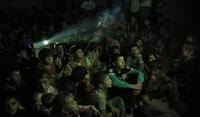
A presentation of Kurdish films by the Rojava Kurdistan Film Commune (Northern Syria)
OVNI has collaborated with the Rojava Film Commune in a project aimed at researching, screening, and promoting their work in Spain, Italy, and France. A process of investigation through videos, texts, and meetings, in order to listen to their voices and understand their struggle together. We have created a website that you can visit link.
Komîna fîlm a Rojava (Rojava Film Commune) is a collective of filmmakers founded in 2015, based in the autonomous Rojava region in the Federation of Northern and Eastern Syria. The Commune is actively working in the region to rebuild and reorganise filmmaking and film education infrastructures.
The Rojava Film Commune was established to promote local film culture by organising film screenings, facilitating discussions on the role of film within society, producing new films, and setting up a Film Academy. Following the 1960 fire in Rojava’s only cinema in the city of Amude—which saw the death of 298 children trapped inside—the Commune aims to reclaim film as a central space for reimagining society, by democratising and revolutionising the imagination itself.
The Commune has educated a new generation of Rojava filmmakers, organized screenings in cities and villages, and produced new films. It seeks to represent the values and ideals of the Rojava Revolution, but also to mediate and depict the daily struggles in the Syrian civil war and Rojava’s collective attempt to build a new society.
The Rojava Film Academy provides education for aspiring filmmakers in Northern Syria. Founded in 2015, it offers one-year programmes, with courses on international film history, Kurdish film history, film theory, photography, cinematography, script writing, editing, and sound design, taught by local and international film professionals.
The Academy is self-organized and non-hierarchical, encouraging students to participate in every aspect of its organization. Exchange networks have also been set up with other academic, media, and news platforms, and with civil society organizations, in order to engage in broad discussions and create screening possibilities. Considering the influx of foreign filmmakers and journalists to Rojava, it is important for the Commune to reclaim the representation and imagination of the revolution.
After decades of oppression of Kurdish language and culture, the Rojava Film Academy aims to revitalize local film culture, reclaiming the power to narrate and imagine one’s dreams and realities. After the Syrian Civil War started, the predominantly Kurdish northern region declared the Autonomy Administration, creating structures based on grassroots democracy, women’s liberation, and cultural diversity.
The Academy bases its methodology on ‘revolutionary realism’, i.e. a realism that does not merely reveal the current reality in a new way, but also restructures the reality of the possible . As well as finding forms to express things as-they-are, it creates the opportunity to imagine the not-yet-present, the ‘eternal becoming’ that is the revolution itself.
If the popular uprisings of 2011 have taught us anything, it is that revolutions do not occur as singular events – with the toppling of a tyrant or the capture of state power – but are complex long-term processes that play out over multiple years or even decades. They involve not just the removal of a government, but also the systemic transformation of political and social institutions, cultural norms and values, human consciousness and collective action. Such revolutions are, by their very nature, social and collaborative processes. In this presentation, I will look back at the uprisings of 2011-12 from the perspective of ‘networked resistance’, analysing how and why – in this time of crisis – the world is suddenly faced with the emergence of decentralized, leaderless protest movements from Tunis to Toronto. Providing a panoramic overview of the ongoing global revolutionary wave, I will not only show how all these uprisings emanate from the same source (a defunct world capitalist system), but also how their similar revolutionary tactics might be an indication of the world that awaits us. I will tell my story along the line of videos and songs of the movement. My final video will be a special address by the Greek resistance hero Manolis Glezos to the Spanish movement, to be premiered at OVNI.
After a year of guerrilla warfare in Bolivia with a small group of 52 comrades, Che was now dead. His dream of uniting Latin America through armed revolution had come to an end. The person who, more than any other, has gone down in history as guilty of Che's death is his former lieutenant, Ciro Bustos. When captured, he drew Che's portrait for the Bolivian army. Since then he has been living in silence. He now appears for the first time in a documentary film. His version of the events raises questions about how history is written.
Untitled“If you have built castles in the air, your work need not be lost, that is where they should be. Now put the foundations under them.” George Bernard Shaw. Some images from the 2011 protests at Puerta del Sol in Madrid. “These are just some impressions, which I have etched in my mind. With all my respect to the people who have acted in accordance with their beliefs and gathered in this square for days. And to Antonio, warrior of words who shares his outrage with all those present."
UntitledBetween 1970 and 1972 the Angry Brigade used guns and bombs in a series of symbolic attacks against property. A series of communiques accompanied the actions, explaining the choice of targets and the Angry Brigade philosophy: autonomous organization and attacks on property alongside other forms of militant working class action. Targets included the embassies of repressive regimes, police stations and army barracks, boutiques and factories, government departments and the homes of Cabinet ministers, the Attorney General and the Commissioner of the Metropolitan Police.
UntitledCuba, an isolated island nation, rebuilt its quality of life following the collapse of cheap oil, supplied by the former Soviet Union. This fascinating and empowering film shows how communities pulled together, created solutions, and ultimately thrived in spite of their decreased dependence on imported energy.
Untitled