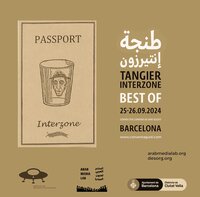
/ Passport Interzone I /
/ Passport Interzone II /
SCREENINGS, PRESENTATIONS, DEBATES.
Centre Cívic Convent Sant Agustí
25 - 26 September 2024
Noble Hall from 6:30 pm to 10:00 pm
Beginning in the mid-1950s , Tangier emerged as a vibrant nexus for artists, poets, and intellectuals. Heavily influenced by the presence of Paul Bowles , members of the Beat Generation were drawn to this northern Moroccan city, seeking not only inspiration and completion of their creative works but also an escape into the mystique of the Moroccan dream. While some engaged meaningfully with the local culture, most were in pursuit of experiences that transcended the conventional confines of their realities.
During the era known as “INTERZONE ,” Tangier became a site where the East and West intersected in a chaotic interplay of misapprehensions, with each side anticipating revelations or secrets from the other. Yet, this encounter was often marked by mutual disillusionment; neither side fulfilled the other’s expectations, highlighting a deeper impasse in cross-cultural understanding. For some, Tangier represented a fertile ground for intercultural exchange; for many, however, it underscored the inadequacies inherent in reductive “culturalist” interpretations of reality.
In the anarchic vision of William S. Burroughs , cultural identities are seen as constructs shaped and manipulated by bureaucratic forces for strategic ends. His critique of the failed East-West encounter resonates with Edward Said ’s analysis of the flawed mutual perceptions each culture holds of the other. Said’s theory of Orientalism encapsulates the West’s constructed narrative of the Orient, a narrative subsequently appropriated and recontextualized by Eastern institutions. Tangier thus stands as a liminal space, a crossroads of these cultural “pharmacies.”
The film program, “TANGIER INTERZONE ” , endeavors to probe the porous boundary between reality and fiction, delving into the imaginative dimensions that shape our understanding of this “reality.”
TANGIER INTERZONE PROJECT / BEST OF
(CONCEPT AS IT IS) CREDITS: