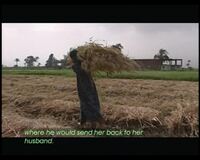
Janata Bennuna is from Morocco; Hanan Al Shaykh is from Lebanon; and Nawal Al Saadawi is from Egypt. All three are authors of the Arab word, committed intellectuals who shed light on the complex social reality of the Arab world through their books. In their hands, literature becomes a weapon through which to draw attention to and denounce situations that they oppose. The three women, from a generation heavily influenced by Pan-Arabism, initially studied against the wishes of their families, but ended up gaining their support. In A Woman's Word, these three very different writers who nonetheless share a common ground talk about their lives and their work. By learning about them, we also gain an insight into the Arab world, which is much more complex than the Manichean and mostly malicious information on the subject that predominates in our own society today. They too are Arabs, women, who refuse the victim mentality, and demand their rights through their work and their commitment.
UntitledMujer
6 Archival description results for Mujer
The director travels with a group of young Moroccan women who are going to visit their families. A story about migration, reunion, and loss.
UntitledThis film is a cry from the heart of the Medina of Casablanca for its inhabitants and their memory but, above all, for a more humanitarian world. At night, the Medina is embodied by the figure of a draped woman who rides through the alleys. Her mysterious voice comes out of the silence, speaking to the world she once welcomed with open arms; a world which has betrayed her through a stifling economic environment. Her testimony and that of its inhabitants will feed the narrative structure of the film in a poetic way, mixing magic and reality.
UntitledEuroplex tracks distinct cross-border activities through the Spanish-Moroccan borderland and seeks to make these obscure paths visible. On their repetitive circuit around the check-point to the Spanish enclave Ceuta, the video follows in three borderlogs the smuggling women who strap multiple layers of clothes to their bodies; the daily commute of "domesticas" who turn into time travellers as they move back and forth between the Moroccan and European time zones; and the Moroccan women working in the transnational zones in Northafrica for the European market. All these trajectories move around and in between the imperative of the territorial borders. They form, however, a vital layer of the cultural and economic space between Europe and Africa.
The life story of an elderly Mauritanian woman, Aïcha Messaoud, who spent her whole life as part of Sheik Ma-el-Aïnïne's distinguished family of nomads and now lives in the small Moroccan village of Tata, in the northern part of Western Sahara. The filmmaker sets out to trace the memories of her heroine. Stage after stage, she travels through thousands of kilometres across the desert, encountering the descendants of the Sheik.
UntitledA man who is not there. A woman who receives his letters. She reads them to us, but remains out of sight. The man who sends the letters describes his journey. In the end, he stops writing. Has the journey, then, ended'