
The Observatory Archives are structured around particular themes and have a clear purpose: to encourage a critique of contemporary culture and society, using different strategies, among others, video art, independent documentary, and mass media archaeology- The Archives cover a huge range of works that are very different from one another, but share a commitment to freedom of expression and reflect on our individual and collective fears and pleasures- Together, they offer a multifaceted view, thousands of tiny eyes that probe and explore our world and announce other possible worlds- It is a discourse that above all values heterogeneity, plurality, contradiction and subjectivity, an antidote to the cloning and repetition of corporate mass media- Given that the call for entries organized by OVNI every 18 months is theme-based, the works selected over the years offer a reading, a kind of record of some of the dreams and nightmares of our times- We have seen the range of issues and preoccupations become more focused over time, from works with very diverse themes in OVNI 1993 to 1996 (extending and exploring the video medium, regaining the formal and the thematic freedom of its early years), to progressively narrow down to increasingly specific themes: identity versus media (1997-1998), community (2000), globalisation (2002), Post Sept 11th (2003), Resistances (2005), The Colonial Dream Autonomous Zones (2006), Exodus, The Margins of the Empire (2008), Rhizomes (2009), Dis_Reality (2011), Oblivion (2012), In Limbo (2014), Arxius de l'Observatori ( 2015), The Border as a Center- Zones of Being and Non-Being-Migra and Coloniality (2016), Path of Return (2018), Winter's End (2020)-
Muerte
53 Archival description results for Muerte
53 results directly related
Exclude narrower terms
ES OVNI RSC-ADLO
·
Series
Part of Non-Identified Video Observatory (OVNI)

ES ES-OVNI CTX-S003-SS002-0011
·
Item
·
1994
Part of Non-Identified Video Observatory (OVNI)
Deliberations on death while a corpse is carefully cleaned and shrouded. 3 Mostra de Vídeo Independent de Barcelona 1996.
Untitled
ES ES-OVNI TS-S002-SS012-0001
·
Item
·
2008
Part of Non-Identified Video Observatory (OVNI)
Los Sures is the name of a Puerto Rican neighborhood in Brooklyn, New York. Recorded in 1991 and published in 2008, this video is not so much a portrait of the neighborhood or a memory of it, but a journey of initiation through different interior landscapes that are reflected in the urban wilderness in the evocation of death and loneliness, but also in contemplation and celebration of life.
ES ES-OVNI RSC-4277
·
Item
·
2009
Part of Non-Identified Video Observatory (OVNI)
The four stories in this film take us from Belgium to the banks of the Senegal River, from the French Ardennes to the mountains of the Western Sahara. What they have in common is that they lead us to meet the sleepers. Men and women moving between two worlds, that of the absent and that of the living, between two states, that of waking and that of sleep. In each of these stories lies a mystery free from all belief, all philosophy, all attempts at explanation. A mystery capable of reenchanting reality.
Untitled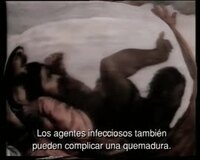
ES ES-OVNI CTX-S006-SS002-0004
·
Item
·
1999
Part of Non-Identified Video Observatory (OVNI)
The violence of revealed religion from the unconscious of the writing. Texts by Derek Jarman, Bertrand Russell, Sun Tzu.
ES ES-OVNI CTX-S019-SS002-0005
·
Item
·
2018
Part of Non-Identified Video Observatory (OVNI)
A conversation with a woman who washes and massages the women who go to the hammam (public baths), helps bring the neighbourhood children into the world, and to wash the dead.
ES ES-OVNI RSC-4227
·
Item
·
2007
Part of Non-Identified Video Observatory (OVNI)
In Mexico there is a cult that is rapidly growing- the cult of Saint Death. This female grim reaper, considered a saint by followers but Satanic by the Catholic Church, is worshipped by people whose lives are filled with danger and/or violence- criminals, gang members, transvestites, sick people, drug addicts, and families living in rough neighborhoods. "La Santa Muerte" examines the origins of the cult and takes us on a tour of the altars, jails, and neighborhoods in Mexico where the saint's most devoted followers can be found.
Untitled
ES ES-OVNI CTX-S005-SS004-0004
·
Item
·
1996
Part of Non-Identified Video Observatory (OVNI)
Deliberations on death.
Untitled
ES ES-OVNI CTX-S019-SS001-0006
·
Item
Part of Non-Identified Video Observatory (OVNI)
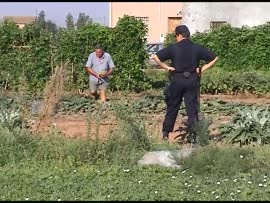
A head erasing the limits between the real and the unreal, between life and death.
ES ES-OVNI CTX-S011-SS004-0001
·
Item
·
2004
Part of Non-Identified Video Observatory (OVNI)
Dream stories. Dreams as a passage into parallel worlds, erasing the limits between the real and the unreal, between life and death.