
We follow the director's camera into the kitchens and living rooms of a community of Moroccan women. inside the walls of their apartment in Casablanca's old Medina, the women cook, clean, take care of their families and help each other. With their hands in the dough, in the soap whilst washing the laundry, doing the house chores, in the market or at the hammam, between laughter and tears ("We are housewives, that's all. ... Our sport? House cleaning!"). These courageous women, proud of their role, talk about their miserable lives with a great sense of awareness, but without self-pity. They show a surprising vitality, curiosity for life and solidarity. These house-proud housewives may not all know how to read, but they know exactly what would improve their lives: equal rights for women and men, more money, and a better future for their children so they wouldn't have to emigrate to support the family. A sense of hope and the possibility of change radiate out of the everyday lives of these heroines ("batalett").
Morocco
102 Archival description results for Morocco
The urban and social structure of neighbourhoods in the medina is one of vast intricacy and complexity, being organized around a series of vital establishments for the everyday life of their inhabitants, such as the hammam or public baths, the bakery, schools and the foundouk, or caravanserai. Communal bakeries provide the heating for the public baths or hammam, fully active establishments that are very important for the cohesion of the city's social fabric. Foundouks are establishments where visiting merchants traditionally stayed and stored their products overnight. Most have now lost their original function and are adapted for other uses, such as dwellings or workshops.
“Do not be sad, my son, you are destined to fall in love.” An intervention-reading of a concert by Egyptian musician Abdelhalim el Hafiz, performing The Fortune Teller by the poet Nizar Qabbani. "My son you are 10 years old, I look at the life you have ahead of you and today it gives me vertigo. But it is not fair, perhaps because I am seeing it from my decline, I no longer have the drive that is becoming strong in you now, that is growing every day; this whirlwind of dust, but also of beauty that will take your life, like ours, like a leaf in the wind. Perhaps it was you and Yasmin who recently crossed the dense city sky... I remember as if it were yesterday in the wastelands, you picked up a translucent stone that shone in the sun when you showed it to me and now I know that you are that star you were holding in your hands".
UntitledThis video was made using images recorded from TV between 2001 and 2004. Many were collected during a workshop that invited participants to record their ?zapping? with access to every channel in the world. One of the prophet Mohammed's Hadiths provides the narrative thread: "The first look at a woman is for you, the second is for the devil and the third is a crime". Our looks are displaced towards televised images and show us how the repetition and impoverishment of images in our culture place us in the role of voyeur. The television creates an ambiguous situation and insidiously make us enjoy, in a way that is almost erotic, these catastrophic but strangely beautiful images.
The sacrifice. The lessons of death, its open spaces. Video Serie: El Hamdulillah Tapes * Pirate Utopias & European Renegadoes.
This film is a cry from the heart of the Medina of Casablanca for its inhabitants and their memory but, above all, for a more humanitarian world. At night, the Medina is embodied by the figure of a draped woman who rides through the alleys. Her mysterious voice comes out of the silence, speaking to the world she once welcomed with open arms; a world which has betrayed her through a stifling economic environment. Her testimony and that of its inhabitants will feed the narrative structure of the film in a poetic way, mixing magic and reality.
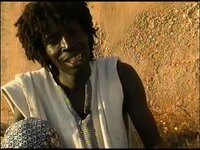
UntitledA strange Sheikh in a barely-glimpsed place: "Destiny is as wide as a hand and four fingers, the width of a grave. The man who owns 40 buses, what does he really have? The man who owns 4 houses, poor fellow! What does he have? A grave!...?" Video Serie: El Hamdulillah Tapes * Pirate Utopias & European Renegadoes.
Untitled... 6th Independent Vídeo & Interactive Phenomena Show
Inside Paul Bowles, and his relation with some of The Moroccan writers and friends. Featuring Paul Bowles, Mohamed Choukri, Mohamed Mrabet, Abdelwahaid Boulaich, Mohammed Temsamani...