Monoforma

Elements area

Taxonomy

Code

Scope note(s)

    Source note(s)

      Display note(s)

        Hierarchical terms

        Monoforma

          Equivalent terms

          Monoforma

            Associated terms

            Monoforma

              8 Archival description results for Monoforma

              8 results directly related Exclude narrower terms
              ES ES-OVNI CTX-S015-SS005-0008 · Item · 2012
              Part of Non-Identified Video Observatory (OVNI)

              First and Second part. the story of Rebond dates back to January 8, 2000, when some fifty “actors” and film technicians came together to organise the first weekend of experimentation at the Maison Populaire in Montreuil, on March 11 and 12, under the title "Rebound - media et immediat”.

              Oblivion
              ES ES-OVNI CTX-S015 · Series · 2012
              Part of Non-Identified Video Observatory (OVNI)

              / CONTEXT 1994 - 2020

              This program in the form of an essay aims to shed light on some of the more disturbing aspects of contemporary life. Specifically, it looks at experiences involving conflict with power and at the imminent arrival of an even greater confrontation. A clash that exceeds the political realm and expands towards the notion of civilisation itself, and that seems to emanate from a source within the inner life of human beings.

              Bearing this in mind, we present a series of screenings that look further than the immediacy of recent events, the logic of action-reaction, and the persistent notion of the other as intrinsically negative, in order to take a step back and observe from a distance that allows reflection.

              We convey this vision through a programme with a dual core: La Commune by Peter Watkins, and The Mahabharata by Peter Brook, which we have contextualised with a series of documentaries and other documents that show contemporary expressions of the central theme.

              La Commune offers a vision of contemporary conflict that transcends political oblivion. A cinematic reflection that looks back to a historical milestone – the emergence and disappearance of the 1871 Paris Commune and, at the same time, questions our own social reality and its representation in the media, given that Watkins chose to work with non-actors, people who express the actual conditions of their lives in Paris in 1999.

              We will screen this film in three parts, each followed by a discussion session led by members of Rebond La Commune , the group that was created as a result of the making of this film.

              Peter Brook’s The Mahabharata also deals with conflict but rather than taking a historical approach it positions itself outside of history, outside of linear time. It plays out in mythical time, the time of constant return and of the dialectic tension between the oblivion and remembrance of true human nature. The Mahabharata presents this conflict on several levels – linked to politics (power), civilisation, and the survival of life on Earth –, but also as an expression of the inner struggle that is fought out within every human being.

              Each of the three parts of The Mahabharata will be preceded by excerpts from a conversation that we recorded with Jean-Claude Carrière, the screenwriter in charge of the theatrical adaptation of Brook's The Mahabharata , in which we explore the keys to this work in relation to the notions of conflict and oblivion.

              This story is about you

              The programme begins by following the course of the Mahabharata, an immense poem that flows with the majesty of a great river, which is full of “inexhaustible riches, defies all analysis, whether structural, thematic, historical or psychological. Doors are continually opening, which lead onto other doors. The Mahabharata cannot be held in the hollow of one’s hand. There are many ramifications. Sometimes seemingly contradictory, they succeed each other and intertwine, but we never lose the central theme of a looming threat, to which everything starkly points. We are living in a time of destruction. The question is, can we avoid it?” (1)

              Against this background, from its very first lines, the Mahabharata takes us on an inner journey of knowledge and transformation.

              • What is the poem about?
              • It is about you. It is the story of your race. How your ancestors were born. How they grew. How vast war arose. It is the poetical history of mankind. If you listen carefully, at the end you will be someone else. (2)

                The illusion of power

              The story gradually introduces us into a confrontation between the Pandava and the Kaurava . A confrontation that is a battle for power, although it arises from two almost opposite conceptions of life. With all their nuances and ambivalence, we see the Pandava proceed in accordance with their quest to fulfil the dharma , while the Kaurava seem to be guided only by desire and fear: the desire to possess power and the fear of losing it. They do not hesitate to use all possible means to achieve their end, they respect no limits whatsoever. And they act with the complicity of their parents, a blind king and a queen who voluntarily blindfolds herself.

              Then the two sides play a game of dice, as a way of representing and temporarily avoiding direct conflict; but it is also a frame-up. The game is rigged – power play is always rigged. There can only be one outcome: defeat and the loss of everything they own, even their freedom. The Pandava face a future of exile and war.

              In the present day, this rigged game takes on shapes and names that often hide its true purpose: to create a reality that is tailored to the private interests of a few. This is the case of so-called “free trade”, for example, which is supposedly a fair game in the sphere of economics. But the unequal terms of its participants and the non-reciprocal nature of the rules mean that it is inherently based on a desire for supremacy. Other examples disguise the obvious corporate and entrepreneurial nature of some social networks, and of many digital tools that barely hide their dark underside of control. And so we dwell in a realm of appearances: we appear to choose, we appear to communicate, we appear to be safe, thanks to a dense network of social devices. But inadvertently, when we comply with the daily ritual of submission to our work, to the educational and health system, to culture and to entertainment, we are signing a silent contract:

              I accept competition as the foundation of our system, even though I am aware that it generates frustration and anger for the majority of those who lose. I agree to be humiliated and exploited in exchange for being allowed to humiliate and exploit those on a lower rung of the social pyramid (...)"

              I accept that, in the name of peace, the largest Government expense will be Defence (...) I agree to be served up negative and terrifying news from around the world every day, so that I can ascertain the extent to which our situation is normal. (3)

              Obviously, failure to sign “the contract” entails various increasing forms of exclusion. In view of this situation, protest can easily be channelled through the realm of appearance and made to give up its transformative power. But if protest tries to become real it will be stigmatised as sectarian, aggressive and violent, regardless of the means and ends it chooses.

              Del Poder (“On Power”), the documentary by Zaván, focuses precisely on this aspect: the moment at which power reveals its true nature, beyond the fine names that it adopts to protect and legitimise its actions. This moment of revelation when power shows its true face comes about when it turns to the violence of repression. Genoa, 2001, hundreds of thousands of demonstrators protest on the streets. It is not an isolated event, the movement has been gaining strength, in Seattle in 1999, in Prague in 2000, and it is starting to represent a possibility for change… The “authorities” shield the city. They fence in entire neighbourhoods and suspend the Schengen treaty, to protect the summit of the heads of the world’s eight most powerful states. According to police trade union sources, they deliberately plan for a scenario of extreme violence, without ruling out the possibility that people may be killed (4). Police violence is unleashed, people are beaten indiscriminately. There are soon casualties, hundreds of them, some of people in comma. The situation quickly becomes a trap for the protesters, to such an extent that Amnesty International declares it “the greatest violation of human rights in Italy’s history since World War II.” Carlo Guiliani is killed by two shots to the head; the Commissioner who is tried for his murder is subsequently absolved. Far from reigning in the police violence, this death seems to stimulate it and give it its true meaning. The repression continues undiminished during the days that follow. De


              Privilege
              ES ES-OVNI RSC-4084 · Item · 1966
              Part of Non-Identified Video Observatory (OVNI)

              "In 1966, following the collapse of a film which I hoped to develop with Albert Finney’s production company, on the 1916 Easter uprising in Dublin, I was approached by John Heyman, a British artists’ agent, to make a film based on an original screenplay by Johnny Speight, which dealt with the influence of Steven Shorter, a pop star in the 1960s. American novelist Norman Bognor and I adapted the script, which we retitled Privilege, to emphasize the significance of Steven Shorter as an allegory for the manner in which national states, working via religion, the mass media, sports, Popular Culture, etc., divert a potential political challenge by young people. In case this theme appears exaggerated, it is important to keep in mind that it was set in the ‘swinging Britain’ of the 1960s, and was prescient of the way that Popular Culture and the media in the US commercialized the anti-war and counter-culture movement in that country as well. ‘Privilege’ also ominously predicted what was to happen in Margaret Thatcher’s Britain of the 1980s - especially during the period of the Falkland Islands War". Peter Watkins

              Untitled
              ES ES-OVNI CTX-S015-SS005-0001 · Item · 2012
              Part of Non-Identified Video Observatory (OVNI)

              A discussion with Patrick Watkins and the group Rebond pour la Commune, which was created as a result of the participants’ experience in the production of Peter Watkins’ La Commune. The gathering between Rebond and local groups from Barcelona will revolve around the film and its reading and experiences in the current context.

              ES ES-OVNI CTX-S015-SS006-0002 · Item
              Part of Non-Identified Video Observatory (OVNI)

              A discussion with Patrick Watkins and the group Rebond pour la Commune, which was created as a result of the participants’ experience in the production of Peter Watkins’ La Commune. The gathering between Rebond and local groups from Barcelona will revolve around the film and its reading and experiences in the current context.

              Untitled
              ES ES-OVNI CTX-S015-SS007-0015 · Item · 1959
              Part of Non-Identified Video Observatory (OVNI)

              In The Diary of an Unknown Soldier Watkins initiated a style of filmmaking which he has consistently developed and experimented with in all of his professional films… Watkins refused to be constrained by cinematic conventions. In this film, he freed the camera from the limitations of a fixed vantage point and forced it to take part in the action so that he could create strikingly realistic, almost newsreel-like, effects and directly involve the viewing audience in the events it was witnessing. The Diary of an Unknown Soldier, however, is not limited strictly to techniques of realism. It contains a curious, almost uneasy, mixture of expressionist and documentary styles, and one suspects that the financial and physical limitations that Watkins faced because of equipment and location problems played a major part in the evolution of this syncretistic approach.

              Untitled
              ES ES-OVNI CTX-S015-SS007-0012 · Item · 1968
              Part of Non-Identified Video Observatory (OVNI)

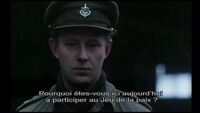
              The Gladiators is a bleak satire set in the near future, in which the major powers of the world, East and West, aligned and non-aligned, recognize the possibility of a major world war within our lifetime and try to forestall it by channelling man’s aggressive instincts in a more controllable manner. They do this by forming an International Commission along the lines of the United Nations, dedicated to fighting a series of contests between teams of selected soldiers from each country. These competitions, which can be fought to the death, are called “Peace Games”, and are broadcast on global television via satellite - complete with sponsors and commercials. The film follows Game 256... The international group of officers watching Game 256 decide to eliminate a man and a woman from opposing teams who reach out to each other, because they decide that such forms of communication would be the gravest threat of all to the stability of the existing world-system.

              Untitled
              WAR, INSUBMISSION, ART
              ES ES-OVNI EXP-S013 · Series · 2025
              Part of Non-Identified Video Observatory (OVNI)

              Project in Residency Falconetti Peña

              / Exhibition War, insubmission, art /

              / FILMOTECA DE CATALUNYA /

              / CRIPPLES OF WAR AND NORMALITY /

              / PATRIOTISM AND COLONIZATION /

              / YOU WILL DIE AS HEROES /

              / PAMPHLET AND REVOLUTION /

              WAR, INSUBMISSION, ART

              Project in Residency Falconetti Peña

              In 1924, coinciding with the tenth anniversary of the end of World War I, Otto Dix published his work The War, composed of fifty engravings in which he denounced warmongering with a harshness that had not been seen until then. A century earlier, Goya, a painter who inspired Otto Dix, produced The Disasters of War. And now, one hundred years later, a cruel and senseless war is once again being fought in Europe.

              Otto Dix is located between two times, Goya's and ours. The project for this exhibition/intervention is to take his engravings as a starting point for a journey through the art that has rebelled against war slogans.

              Goya, Dix, Grosz, Arntz, Watkins and many other artists defied the prevailing aesthetic order by creating works of enormous relevance. To do so, they used modest formats, the engraving, the poster, the mimeographed magazine, the pamphlet, the false documentary, the only ones they could access in times of censorship and blockade. These are works that managed to last against all odds, as there were many who were interested in making them disappear.

              Thanks to them, today we can follow the trail of those who in their day disobeyed the patriotic slogans, maintaining the flame of resistance to the war madness.

              The project will cover various spaces and historical periods, combining different formats, pictorial, graphic and audiovisual.

              The idea is to contrast them, face to face, with the messages of those who at the time bet on galvanizing the warrior ardor of the masses.