
ES ES-OVNI RSC-1651
·
Item
·
2005
Part of Non-Identified Video Observatory (OVNI)
Lebanon
42 Archival description results for Lebanon
42 results directly related
Exclude narrower terms

ES ES-OVNI CTX-S009-SS002-0023
·
Item
·
2002
Part of Non-Identified Video Observatory (OVNI)
Images of orchids opening, plants sprouting, clouds and water superimposed onto images of the Sabra and Chatila refugee camp massacre in Lebanon in 1982. The voice of Abdel Majid Fadl Ali Hassan (a refugee from 1958 who lives in the Bourg El Harajneh camp) tells how his house in Palestine was destroyed.
ES OVNI RSC-1350
·
Item
·
2001
Part of Non-Identified Video Observatory (OVNI)
An intimate dialogue with Soha Bechara, ex-Lebanese National Resistance fighter, in her Paris dorm room. The interview was taped during the last year of the Israeli occupation, one year after her release from captivity in El-Khiam torture and interrogation center (South Lebanon) where she had been detained for 10 years—six in isolation. Revising notions of resistance, survival, and will, the overexposed image of the survivor speaks quietly and directly to the camera—not speaking of the torture, but of separation amd loss; of what is left behind and what remains.
Untitled
ES ES-OVNI RSC-1705
·
Item
·
2004
Part of Non-Identified Video Observatory (OVNI)
ES OVNI RSC-60
·
Item
·
2003
Part of Non-Identified Video Observatory (OVNI)
ES ES-OVNI CTX-S014-SS001-0073
·
Item
·
2008
Part of Non-Identified Video Observatory (OVNI)
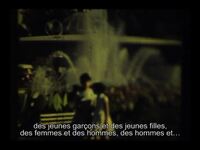
This work by Lebanese filmmaker Danielle Arbid is based on the secret, ardent and obsessive sexual experiences that are freely recounted in minute detail by her friends. Archival super-8 footage of prim young girls alternates with darkened shots of men and women discussing their formative experiences and their fantasies. Their words and the visual representations create a highly poetic erotic tension.
Untitled
ES ES-OVNI CTX-S012-SS006-0011
·
Item
·
2007
Part of Non-Identified Video Observatory (OVNI)
Letters From Beirut is an intimate, personal and powerful telling of the story of the 2006 war in Lebanon. A series of letters written by Hanady Salman - a mother living through the war in Beirut - carve a narrative arc through intense and haunting images of the conflict. She tells the stories of her family and the people she lives through the war with - the refugees, the wounded, and the everyday Lebanese, struggling to maintain their sanity and their humanity in times of war.
ES ES-OVNI RSC-4317
·
Item
·
2016
Part of Non-Identified Video Observatory (OVNI)
The film tells of the lives of four young men in a refugee camp who dream of inviting Rogers Waters (Pink Floyd) to give a concert in their camp, thus giving us an insight into the lives of these young men, their struggles and the daily hardships they face in order to survive.
Untitled
ES OVNI RSC-1348
·
Item
·
2002
Part of Non-Identified Video Observatory (OVNI)
ES ES-OVNI RSC-2929
·
Item
·
2008
Part of Non-Identified Video Observatory (OVNI)
The One Man Village (Semaan bil-Day'ia) A film that goes under the skin. (Al-Mustaqbal, Reema Mismar) Thrilling, painful, mature and very well done. It announces the birth of real cinematographer, who combines courage and talent. A film that has no place for hatred. (Al-Akhbar, Pierre Abi Saab) Short Synopsis Semaan is leading a quiet life on his farm in the small village Ain el-Halazoun in the Lebanese mountains. The hamlet was completely emptied and destroyed in combats during the civil war in Lebanon between 1975 and 1990. Today, many years after an official reconciliation, its inhabitants which are all from one family regularly go back to the village to cultivate their plots of land or visit their houses and always leave before sunset. In his comforting and humorous film Simon El Habre observes the life in his quasi ghost village and tries to reflect on the collective and individual memory in a country that seems to live in a collective amnesia and is vulnerable to a new civil war. Long Synopsis The One Man Village follows live in the Christian village Aïn el-Halazoun in the Lebanese Mountains that was emptied in combats during the civil war in Lebanon between 1975 and 1990. 1983 the region of the Mount Lebanon, one hour away from the capital Beirut, faced merciless fighting between Christian and Druze militias which ended in reprisals in the form of civilian massacres and the displacement of populations. The Christian inhabitants of Mount Lebanon had to seek refuge in Beirut. Entire villages, including Aïn el-Halazoun, were evacuated and destroyed. Reconciliation was officially declared in 1994 and Christians were allowed to return to their villages. Thirteen years later, Aïn El Halazoun is still a ghost village. Its inhabitants decided to stay in Beirut in spite of the difficult living conditions there. They go back to the village to cultivate their plots of land or visit their houses regularly and always leave before sunset. Only one man decided to return to Aïn el-Halazoun for good: Semaan El Habre. Over the period of year Simon El Habre returned to his village with his film team to observe the daily routine in Aïn el-Halazoun. His portrait of life in a quasi ghost village reflects the collective and individual memory. It calls into question formal reconciliations. Yet, through the story of Semaan el-Habre who decided to return home against all odds it is also, and above all, the story of a healing. Simon El Habre, Lebanon 2008, 86 min, color, HDCAM, Arabic with English subtitles Director Simon El Habre | Writer Simon El Habre | Cinematography Bassem Fayad, Marc Karam | Sound Chadi Roukoz | Cast Semaan El Habre | Editing Simon El Habre | Sound Editing/ Mixing Emile Aouad | Producers Simon El Habre, Jad Abi-Khalil, Irit Neidhardt | Produced by Beirut DC in association with mec film