
Demetrio Stratos was born in Egypt to Greek parents. He first came to Italy in the 1960s where he becomes the singer of I Ribelli, which had been the band of Adriano Celentano. In the 1970s he co-founded Area, one of the most provocative and innovative experimental pop groups. Area brought musical exploration directly to the streets and protest gatherings. The band combined rock, jazz, contemporary western music, ethnical themes and electronic sounds. Beginning with Area's experimental repertoire, and running parallel to this, Stratos engaged in a study of the voice as a pure musical and sound-producing instrument. His discography includes several voice-only records, while he worked with artists such as John Cage, as he was able to express a very wide range of tonality, and was able to emit even three different-pitched sounds simultaneously. He gets studied by physicians and phoniatrists. The paths followed by his voice lead us to discover the creativeness of Italian and European political and artistical movements of the 70s, whose heritage is often at the fundaments of today's society.
Italy
125 Archival description results for Italy
125 results directly related
Exclude narrower terms
ES ES-OVNI RSC-3381
·
Item
·
2009
Part of Non-Identified Video Observatory (OVNI)
ES ES-OVNI RSC-3465
·
Item
·
2010
Part of Non-Identified Video Observatory (OVNI)
Ladyfilmine is an instant movie about the first roman edition of Ladyfest: a ten-year-old international no profit festival for independent music, politics and arts with a queer feminist focus. Four days in four different countercultural spaces, told by four ladies' voices: those ladies who have decided to take back a place to express themselves, in a country where they see it becoming tighter and tighter every day. Part black and white super8 film, part color digital video, Ladyfilmine shows Ladyfest Roma through different moods, alternating some home movie moments, which evoke past feminist seasons, with partecipant observations of the contemporary social and musical documentary.
ES OVNI RSC-1367
·
Item
·
1997
Part of Non-Identified Video Observatory (OVNI)
The spectacle of life in 7 pieces of theater-film. The scenes are based on the dramatic moment of "Handbook of Italo-English Conversation" Professor EW Fulk. Shot in Super 8.
ES ES-OVNI RSC-263
·
Item
·
1997
Part of Non-Identified Video Observatory (OVNI)
ES ES-OVNI CTX-S006-SS002-0004
·
Item
·
1999
Part of Non-Identified Video Observatory (OVNI)
The violence of revealed religion from the unconscious of the writing. Texts by Derek Jarman, Bertrand Russell, Sun Tzu.
ES ES-OVNI CTX-S011-SS004-0015
·
Item
·
1971
Part of Non-Identified Video Observatory (OVNI)
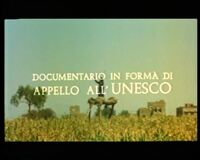
On Sunday October 18, 1970, the last day filming “Flower of the Arabian Nights” on location in Sanaa, the capital of Yemen, Pasolini decides to use some leftover rolls of film to make a documentary about the city and thus persuade Unesco to intervene to protect the beauty of this world heritage. ”With every passing day, one part of the Sanaa walls falls to pieces... One of my dreams is to save Sanaa and other cities – their historic centres. I will strive for my dream and endeavour for Unesco to intervene”, says Pasolini.
Untitled
ES ES-OVNI CTX-S011-SS006-0098
·
Item
·
1938
Part of Non-Identified Video Observatory (OVNI)
For the first time, the Luce Institute presents one of its best-known documentaries, to show people today the deeds and images of the old times, in original version, restored, without any changes to the editing.
ES ES-OVNI RSC-1623
·
Item
·
2004
Part of Non-Identified Video Observatory (OVNI)
Otranto, Torre del Serpente, the easternmost part of Italy, the point where, lest we forget, East and West once touched. Today, the memory of that link seems to re-emerge as a consequence of all the illegal immigrants that disembark on its beaches, as their clothes, shoes and personal effects found along the coast remind us. To those among them that did not make it, we dedicate the canto of the polyphonic Albanian chorus of Lapardha that, on August 5, 2002, at dawn, sang one of its passage for the victims of the 1997 “accident”, in which dozens of Albanians died aboard a boat sunk by the Italian navy.
Untitled
ES ES-OVNI RSC-4300
·
Item
·
2021
Part of Non-Identified Video Observatory (OVNI)
“Lui ed io” tells the thoughts of a woman as a wife and a mother, and how she lived through these roles between obligation and choice. The woman, filmed through the footage taken by her husband, militant and always far from home, is revealed as opposed to her husband’s world. A reinterpretation of women’s world as a politic act, aiming to tell that love is an act of acceptance of differences, and also that personal memories are part of collective history.
ES ES-OVNI RSC-4311
·
Item
·
2006
Part of Non-Identified Video Observatory (OVNI)
The neutral surface of the screen is continuously traversed by luminous interferences. The surface, defined by the screen, is traversed by a beam of light in multiple directions, revealing bodies of different nature and identity. Light, as a technical resource, names the object and, in its incessant movement, establishes a play of correspondences. Light is the eye that forms a singularity from the whole. Light is the language that isolates from the indistinct noise of sounds.
Untitled